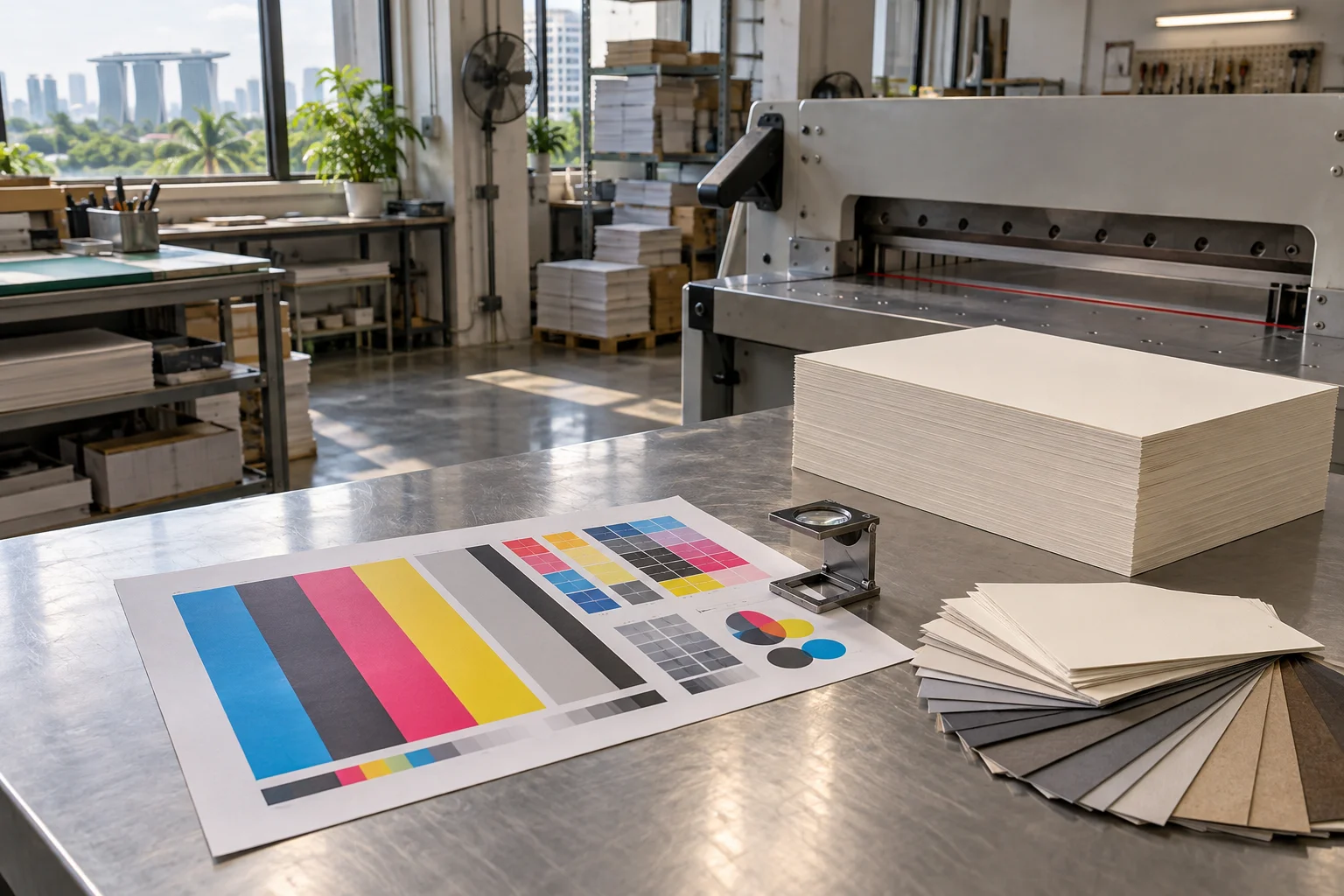
Business cards, flyers, booklets and stickers printed on a published per-quantity ladder, with the minimum order, the file rules and the turnaround stated before you send a file.
Everyday print is bought by quantity, so the quantity is the first decision on the job — not a box in a form. Every product on this page states its minimum, the tier where the press changes, and what the run includes.
Business cards
Minimum 100 in a digital run, and sold in tiers from there. Heavier stocks, lamination and rounded corners are separate lines.
Flyers & leaflets
Minimum 500, single or double sided, folded on request. Folding, creasing and bundling are priced lines rather than assumed.
Booklets & brochures
Minimum 250. Page counts in fours, with the binding stated: saddle-stitched or perfect-bound.
Stickers & labels
Minimum 500 on a sheet, or cut to shape on a roll. The material and the laminate are named on the quotation.
Which press, and why the tier matters
Small runs print digitally: no plates, quicker to start, and the piece price only falls slowly. Above the tier stated in the pricing section the job moves to offset, where the plates are made once and their cost is spread across the whole quantity — which is why the piece price drops sharply at that step and then flattens. We choose the method from the quantity on the order, and when two methods land close together on price we say so and let you pick.
What we need before we print a file
Read this before ordering. A file that does not meet these rules either comes back to you or is printed as supplied — we do not guess at what was meant.
Size — set at the final trim size, with 3 mm bleed on every trimmed edge, and nothing that has to be read sitting outside the safe area.
Resolution — 300 DPI at final size for anything photographic, vector for anything that has to stay sharp when it is small.
Colour — CMYK, with spot colours named separately. What is on your screen is RGB, and it will not match the press.
Format — PDF preferred, at the settings above. TIFF and JPG are accepted at the same resolution; we do not work from office documents, screenshots or a link to a design tool.
Fonts — outlined or embedded, because a missing font substitutes itself silently and nothing warns you.
Pages — one page per printed side, with the front and back named so neither can be printed twice.
Blank templates at each trim size, with the bleed and the safe area already drawn in, are available on request. Setting your design on the template is the shortest route to a file that passes.
Every file is checked before it reaches the press
A person opens the file and checks it against the list above — bleed, safe area, resolution, colour mode, fonts and page count — and it is not queued until that check has been written down. If something will print badly we say so in writing, with the page and the reason, and nothing starts until you confirm what to do. The check is free when we are the ones who find the problem. A second file after approval, or a re-proof because the design changed, is a priced line, and it is on the quotation before the work is done rather than on the invoice afterwards.
Ordered: 1,000 on 350 gsm art card, matt laminated both sides, rounded corners
File arrived at final size with 3 mm bleed and passed the check the same day
Proof approved the next morning, and the run was quoted from that approval, not from the order
Output: one box, collected, with lamination and corners as their own lines on the invoice
5,000 folded leaflets · retail promotion
Ordered: 5,000 on 130 gsm gloss, folded to a quarter and bundled in 500s
Folding and bundling quoted as separate lines rather than folded into the piece price
Two addresses in one run: part collected by the shop, part delivered to the agency
Output: a reprint note was not needed, and the delivered bundle count was stated on the delivery note
Illustrative runs. They show how a job is quoted, checked and scheduled, not completed client work.
From artwork to installed object
GOOD ON PAPER. RIGHT ON THE WALL.
Enquiry & scope
Which sign, where it goes, and the date it has to be up.
Survey the space
Dimensions, wall condition, viewing distance, power and access.
Mock-up approval
Artwork, material samples, fixings and light — approved before production starts.
Fabrication
Production details confirmed, then built.
Permits & access
Who applies, permitted working hours, landlord and building consent.
Install & handover
Site coordination, fixing, removal of the old sign, clean-up and a walk-round.
Before the press runs
The clock starts at proof approval.
Four stages, and each one has a date attached to it. The number of days we quote is counted from the third, not from the enquiry.
Order & file
Quantity, stock and finishing chosen, and the file sent — or an order placed now with the artwork to follow. Output: an order confirmation stating the quantity, the tier price, the delivery basis and the cut-off that applies.
File check
Bleed, safe area, resolution, colour mode, fonts and page count, checked by a person. Output: a written pass, or a written list of what has to change with the page named.
Proof
The proof is the gate, and it is the last point at which a change is free of consequence. Output: a proof at the finished size with the stock and the finishing named. The production clock starts when you approve it in writing.
Production & hand-over
Printed on the press the quantity calls for, then finished, counted and released. Output: the finished run delivered or ready for collection, an invoice that matches the quotation line for line, and a written reprint note if anything left the press wrong.
Turnaround by job type. Every figure is counted from written proof approval — not from the enquiry and not from the day the file arrived — and the order confirmation states the cut-off that applies to your order.
Job
What has to be ready
Turnaround from proof approval
Business cards
Final-size file, stock and finishing chosen
2–4 working days; next-day when the press has room
Flyers & leaflets
File, and folding and bundling decided
3–5 working days
Booklets
Page count in fours and the binding chosen
5–8 working days
Stickers & labels
Material, laminate, and whether it is cut to shape
3–6 working days
RUN
Orders confirmed before the daily cut-off stated on your order confirmation start that working day; anything later starts the next one, and a weekend or public holiday is not a working day. Rush is a named upgrade priced in the pricing section, and it depends on what is already on the press, so it is confirmed in writing rather than assumed from the size of the order. Where a job has a fixed date — an event, a launch, a mailout — give us the date at the order stage, and we will answer with the date we can actually meet before you pay.
The method follows the quantity, not the price
Below the digital tier we print digitally, because making plates for a short run costs more than the run. From the tier stated in the pricing section we move to offset, where the setup is spread across the whole quantity and the piece price falls with it. That switch is the step in the ladder where the price stops behaving the way a linear guess would, and it is why a run of 5,000 is not five times a run of 1,000.
Delivery & collection
Where it goes, and by when.
Two ways to take delivery: collect it, or have it delivered. Delivery is quoted by where it is going, and the address is confirmed before the job is accepted.
The collection point and its opening hours are on your order confirmation. Check the address before choosing this basis — it is not the same as a delivery address.
Bring the order number.
If someone else is collecting, name them on the order and tell us in writing before they arrive.
Collection is free, and it is usually the fastest path once the run is finished, because the run does not wait for a delivery slot.
Delivery
Delivered on working days islandwide, with the cut-off for a next-day delivery stated on your order confirmation.
Quoted by zone and by the number of addresses: one run to one address is one line, and the same run split across three addresses is three.
Larger runs are delivered in cartons or on a pallet, and anything needing a lift, a loading bay or a delivery appointment is quoted after we see the address.
Delivery is priced in the pricing section; the address decides whether we can serve it at all.
Addresses we cannot serve in one run
Some addresses need a second trip — a restricted loading window, a building that will not take a pallet, a site with its own booking system for deliveries — and we say so before the job is scheduled rather than after it is printed. If an address turns out to be outside what we cover, the run waits at the collection point and you are told the same day, with the option of collecting it or paying the second trip as a separate line. We would rather refuse a delivery date than print against one we cannot keep.
Give us the delivery address and the date it has to arrive at the enquiry stage — not after the proof is approved. A run that has to reach three branches on the same morning is a scheduling question, and it is cheaper to answer it before the press is booked.
Quantities & guide pricing
By quantity, then by basis.
The ladder first, then the minimums, the speed and the delivery. Every figure is a starting point on a file that has passed the check.
Illustrative concept pricing, not a quotation. The ladder assumes 350 gsm art card printed one side in CMYK, with a file that passed the check and standard turnaround; the piece price falls with the quantity because the make-ready is spread across it. Delivery, lamination, heavier stock, folding and rush turnaround are separate lines and are not inside these figures. Confirm current rates with the printer.
Quantity
Price each against the smallest tier
Total
100 the minimum run
S$0.22
S$22
500
S$0.09 — 59% less each
S$45
1,000
S$0.06 — 73% less each
S$60
5,000
S$0.04 — 82% less each
S$190
10,000
S$0.03 — 86% less each
S$320
The tier is a rule and not a negotiation. Below the minimum the job cannot be run at all, at whatever figure; above the largest tier we quote rather than list it; and two different products never merge into one ladder, because they are two jobs. A repeat run of the same job at the same specification is quoted at the ladder figure again, with the file already checked and on record.
Illustrative concept pricing, not a quotation. These are per-job lines added to the ladder figure, not alternatives to it. Lamination and finishing are priced per 1,000 sheets or per fold, delivery by zone and by the number of addresses, and the proof line covers a printed proof posted to you. Free delivery applies above the stated order value. Rush depends on the press calendar and is confirmed in writing before the job is accepted. Confirm current rates with the printer.
The quantity is the first axis. The second is whether the order repeats: an ad-hoc run is quoted at the ladder figure, and a standing order — a monthly set of cards, a quarterly leaflet drop — is quoted per run with the file held on record, the delivery folded into the price and a single invoice per month if that is easier for your accounts. A standing order is a schedule, not a discount, and it is priced as the runs it contains.
If you stop after the file check and before the proof, you owe nothing: nothing has been printed and the check is not billed on its own. Once the proof is approved the stock and the press time are committed, so a cancellation is charged at what has already been used, and we will say what that is before you decide. A reprint for a fault we printed or finished is at our cost. A reprint for a file that was approved as supplied is quoted at the ladder figure. Both outcomes are written on the quotation before you approve it.
What the figure covers
Line by line, what you are paying for.
The ladder figure is printing, on paper, at the quantity. Everything else is a named line, so the only invoice we can send is one that matches the quotation.
Printing in CMYK on the stock named for that product, at the quantity ordered
The file check, and the make-ready the press needs to start
Trimming to the finished size, and the standard bundling
The online proof for approval, which is included; a posted printed proof is a priced line
Documents you can hold: the quotation, the order confirmation and the invoice, each stating the same lines and the same figures
Tax where it applies, shown as its own line rather than folded into the piece price
Outside it, unless it is stated
Design work or artwork changes: we print what you send, and we do not redraw it
Stock imagery, fonts or licences for material you supply — those stay yours to hold
Delivery, and any second trip an address turns out to need
Finishing: lamination, folding, creasing, rounded corners, numbered or padded sets
Rush turnaround, and any job re-proofed because the file changed after approval
Storage beyond the stated holding period, which we say in writing before we dispose of anything
Who you are buying from
Our registered company name, our registration number and our tax registration status appear on every quotation and invoice. Ask for them, and check them against the register before you pay — it takes a minute and it is the only way to know who is holding the job. We also state, on the quotation, which press the job will run on and whether any part of it goes outside our own production. We do not claim a certification or an accreditation we do not hold: if your procurement needs one, ask, and we will answer in writing whether we have it.
Your files are kept for a stated period so a repeat order can be run from the same approved version, and then deleted. If you want your files and their version history deleted sooner — or not kept at all — say so and we confirm it in writing before the job starts.
Client perspective
“They told us 1,000 at one rate and 5,000 at less than a quarter each, and the reason why — the invoice was the quotation with nothing added at the end.”
1,000 business cards · sample story
Sample story. Not a real customer review.
Before you order
The questions that decide a print run.
What is the smallest order you will print?+
Business cards start at 100, flyers and stickers at 500, and booklets at 250. Below those figures the make-ready costs more than the printing, so there is no version of the job that makes sense — digital or otherwise. What we can do instead is put a small run of a different product on the same order, which is one delivery and one invoice rather than two minimums ignored.
Why is 5,000 not five times the price of 1,000?+
Because the expensive part of a run is setting it up, and that part is paid once. At 1,000 the make-ready is spread across a thousand pieces; at 5,000 it is spread across five thousand, and from the tier stated in the pricing section the method changes to offset, which brings its own setup and then a much lower piece price. The ladder shows both the piece price and the total at each tier, so you can see where the drop happens rather than take our word for it.
How long will it take, and when does the clock start?+
Turnaround is counted from the moment you approve the proof, not from the enquiry and not from the day the file arrived. The service guide carries the days per product; the order confirmation carries the cut-off that applies to your order. Rush is a named upgrade, it depends on what is already on the press, and it is confirmed in writing before the job is accepted. If a date matters — an event, a mailout, a deadline — give it to us at the order stage and we will answer with the date we can meet.
What happens if my file is wrong?+
A person opens every file and checks bleed, safe area, resolution, colour mode, fonts and page count before it is queued. If something will print badly you get it in writing, with the page and the reason, and nothing is printed until you confirm what to do. The check is free when we find the problem. If nothing is wrong and the file simply is not what you meant, the proof is where you catch it — and a re-proof after the design changes is a priced line, stated on the quotation rather than discovered on the invoice.
What if the finish is wrong — a reprint?+
A fault we caused in printing or finishing is reprinted at our cost, and we will tell you which fault it was rather than attribute it to the file. A fault that came from a file approved as supplied is a reprint quoted at the ladder figure. The difference is decided by the approved proof and the file version on record, which is why both are kept against the order. A defect has to be reported within the window stated on the order confirmation, because a run that has been handed out to customers cannot be counted afterwards.
Can I collect it, or will you deliver?+
Both. Collection is free and usually the fastest once the run is finished, from the address and during the hours on your order confirmation. Delivery is priced by zone and by the number of addresses, with free delivery above the stated order value, and anything needing a lift, a loading bay or a delivery appointment is quoted once we see the address. Give us the delivery address and the date it has to arrive when you order, not after the proof is approved.
How long do I have to raise a defect, and what is the most you will pay?+
The window is counted from delivery or collection, and it is stated on the order acknowledgement: three days for anything you can see — a count, a cut, a colour that is visibly off the proof — and seven days where a print or finishing fault only shows up once the job is in use. The remedy order is fixed: inspect the run against the approved proof, then reprint the affected quantity; a refund of that line only where a reprint cannot fix it. Our liability is capped at the value of the affected line, which is the ceiling rather than a starting point, and consequential loss is excluded in the terms rather than argued afterwards. A reprint runs at the original lead time on the same artwork — it cannot carry a design change, or it is a new order at the new price.
The reprint condition, as a document
The quotation carries it in writing, and it has four parts: what is covered, which is a print or finishing fault we caused; what is not, which is a file approved as supplied, a design change after approval, and any material you supplied; the window to report a defect, counted from delivery or collection; and what we do, which is inspect the run against the approved proof and then reprint the affected quantity or refund that line. The approved proof and the file version are kept against the order for exactly this — so the question of what was approved is answered by the document rather than by memory.
Start with a quantity
Tell us the quantity. We will tell you the date.
Send the product, the quantity and the date it has to be in your hands. If the file is not finished, order anyway and send it when it is — the clock starts at the proof, not at the order.
Concept only. Nothing is sent or booked.
What happens next. A written reply within one working day, with the ladder figure for your quantity, the delivery basis and the date we can meet — and a straight answer if the date cannot be met. Then the sequence, with a message at each step: order confirmation with the tier price and the cut-off; the file check result, in writing, with anything that has to change; the proof for your approval, which is the gate; a message when the job is on the press; and a final one when it is ready to collect or has left for delivery. If a run has to be re-proofed or re-scheduled, that message arrives the same day it happens, not after the deadline has passed.