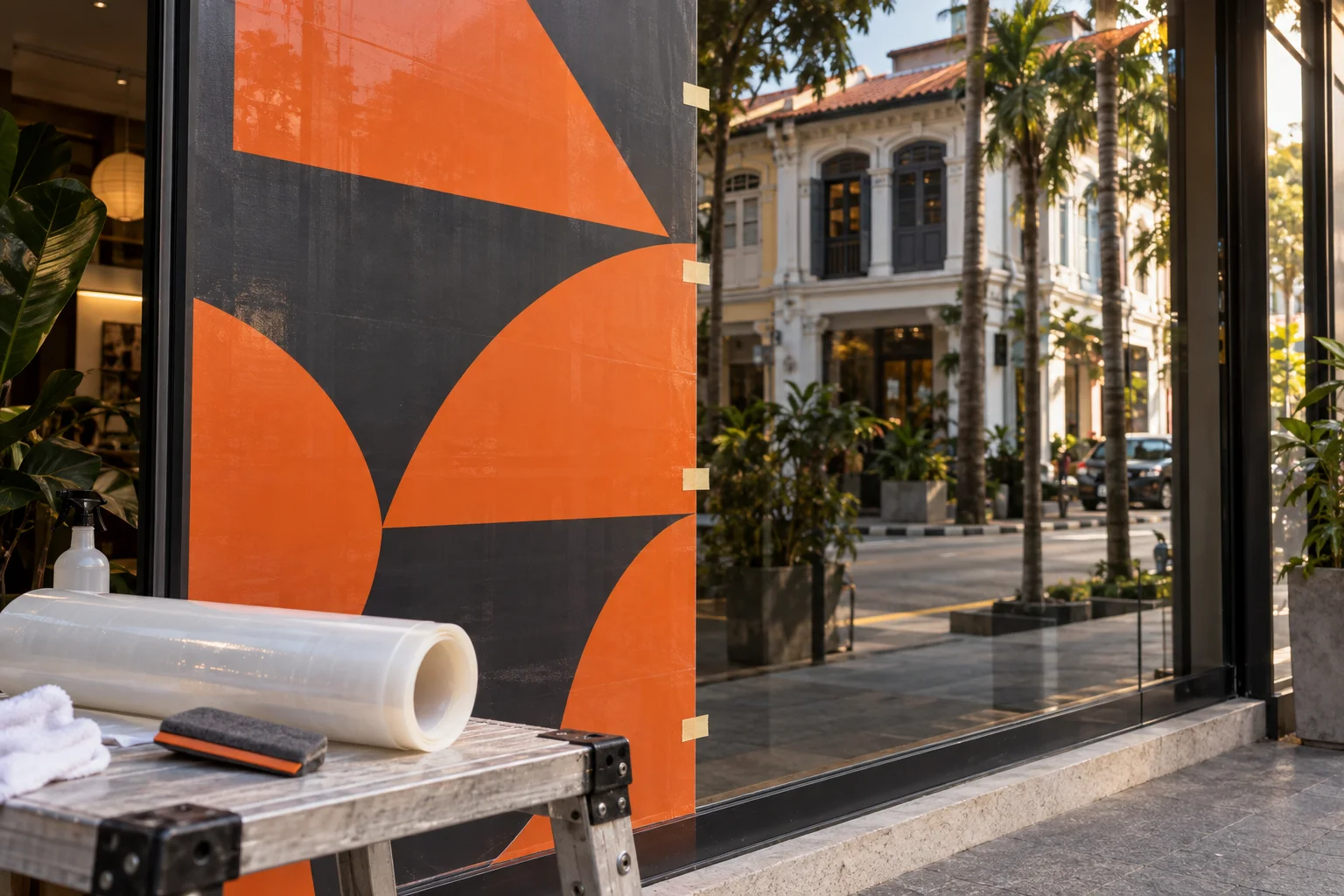
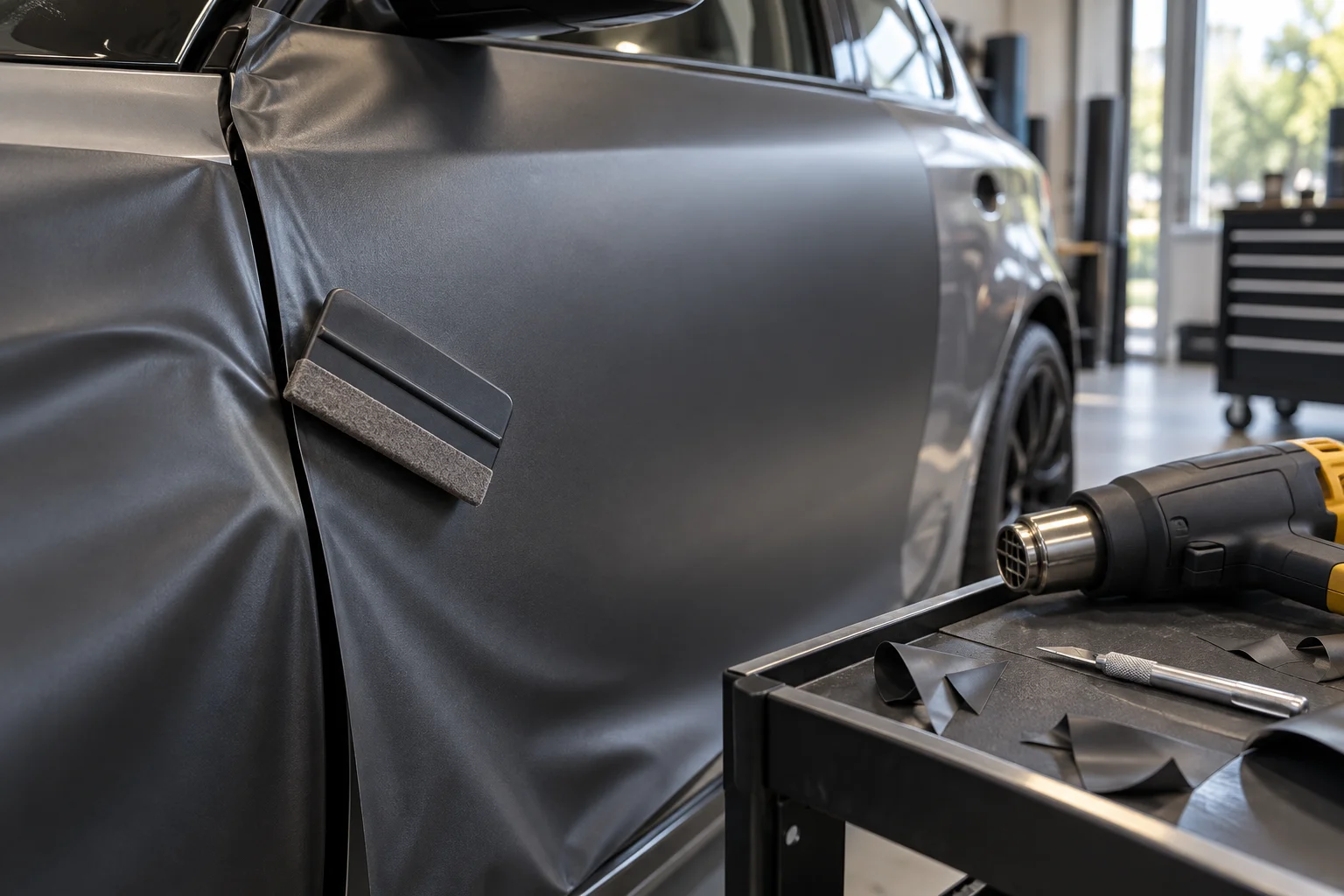
Wall, glass, floor, hoarding or a vehicle panel: we name the film, the coverage, the measured area and who installs it, and only then quote the figure.
SURFACE FIRST / material, area and installation named before a number
Surfaces, film, and how you buy it
Which surface, which film.
Wall, glass, floor, hoarding or a vehicle panel: each one takes a different film, a different preparation and a different working life. We print and install it ourselves, so the film is chosen for the surface it is going on rather than from a single stock list.
Wall & facade
Cast or calendered vinyl over painted plaster, concrete or metal cladding, laminated for the exposure the wall gets. A rough, chalky or flaking substrate is quoted as preparation work, not assumed away.
Glass & windows
Cut vinyl, one-way vision and frosted film, priced on the visible area and on how much you want seen from each side of the glass.
Floor & hoarding
Laminated floor film rated against the traffic it will take, and hoarding panels for a site boundary, with the access and the programme read at the survey.
Vehicle & fleet
Spot graphics, partial and full wraps in cast film, on cars, vans, trucks and box bodies. The coverage level is named on the quotation before the price is.
Two ways to buy it
Supply only — we print, laminate and trim, and you or your own installer fit it. Supply and install — we survey, prepare the surface, fit it and hand it over with a record. They are quoted on separate bases with a separate minimum order each, and they are never blended into one figure. A trade buyer who wants unbranded output and no client-facing involvement can ask for it, and we say plainly whether the job is one we take.
The ladder, as deliverables
Each step produces something you can check, and nothing starts until the step before it is agreed.
Measurement drawing — the surface dimensioned in metres, with the seams, corners, fixtures and trims shown.
Print-ready file — the artwork set at final size, at the resolution and colour mode the press needs, with the bleed the visible area does not include.
Approval proof — the actual job at reduced scale, supplied for approval before anything is printed.
Printed and laminated length — the film class named, the laminate stated, and every piece marked for its position on site.
Install record — what was fitted, where the seams fall, and the film and laminate batches used.
Warranty document — the period, what it covers, what voids it and how a claim is raised, issued at handover.
What we measure, and what we print
A large-format price is quoted on printed square metres and on the measured area, not on a round guess. The finished visible area, the bleed and laminate the job consumes, the number of separate pieces, and whether they have to line up across a seam are all stated as lines. A wall that finishes at 3.0 by 2.0 m in one piece and the same wall in three pieces are not the same job.
We say plainly what we hold and what we do not. Our registered company name and registration number appear on every quotation; the film and laminate brands we use are named with the batch on the install record; the manufacturer's own data sheet gives the film's outdoor rating and you can ask for it. Where a job needs a licence, a permit or a building approval, we say who has to hold it — we do not claim one we do not have.
A logistics fleet wrapped to one template so a replacement vehicle can be added later without another design round.
Scope bought: both sides, rear doors and the bonnet, in cast film, laminated
Coverage named as partial — the roof and the bumpers were not in the figure and were not wrapped
Output: one template drawing reused across nine vehicles, and an install record per van against the film batch
Shopfront · glass and fascia
Below the shutter and across the glass, with a film chosen so the interior stayed visible from the street.
Scope bought: printed fascia panel and cut window graphics, surveyed, supplied and installed
Access: a platform booked for the fascia height and stated on the quotation rather than discovered on the day
Output: approval proof at reduced scale, then installation outside trading hours
Site hoarding · 62 m boundary
A hoarding running the length of a construction boundary, printed in panels and joined to the frame already standing.
Scope bought: print and laminate only — the main contractor's own team fixed the panels
Seams planned around the frame posts, so no join landed on a face that would be read from the road
Output: a panel schedule with each piece numbered to its position
Illustrative scopes. They show how a job is qualified, priced and recorded, not completed client work.
From artwork to installed object
GOOD ON PAPER. RIGHT ON THE WALL.
Enquiry & scope
Which sign, where it goes, and the date it has to be up.
Survey the space
Dimensions, wall condition, viewing distance, power and access.
Mock-up approval
Artwork, material samples, fixings and light — approved before production starts.
Fabrication
Production details confirmed, then built.
Permits & access
Who applies, permitted working hours, landlord and building consent.
Install & handover
Site coordination, fixing, removal of the old sign, clean-up and a walk-round.
The order of events
Nothing is printed until it is approved.
Six stages, each with an output you keep. The clock starts at the stage, not at the enquiry.
Enquiry & surface
Send the size, the surface, photographs and the date it has to be up. Output: a written note saying whether it is a job we take and what is still missing.
Site survey
Surface condition, access and height, frame or power positions, and the programme. Output: the survey sheet and the measurement drawing.
Quotation
Priced on the measured area, with the film class, the coverage, the install basis and the access equipment as separate lines. Output: a quotation with an include and exclude list.
Approval proof
The job at reduced scale, supplied for approval before printing, versioned so the approved file is the printed file. Output: your approval in writing against a named version. Production time starts here.
Print, laminate & finish
Printed, laminated and trimmed, or cut to shape while the laminate is still clean. Output: the length or the panels, marked for position, with the film and laminate batches named.
Install & handover
Surface prepared and fitted, seams dressed, edges run down. Output: the install record, a defects walk-round with you on site, and the warranty document stating the period, the exclusions and the claim route.
Lead times, not rates. Every figure below is counted from the moment the approval proof is approved in writing Each figure is counted from the moment the approval proof is approved in writing; a job phased across several visits carries a date per phase.
Job type
What has to be ready first
Usual lead time from proof approval
Vehicle, partial or full
Vehicle released, coverage level confirmed, paint check done at survey
2–4 working days printing, plus 1–2 days in the bay
Visible area measured, film chosen, opening hours agreed
2–3 working days
Floor or hoarding
Traffic and exposure stated, panels mapped to the frame
4–8 working days, in phases on a live site
WIDE
This table carries lead time only — the rates sit in the pricing section. A date fixed in writing is a date we schedule against, and if we cannot meet it we say so before the deposit, not after the print is on the roll. Where a job is phased — a live site, a fleet coming in one vehicle at a time — each phase is a separate line on the programme with its own date.
The visit that prices the job
The survey decides the number.
Surface, access and height are settled on site, not in the artwork. The survey is the paid step that turns a guide figure into a quotation.
Surface condition: how sound the paint or coating is, and whether it will take a film at all
Height and access, and what that means for equipment and for the hours we may work
Seams, corners and fixings: where the film can be wrapped and where it has to be trimmed on a line
The programme: when the vehicle or the site can be released, and for how long
Who owns the install labour on this job — ours, yours, or the main contractor's
What we check on a vehicle before quoting a wrap
Paint: original factory paint is the only surface we can state a wrap life on. Resprayed panels, filler and a previous wrap are named as exclusions on the quotation.
Body condition: rust, dents and lifting trim. We say whether they will read through a wrapped panel and what preparation would cost.
Removal and de-ghosting: what is on the vehicle now, whether removal is in the figure, and what to expect underneath. Sound original paint is what makes removal predictable. We do not promise what a panel looked like before we saw it.
Bay access, drying time, and how many days the vehicle is off the road.
Where we work
Installs run across the island. A return trip outside the stated radius is quoted as travel, per trip, as its own line. Industrial addresses — Tuas, Jurong Island, the shipyards — are quoted with the site's own security, permit and escort time included, because that time has to be paid for by someone and it will not be us by accident. If an address cannot be covered in one visit, we say so at the survey stage rather than after the print has been made.
The survey is a line on the quotation, with the amount stated before we attend. If the job goes ahead, that line comes off the price of the work. If it does not, the survey line is what the survey cost, and the survey sheet and the measurement drawing are yours either way.
Guide pricing
By basis, by vehicle, by film class.
Three tables: how you buy it, what a vehicle costs at each coverage level, and what a film class runs per running metre. Every figure is a starting point on a surveyed job.
Illustrative concept pricing, not a quotation. Print only and print and install are two separate bases and are never blended into one figure; each carries its own minimum order per job. Large-format work is priced on the printed and measured area, not on a rounded guess at the trim size. Access equipment, surface preparation and out-of-hours working are quoted after the survey. Confirm current rates with the printer.
Basis
What it includes
Guide figure
Print only supplied laminated
Printed, laminated and trimmed print, supplied as a length or as flat panels, marked for position, with the drawing. You or your own installer fit it.
From S$4.00 per sq ft · minimum S$25 per job
Print & install surveyed and fitted
Everything in print only, plus the survey, surface preparation, fitting, seam dressing and the install record.
From S$8.00 per sq ft · minimum S$360 per job
The minimum is per job, not per line: a small decal set on its own still has to clear the print-only minimum, and one small install still carries the install minimum. Ask for the minimum that applies to your job and it will be on the quotation as its own line.
Illustrative concept pricing, not a quotation. Vehicle figures are starting prices for a standard vehicle in original factory paint, sound and unrepaired, wrapped in cast film with standard bay access, and they include the template drawing. A resprayed panel, filler, rust, body repairs, removal of an existing film, trim or bumper removal outside the stated coverage, or a host of small repairs are quoted separately after the paint check. Confirm current rates with the installer.
Vehicle class
Partial doors, panels, bonnet
Full wrap
Compact & hatchback four-door hatch
From S$700
From S$2,400
Sedan & SUV mid-size SUV
From S$900
From S$2,900
Van panel van, single or twin wheelbase
From S$1,100
From S$3,400
Truck & box body cab only, or cab and box
From S$1,400
Quoted on the body size
What each coverage level includes
Spot or door graphics
One to three panels. The rest of the vehicle is untouched and the original paint is the finish you keep.
Quarter to half wrap
Both sides plus the rear doors or the bonnet, wrapped to a consistent line. The roof is not included, and a seam is planned where the film stops.
Three-quarter wrap
Sides, rear and either the bonnet or the roof, leaving the front bumper and one panel unwrapped unless the quotation names them.
Full wrap
Every panel including the roof, with doors, handles and mirrors taken off for the wrap and refitted. This is the only level where a colour change of the whole vehicle is intended.
Illustrative concept pricing, not a quotation. Film is priced per running metre of a printed and laminated roll, before labour, preparation and install, on the assumption of a sound surface and a single print pass. Narrow rolls, double-sided work, cut shapes, hand-worked finishes and anything needing a specialist laminate are quoted after the survey. Confirm current rates with the supplier.
Film class
Where it belongs
From, per running metre
Calendered, laminated
Flat wall panels, hoardings and short-life promotional surfaces
S$45
Cast, laminated
Vehicle panels, curves and rivets, and walls that have to hold for years
S$95
Specialty frosted, one-way vision, floor
Glass, floors, and anything carrying its own rating
S$120
Metallised finishes
Accent strips and partial work where the finish is the point
Quoted per job, on the roll ordered
What moves the number: the film class; the measured area against the trim size; the number of pieces the surface has to be broken into; the preparation the survey found; access and height; out-of-hours or dry-bay working; removal of an existing film; and fleet quantity, where the template is already set and the vans wrap faster from the second vehicle on. Each of them is a line on the quotation rather than a movement on the invoice. Two vehicles of the same model can still differ by a panel repair and an hour of preparation, which is why the quotation follows the survey and this page does not pretend to be one.
Survey, measurement and the approval proof of the actual job
Printing, laminate and trimming of the measured area
Fixing to a sound surface the quotation describes, up to the height and access stated on it
Seams planned to the drawing, and an install record naming the film and laminate batches
Removal of an existing film only where the quotation says so
The warranty document, issued at handover
Outside it, unless it is stated
Surface repairs: painting, plaster patching, render or cladding works
Vehicle bodywork, dent repair, or a panel that has been resprayed
Scaffold, hoist or platform hire, road closure and traffic management
Permits, landlord or building approval, and the submission work behind them
Electrical work, illumination or lighting services
Designing the identity itself, stock imagery and licensing fees
Send these six things and our quotation is one you can compare
The finished dimensions, and whether those are the visible area or the trim size.
The named substrate: what the surface is made of, and its state.
Where it lives and how long it has to last — indoor, outdoor, sun, salt spray, foot traffic.
Finishing and hardware: laminate, cut shape, eyelets, frames, fixings.
The quantity, and every address the print has to reach.
The date it has to be installed, not the date you would like the quotation.
Who holds each lever. Three of the seven rows sit with the client, two are shared with us, and two belong to the market, so a quotation can be audited rather than argued with.
What moves the price
Who controls it
What it changes
Substrate and film class
You, with us
The metre rate, and how many years the surface holds
Area, coverage and seams
You, with us
Printed area, piece count and the hours in the bay or on the wall
Finishing and hardware
You, with us
Material passes and hand-worked time
Quantity, and whether it repeats
You, with us
Setup spread across the run, and template reuse per vehicle
Turnaround and working hours
Shared
Whether the job runs in normal hours or in a bay at night
Freight and install logistics
Shared
Whether the print travels alone or an installer travels with it
Film, resin and freight input costs
Neither
Quotations are held for the period stated on them, then re-checked
The table is here so the levers are visible: three of the seven rows are yours to move before we print a metre. If the job changes after approval — a different size, a different surface, a different date — it is re-quoted, and the part already printed is charged at what it cost. If a reprint is needed because we printed the wrong approved version, that is ours and we say so in writing. We do not quote against a surface we have not seen.
Client perspective
“They measured the wall before they quoted it, so the price we approved was the price we paid — and they told us which half of the wrap the roof was not in.”
Fleet livery · sample story
Sample story. Not a real customer review.
Before you commit
The questions that decide a surface.
How much is a wrap, or a wall, honestly?+
Start with the tables in the pricing section: print only or print and install, then the coverage level for the vehicle class or the film class for the wall. Both are starting points and both say so. What moves the figure is the area we measure on site, the film you choose, and what the survey finds under the surface. If the guide figure and the quotation end up far apart, the difference will be a named line — preparation, access equipment, a panel repair — and we will show you which one.
What is actually included in a half wrap?+
In ours: both sides, plus either the rear doors or the bonnet, wrapped to a consistent line with a seam planned where the film stops. The roof is not included, and neither is the front bumper, unless the quotation names them. Trim, handles and mirrors are refitted rather than wrapped unless it says otherwise. The quotation states the coverage in words as well as in the figure, so the two cannot drift apart later.
Will removing the wrap damage the paint?+
On original factory paint in sound condition removal is a predictable process: the film is warmed and pulled, the adhesive is cleaned off, and the de-ghosting — the shade difference between covered and exposed paint — depends on how long the film was on and how much sun the vehicle saw. On a resprayed panel, filler, or paint that was already lifting when the film went on, we say at survey that removal carries risk, and the quotation names that risk as an exclusion. We do not promise what a panel looked like before we saw it.
What happens if the film lifts or fades?+
The warranty document issued at handover states the period, what it covers, what voids it and how a claim is raised. The usual exclusions are an edge lifted by an impact, pressure washing held against an edge, a surface that was not sound when the film was fitted, and film supplied by someone else and installed by us — written on the document rather than remembered. Bring the install record with the claim and we can match the film and laminate batch.
How long is the vehicle off the road?+
A partial wrap is usually one day in the bay; a full wrap of a van or a truck is two, sometimes three, because doors, handles and mirrors come off and go back on and the film needs dry panels. The survey states the number of days and whether the vehicle sleeps indoors, because a wrap cannot be fitted in the rain or in direct sun. Vehicles can come in one at a time on a fleet job so the business keeps running.
Can we buy the print and install it ourselves?+
Yes, on the print-only basis, with its own minimum order. You receive the laminated print marked for position, with the measurement drawing and the panel schedule, and trade buyers can ask for unbranded output. Two things change: the fit and its quality are yours, and the warranty document then covers the print and the laminate only, because we cannot vouch for how a film was applied. If the surface is one we would have refused, we will say so even when we are only printing.
The warranty, as a document
At handover you get a printed statement with four things on it. The period, counted from the install date, and the surface it was fitted to. The covered defects: print quality, the laminate, and our workmanship at seams, edges and trims. What voids it: damage or washing after handover, film supplied by another party, and any fitting by another party. And the claim route: who to contact, what to send — photographs of the defect and the install record — and what happens next, which is an inspection and then either a re-fix or a reprint of the affected piece. The film and laminate batches are on it too, so a repair years later can be matched to the same roll.
Start with the surface
Tell us the surface. We will quote the number.
Send the size, the surface and the date it has to be up. If you already have photographs and a drawing, send those; if the surface is one we have not seen, the survey comes first.
Concept only. Nothing is sent or booked.
What happens next. A written reply within one working day, and either a survey slot offered within three working days or a straight answer that the job is not one we take. The quotation follows within two working days of the survey, and the guide figures on this page are replaced by the measured ones. A trade enquiry on the supply-only basis gets the same reply with the trade line stated — including whether we can supply unbranded.