Zone one · within 6 km
A 20 to 30 minute window at any hour, for a burst pipe, a leak, a drain that has backed up or a circuit that will not hold. Out of hours the band applies to the time worked, and it is stated before the call ends.
Emergency attendance · Singapore
A leak, a blockage or a circuit that will not hold: the window is stated per zone, the band and the minimum charge are agreed on the phone, and the fault is proved before any part is replaced.
Request a call-out
Called out now
Both crews run every day of the year: a night crew and a day crew, a band for each, and a window held by zone. The band and the window are confirmed on the phone before anyone sets off, so the figure you are given is the one that applies when the van arrives.
A 20 to 30 minute window at any hour, for a burst pipe, a leak, a drain that has backed up or a circuit that will not hold. Out of hours the band applies to the time worked, and it is stated before the call ends.
A 30 to 45 minute window off-peak, and up to an hour in the evening peak. If the window cannot be held we say so on the call, so you can try someone nearer instead of waiting on a promise.
We take the job only where a window can be stated that we expect to hold. Outside both zones we quote a window rather than a guess, and if someone nearer can get there sooner you will be told so on the call.
We do not open a sealed riser, a meter cabinet or a board that is not ours to open without a right to be at it: photo identification where we meet you, or, if the unit is rented, the landlord, the agent or the building management confirming access. On a shared riser that confirmation comes first, before anything is isolated.
What the call is
Which of these it turns out to be is settled on site, but the rate, the band and the method are agreed on the phone before anyone travels.
A burst or leaking pipe, a cistern or a flexible hose that will not stop, a drain backing up into the unit, or a water heater leaking at the tank or at the connection.
Window for your zone ↗20–45 minA circuit that trips and will not hold, part of the unit without supply, an accessory that is hot or scorched, or a water heater that takes the protection down the moment it is switched on.
Window for your zone ↗Same visitThe fault is proved, the valve is shut or the circuit is taken out of service, and the repair is priced as a separate decision whether it is a part, a length of run or a surveyed project.
What the visit covers ↗Method before price
Nothing is replaced because a visit has been paid for. The line is shut or the circuit isolated, the fault is proved, and the difference between making it safe now and repairing it properly is priced before a tool is used.
Whole jobs, not hours
Each of these is finished in one visit on most units, and the price is for the job rather than for the clock: the fitting and the labour are in it, and the band is not charged on top where the repair is completed inside the first hour.
A start price assumes the isolation point is reachable, the fitting is not sealed into the finish, and the accessory can be worked on without access equipment. A job that turns out to be larger is priced and agreed before the extra work begins, and where the visit is charged by the band, the band applies instead of the start price rather than as well as it.
Before anything is replaced
What can be repaired without opening a run, and what has to be left alone, depends on the installation and on the building. This is what the visit checks, and what you should ask of anyone who attends.
The valve is shut or the circuit is taken out of service before anything is opened, and the reading that proves the fault is taken by the procedure that applies. A part changed before the fault is proved is a guess you paid for.
A leak is traced to a joint, a fitting or a length of run with the line pressured and watched. A trip is found by insulation and continuity readings and by load, not by swapping parts until something holds.
Where a valve, a hose, a cartridge or an accessory can be replaced without opening the finish, that is the cheaper job and it is the one that happens. Where the run itself is finished, the price of re-running it is stated before the wall is opened, not after.
A whole-room rebuild is a renovation project with a survey and a schedule, not a call-out. An aircon system, its copper pipework and the electrical point that serves it belong to an aircon contractor. Security cabling — whatever it exists to watch or to secure — belongs to a security installer. Where the job is theirs we say so on the phone rather than on the invoice.
A shared riser, a meter cabinet, a common-area supply and the incoming supply each have an owner. The visit proves which side of the boundary the fault sits on and writes it down, so that two parties are not each charging you for the same pipe or the same cable.
Isolation, testing and access rules are set by the installation's own standard and by the building, and they change. Confirm what applies to your premises, and ask the person attending to show you how the fault was proved rather than telling you it was found.
Before you call
The figure cannot be known before the fault is seen, but the band can. Have these three ready and the call takes two minutes; the band, the minimum charge and the most you can be charged for the job as described are agreed before anyone travels.
Address and unit number, or the level and stack, and whether the unit is on a private meter or a shared riser. A location pin sent to the phone saves a wrong turn at one in the morning.
A pipe that drips, sprays or pours; a drain that backs up; a circuit that trips once and resets, or trips again the moment it is switched on; a heater that leaks at the tank. A photograph or a short video settles it faster than a description.
Which valve you have shut, which breaker you have left down, and whether the water has reached anything electrical. If water and electricity are both involved, say so on the call: that changes what is switched off first.
The band that applies, the minimum charge, the increment after it and what is not included are confirmed on the phone. If the fault turns out to be different on site, work stops and you are told before it continues.
Both ways around
What the person at the door can show you, and who is accountable for the installation itself, are settled before anything is opened rather than after.
The name of the person attending and the company name go out on the call and again as a message, so the person at the door can be matched against both. A plain van and a uniform are not identification.
Work on the fixed electrical installation is carried out, and signed off, by a person holding the licence this jurisdiction requires, and the document you are handed names that person, the qualification and the authority that issued it. The licence number is printed on the certificate that comes with the work rather than claimed in a headline.
The entity you are contracting with, the office address, the hours covered, the zones covered, the band, the minimum charge and the number to complain to are all on the contract and on the receipt, and they are given over the phone if you want them before then.
The warranty on the part fitted is issued as a document with the period printed on it, and what cancels it sits on the same sheet: a second installer working on the same fitting, water damage after the repair, or a part replaced by someone else.
What this direction can be held to, in writing: a window stated by zone, a band agreed before it sets off, a receipt for every payment, and a refusal to open a sealed riser or a meter cabinet without a right to be at it.
Day, evening, overnight
The band is the rate: evening, overnight, weekend and public-holiday work is charged at the band shown, with no attendance fee added on top and no overtime multiplier on the hour. That figure is the time worked on your fault.
A visit is billed at a minimum of one hour from arrival, and after that in 30-minute increments at the same band. Travel sits inside the band rather than on top of it, and nothing is charged for waiting while a valve is found or a supply is confirmed.
| Band | Plumbing & drainage, per hour | Electrical, per hour |
|---|---|---|
| Weekday · 7am to 5pm Day band | S$95 | S$105 |
| Weekday · 5pm to 10pm Evening band | S$140 | S$150 |
| Weekday · 10pm to 7am Overnight band | S$190 | S$200 |
| Saturday · 7am to 5pm Weekend band | S$120 | S$130 |
| Sunday and public holiday Any hour | S$150 | S$165 |
Time and labour only: parts, fittings and any material used are charged at a stated price on top of the band and are itemised on the receipt. Where the fault proves to be on the building's side of the boundary, the attendance is still charged and the finding is written down, so that it can be taken to whoever owns that side. The rates are the ones in force when the call is answered: confirm them on the call.
Three nights, three endings
A night attendance ends one of three ways: repaired inside the visit, isolated and left safe with the repair priced separately, or handed to a project. Each of the jobs below is one of the three.
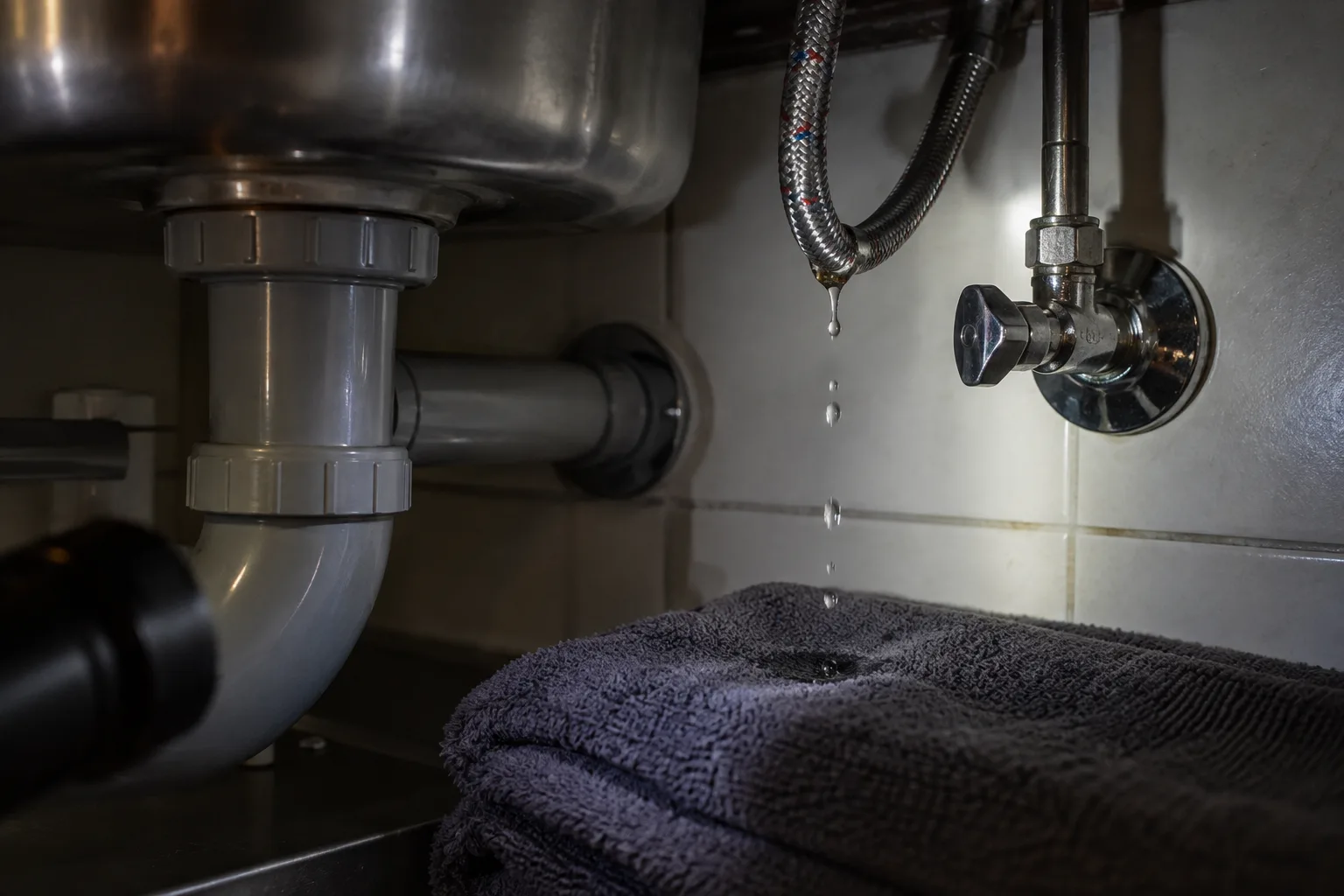
Burst flexible hose · overnight band · repaired in the visit
The resident had closed the angle valve, but water had already reached an accessory on the wall behind the taps, so the circuit serving that wall had to be taken out of service first.
The overnight band was agreed on the phone. At the flat the resident was asked for identification and the meter position was confirmed before any water was touched, because the riser is shared. The circuit was proved dead at the board, the hose was replaced, the accessory was dried and its insulation resistance read, and the circuit went back on with the resident watching. The floor was mopped, the old hose was handed over, and the receipt was written at the flat.
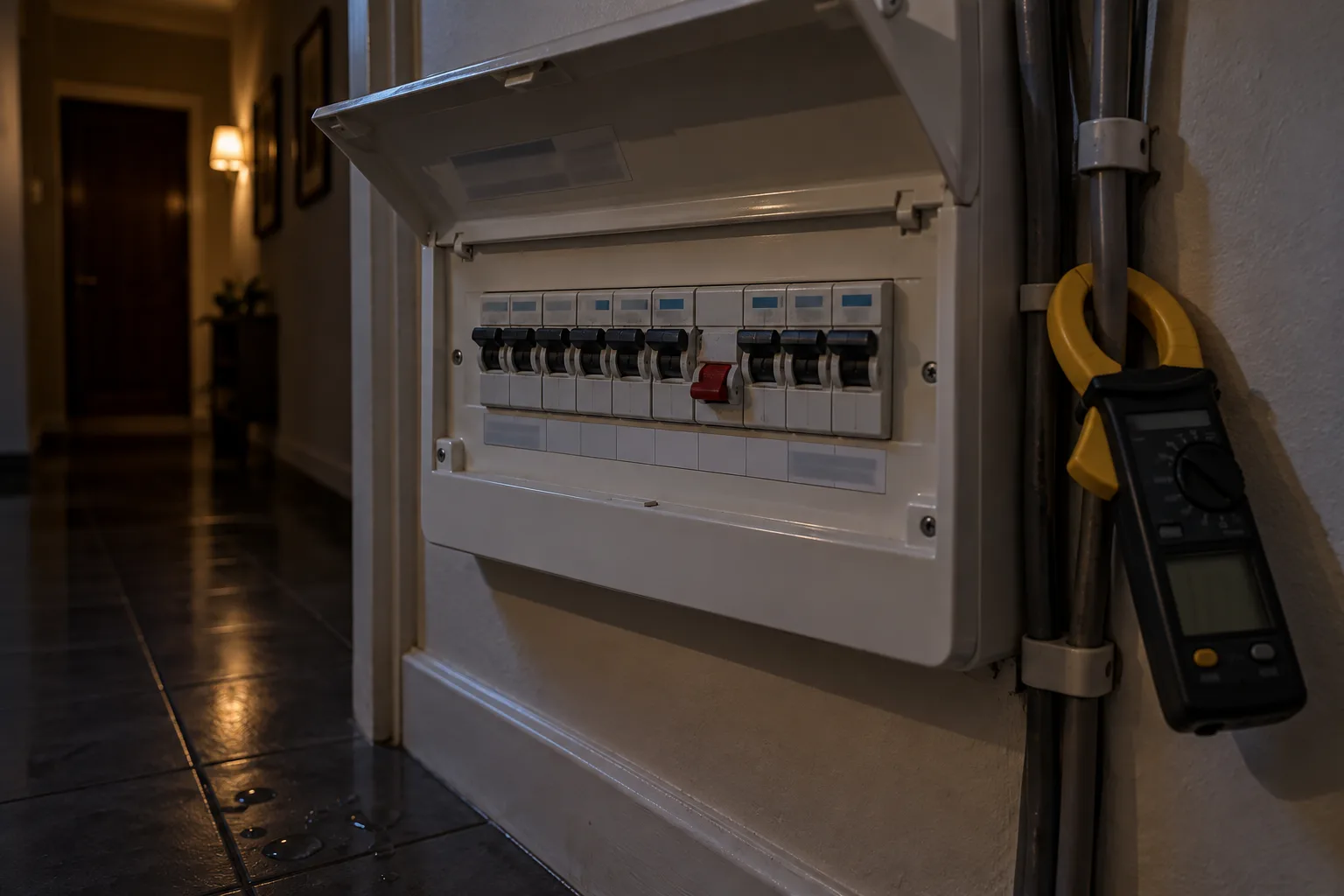
Water into an accessory · circuit isolated and read · repaired in the visit
A trip that resets once and then holds is a different job from a trip that will not hold at all: the second one is tested with the circuit dead, and the test is what decides whether the accessory is dried out or replaced.
Insulation resistance and continuity readings, taken with the circuit out of service, locate the fault to a length of cable, an accessory or a load. Parts are only fitted once the reading identifies what is wrong, and the readings are written down with the receipt so the same circuit can be compared if it is ever called out again.
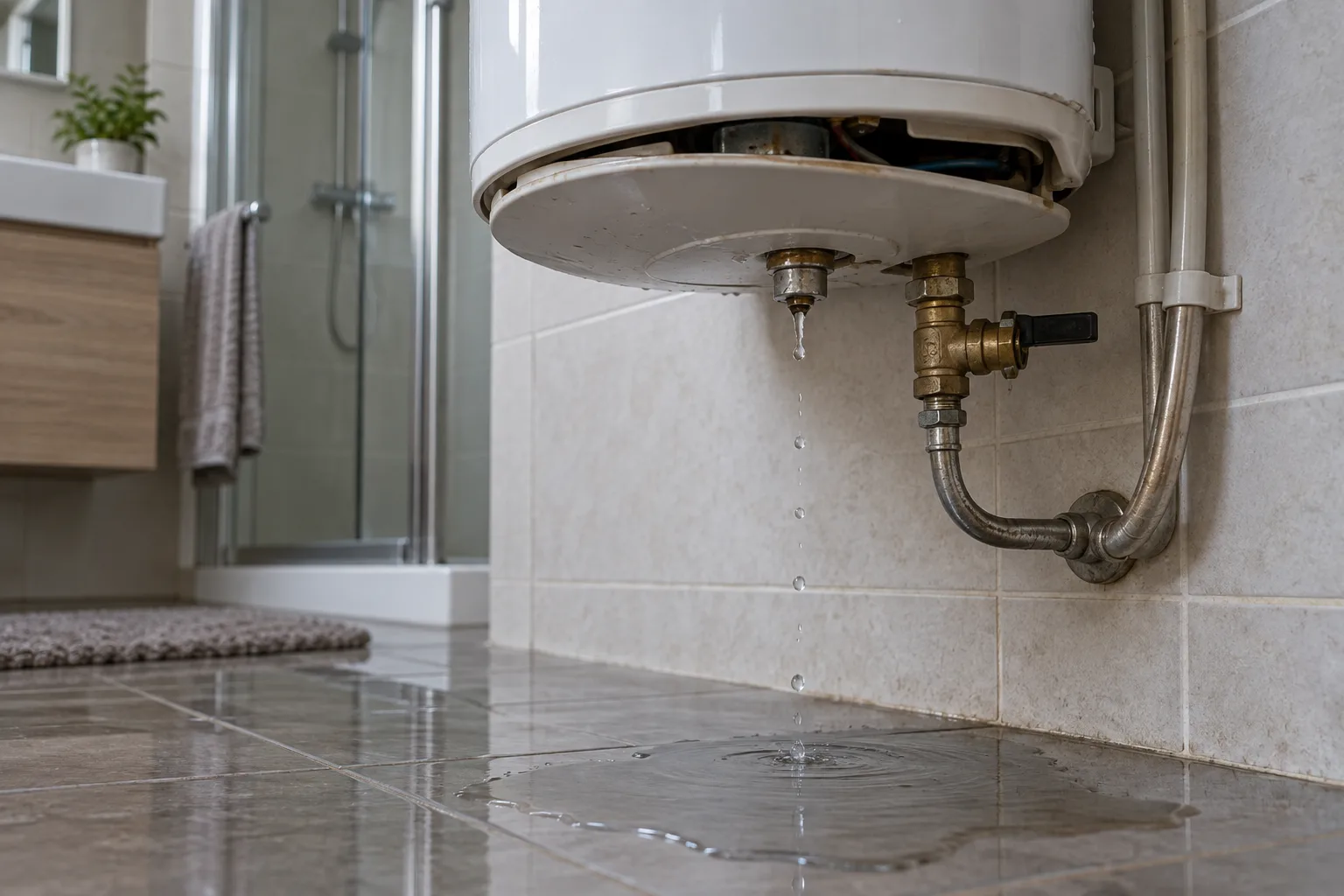
Leak traced at the tank · start price from S$180 · replacement priced before it is ordered
At a tank connection the repair is a new hose or a new compression joint; at the tank itself it is the heater, and the two are priced differently because one is a fitting and the other is an appliance.
The tank, the element and the thermostat are tested and read before anything is ordered. Where the heater is replaced, the price of the heater and the disposal of the old one are stated before the order is placed, and the work is done with the isolation valve proved closed and the circuit taken out of service rather than left switched off.
Each brief above is written to the same structure the receipt follows: what was found, what proved it, what was done, and what was left switched off. The bands and the start prices quoted in them are the ones in the table above.
Talk through your faultAddress and unit, what the fault is doing, and the band agreed before anyone travels.
Window for the zone confirmed, and the name of whoever is coming given on the phone.
Valve shut or circuit out of service, and access confirmed before a sealed riser or a meter is touched.
Pressure or readings before any part is replaced, tested with you before anything is put back.
From the call to the made-safe state
The order matters: the fault is proved before a price is added to, and the isolation comes before anything is opened.
Where you are, what the fault is doing, and what is already switched off, plus whether water has reached anything electrical. Output: the window for your zone, the band, and the most you can be charged for the job as described.
The job is allocated to whoever is on the rota and the window is confirmed, with the name and the company given on the phone. If the window moves you are told rather than left waiting, and waiting is not charged.
Identification first, then the isolation point: whether the unit is on a private meter or a shared riser, and who has to agree before a sealed riser or a meter cabinet is opened. On a rented unit the landlord, the agent or the building management is called while you wait.
The valve is shut or the circuit is taken out of service, and the fault is proved rather than assumed. Output: what the reading or the pressure test showed, where the fault sits, and which side of the boundary owns it.
Three endings, and you are told which one you are in. Repaired inside the visit at the agreed price; isolated and left safe with the repair quoted separately; or handed to another trade, where the work is renovation, an aircon system or security cabling.
What was isolated is tested with you before it is put back into service, the old part is handed over, and the record of what was left switched off is written down. Output: a receipt, and the finding in writing where the responsibility sits elsewhere.

The cost of an emergency attendance is on the rate card above: the band table is the rate, the minimum is one hour, increments are 30 minutes, and materials are separate. The rota covers every hour of the year, and the band that applies is the one in force when the call is answered.
A night call, in the resident's words
“They told me the overnight band before they set off, took the circuit out of service because water had reached the wall, and showed me the reading before it went back on.”
Overnight attendance, condominium unit · sample story
Sample story. Not a real customer review.The practical questions
Inside zone one, 20 to 30 minutes; zone two, 30 to 45 off-peak and up to an hour at the evening peak. Outside both zones we say so. If a pipe is pouring into a live electrical area, or something unsafe is inside the unit, say so on the call: shut the supply you can reach, keep clear of the water, and treat it as an emergency in its own right rather than waiting for us.
The overnight band in the table above, per hour, with a minimum of one hour and 30-minute increments after it. There is no attendance fee on top and no overtime multiplier: the band is the rate, and the band, the minimum and the exclusions are confirmed on the call before anyone sets off.
If you can reach a valve or a breaker and it is safe to do so, yes — it limits the damage and it is the first question we ask. What matters more is not standing in water to do it, and not taking a cover off a board to reach a breaker that is arcing. If either applies, leave it and wait.
Then the building has to be involved. We prove which side of the boundary the fault is on and write it down, and on a shared riser the management or the owner of that side has to agree before anything is isolated. Where the fault is theirs, the attendance is still charged and the finding is yours to take to them.
The band covers time and labour. Parts and materials are charged on top at a stated price and itemised on the receipt, and a repair that needs the wall opened, a run replaced or a survey comes back as a priced job rather than being absorbed into the hour. Nothing is replaced before the fault is proved and you have agreed the price.
No. A rewire or a re-pipe is quoted per point after a survey, scheduled in stages, and signed off with a testing record: that is a project, not an attendance, and it is priced on its own page. The same applies to a whole-room rebuild, to anything served by an aircon system, and to security cabling — we name who does those rather than absorb them.
Not for the job described on the call. If the fault turns out to be different — a different fitting, a run that is finished rather than a joint, or a fault on the building's side — work stops and you are told before it continues, and the extra is priced before it is done.
Start with three details
Address and unit, whether the fault is water or electric, and what you have already switched off. If it is running now, say so on the form and call: the window and the band are confirmed on the phone, before anyone is dispatched.
Concept only. Nothing is sent or booked, and nobody is dispatched until you send it yourself.
Company registration: the entity name and the registration number are printed on the contract and on the invoice, together with the office address and the number to complain to.