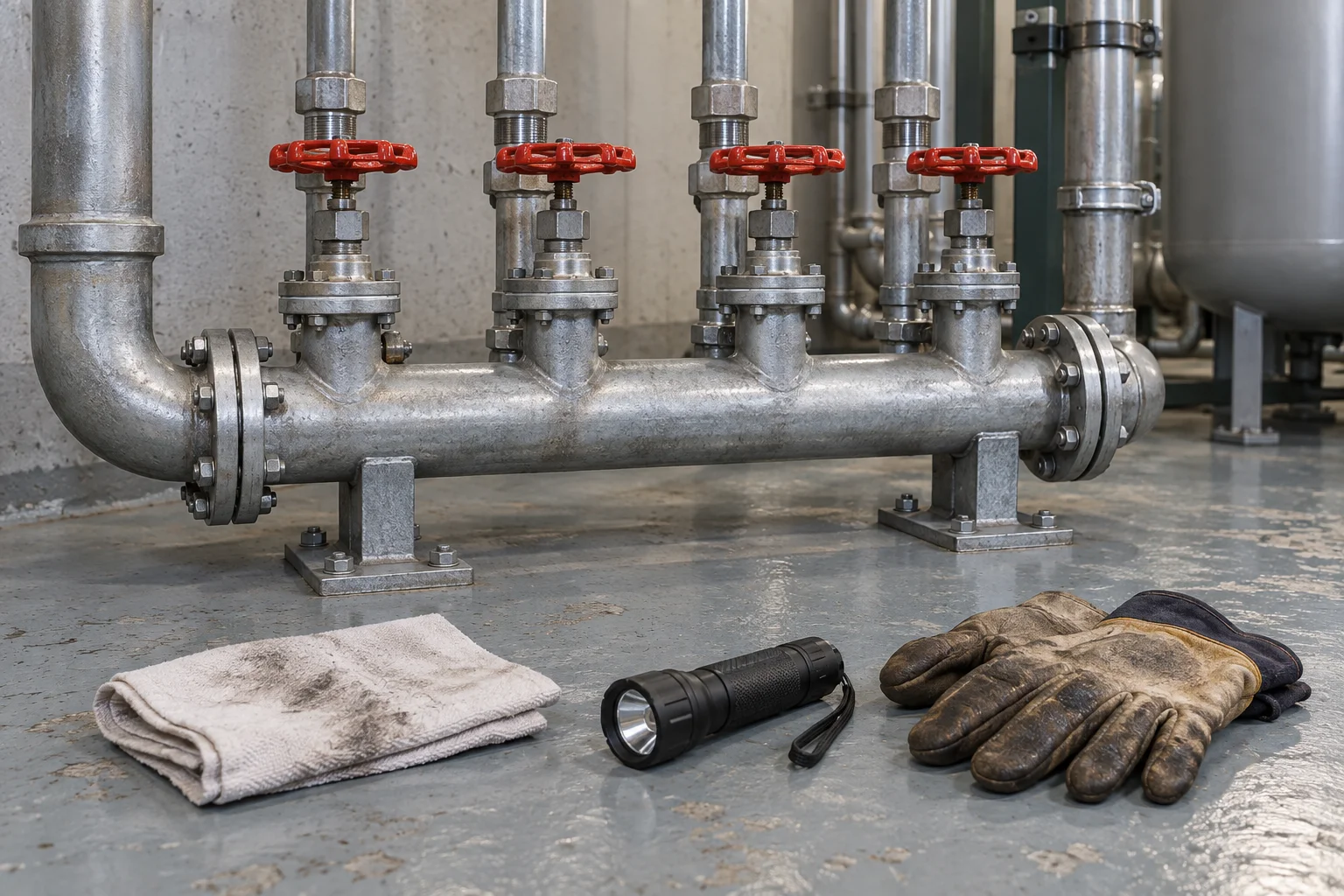
A maintenance contract sold as a schedule and a record: which installation items are inspected at every planned visit, what the fault log contains after each one, and what the contract says when a repair cannot wait for the next visit.
A maintenance term for premises is bought for two things at once: work that happens on a schedule, and a record that exists whether or not anything was found. Both are specified here, both are reported, and the scope is chosen item by item rather than taken whole.
Planned inspection
Inspection and testing of the items on your register, on the cycle the assessment sets: supply fittings and sanitary ware, drainage, water heaters and their isolation, the distribution board and its circuits, accessories and lighting, and earthing. Every visit produces the same sheet, in the same format.
Reactive repair and attendance
A fault reported between visits follows the process written into the contract: who is contacted, how attendance is requested, and the window for arriving. Anything attended outside the schedule is priced per visit, as stated.
The fault log and the record pack
Every visit and every fault writes to the same log: what was found, at which point, what was done, what the premises has to arrange, and what is still open. It is issued per visit and summarised per month, so a year of history is one document rather than a folder.
Optional items, named as optional
Testing at statutory intervals, water-heater servicing, emergency lighting, thermal checks of boards and minor remedial work are separate lines. The assessment says which of them your premises needs, and nothing is added to the term without a written variation.
Restaurants and food premises
Stake: a kitchen that cannot lose its water or its supply during service, and an inspector who asks for maintenance records. What this contract does: a point register covering the kitchen, the wash areas and the waste route, visits scheduled around service, and a log that can be handed over as it stands.
Offices and managed buildings
Stake: tenants reporting the same fault twice, and a landlord duty nobody can evidence. What this contract does: one register for the premises, one contact, planned visits covering common areas as well as the units, and a log showing what was attended and when.
Retail, clinics and classrooms
Stake: hours when the site cannot be disturbed, and fittings the public can reach. What this contract does: visits outside opening hours where they are needed, access rules recorded per area, and checks on what the public touches as well as what is out of sight.
Warehouses and light industrial
Stake: a fixture failure that stops a bay, and equipment that only gets looked at once it has broken. What this contract does: a register by zone, checks on boards and insulation between the plant, and findings written up as defects with an owner rather than as advice.
Landlords with several units
Stake: proving that the same standard was applied to every unit. What this contract does: a register per unit, a visit record per unit, and one summary showing which unit was seen and which was not.
Assessing first, scoping after
There is no standard package, because a two-kitchen restaurant and a four-storey office do not share a cycle. The first step is an assessment of your premises and your register, and the scope and the frequency come out of it — which is also what makes a per-point price defensible.
The register the contract is written around
Every item, and what proves it.
A contract names the items it covers, not a general promise of care. Each row below is a point on the register, the inspection that happens at a planned visit, and what the record shows. The assessment decides which rows apply to your premises.
The register is what the checklist is built from. Rows that are not on your register are not being inspected or charged for, and a row is added or removed only by a written variation agreed with you. The intervals that apply to your premises come from your own risk assessment, your insurer and any statutory interval that governs the item, and they are written onto the schedule at the assessment.
Register item
Checked at a planned visit
Recorded as
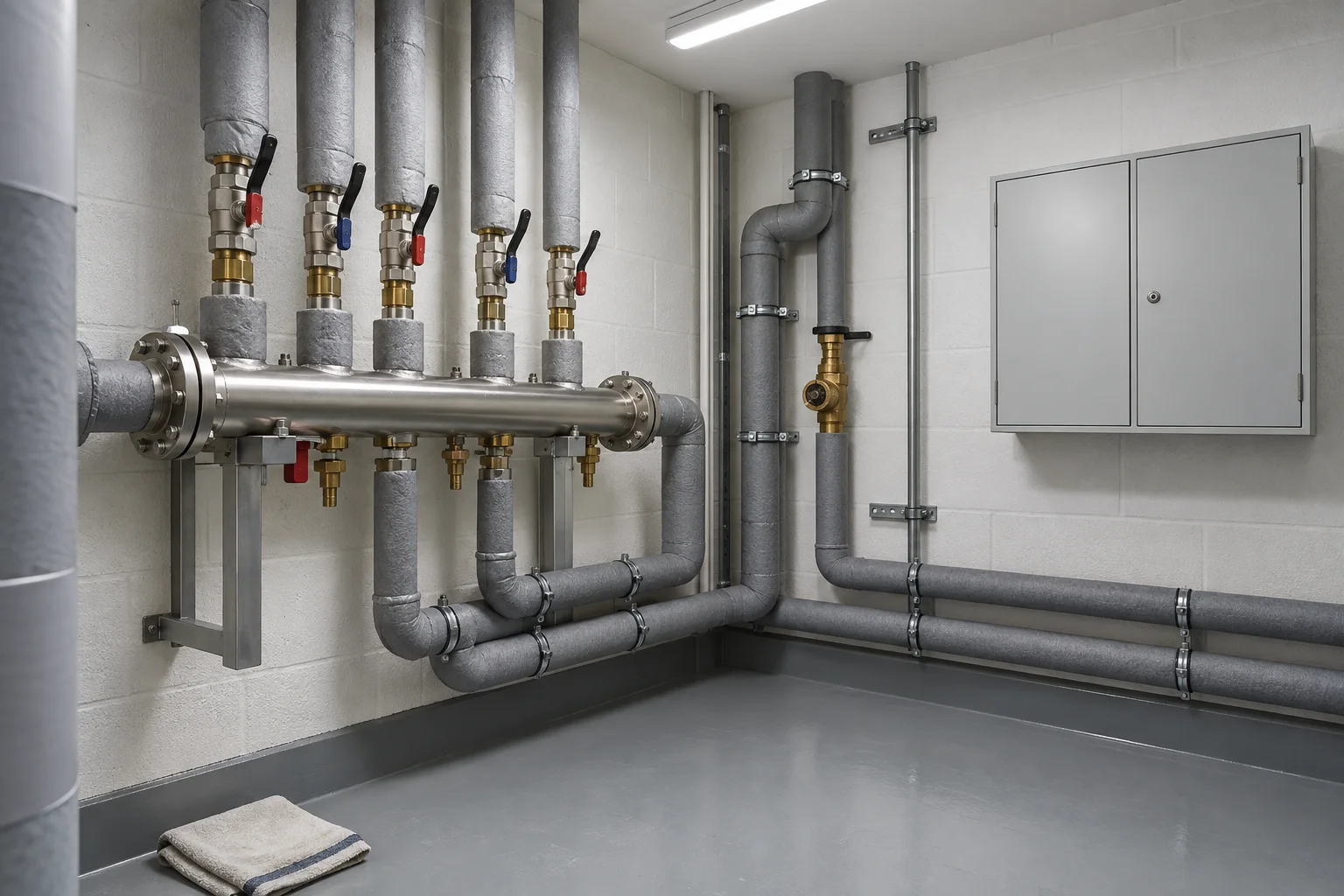
Supply fittings and sanitary ware Taps, cisterns, hoses, isolators
Weeping joints and hoses, cistern refill and flush behaviour, isolation valves worked open and closed to confirm they still do their job, corrosion at fittings
A point number, its condition, and anything replaced
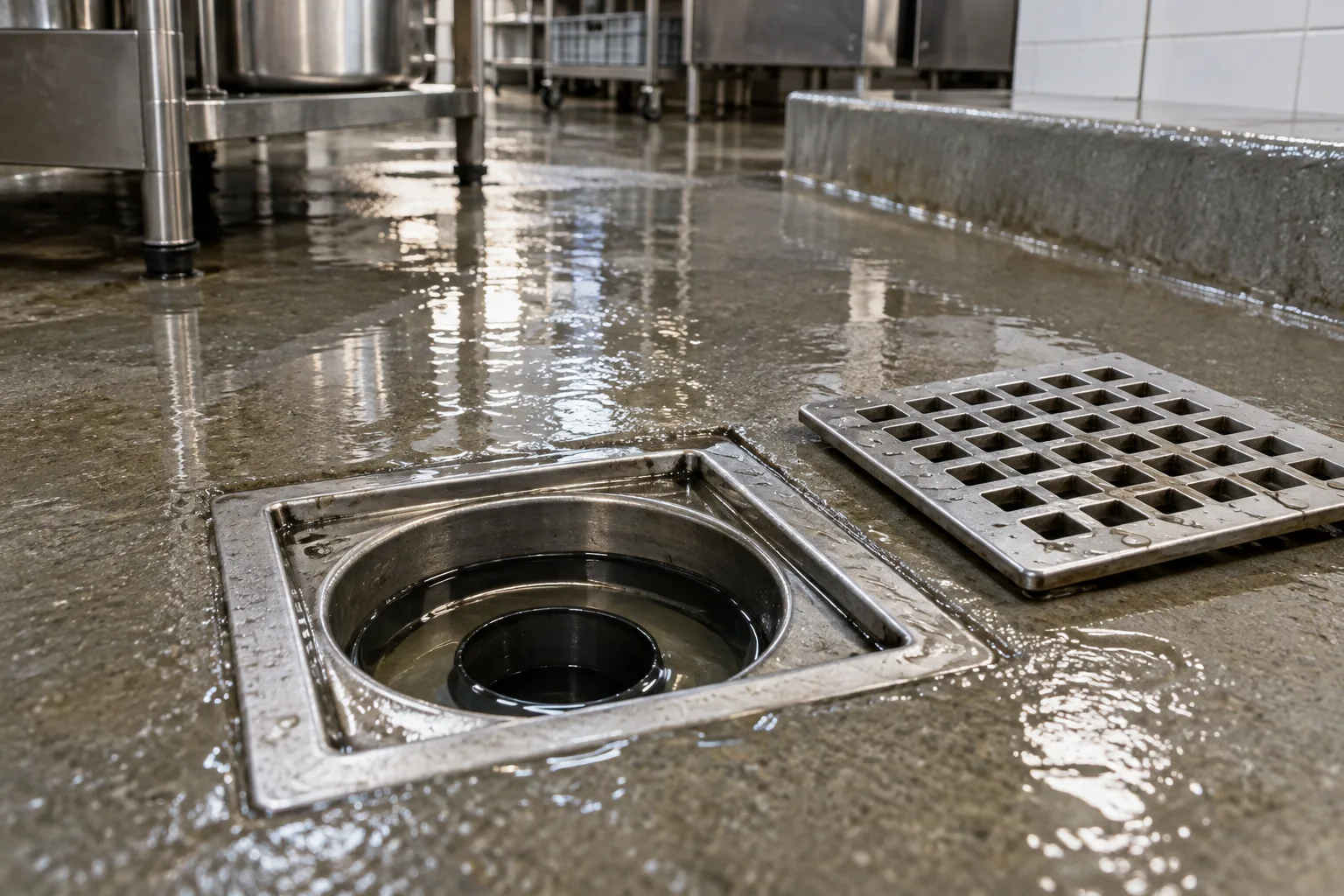
Drainage and floor wastes Gullies, floor wastes, discharge points
Flow at each discharge, slow drainage reported by staff, seals present, covers seated, and an odour traced to its source rather than masked
A point number, the flow observed, and the clearance work done
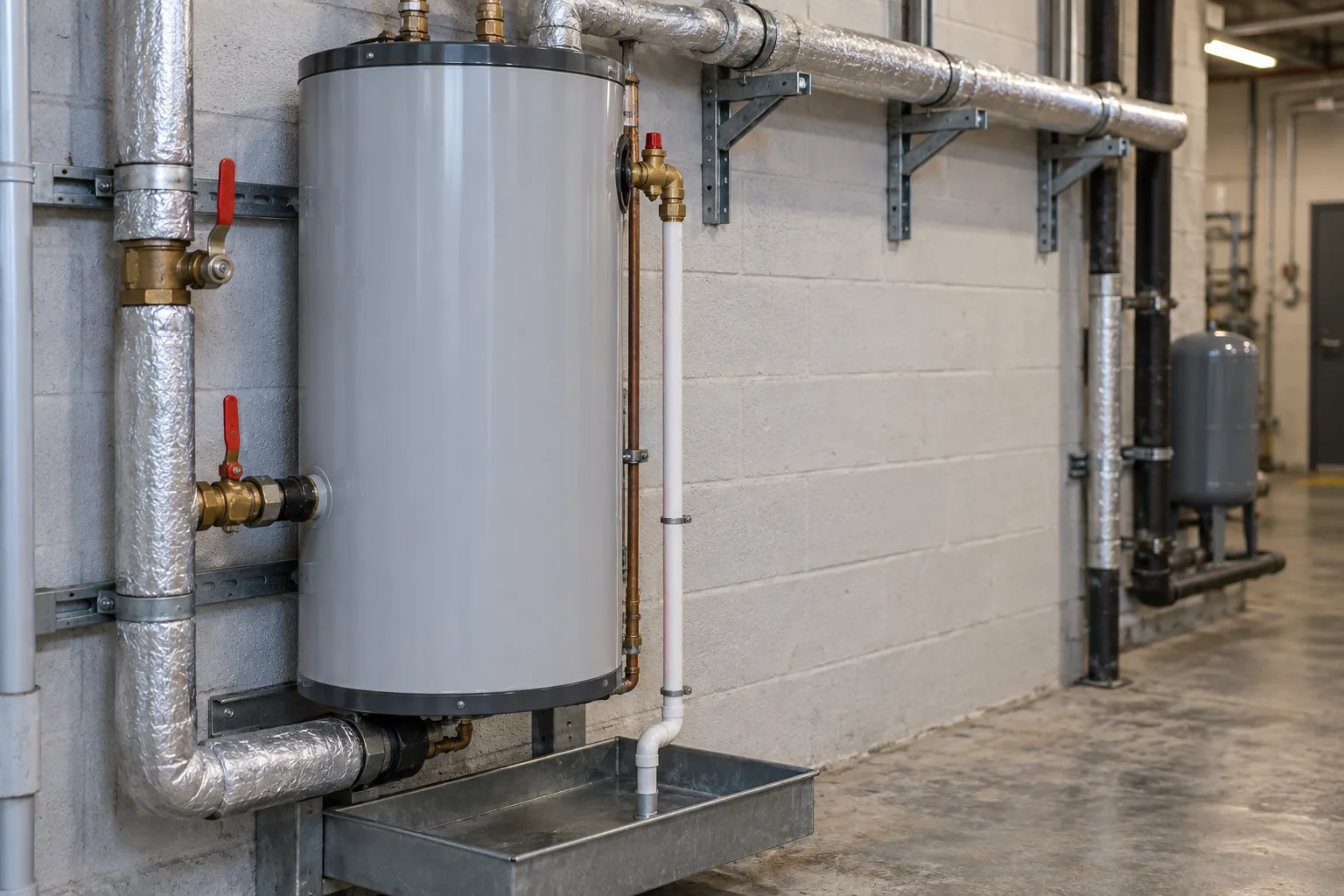
Water heaters Tank, element, isolation
Leaks at the tank and the connections, the temperature setting as agreed, the isolator tested, and the safety cut-out confirmed for that model
A point number, readings taken, and the isolation confirmed
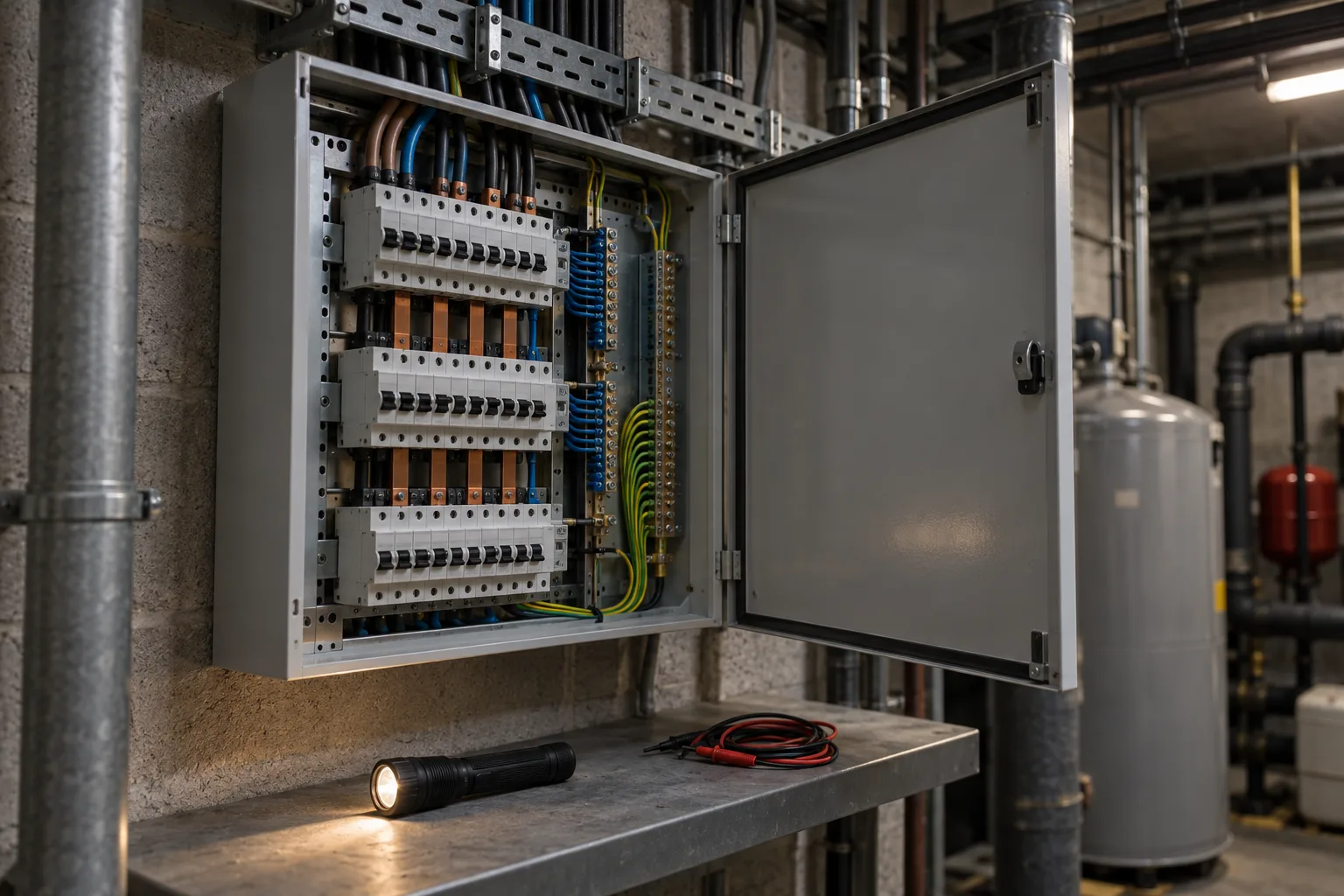
Distribution board and circuits Ways, labels, protection
Board covers and labels, signs of heat or scorching, circuit protection tested, circuits identified against the register, and a thermal check where the contract includes one
A way number, the test result, and any defect with an owner
Accessories and lighting Sockets, switches, fittings
Condition of the fittings the premises actually uses, damage from water or heat, loose plates and mounts, and lamps out at the time of the visit
A point number, the count attended, and the parts used
Earthing and bonding Main and supplementary
Continuity of the bonding conductors that can be reached, condition at the terminals, and any alteration since the previous visit
A reading, or the reason it could not be taken
The table is the register, not a diagnosis: which rows apply to your premises, and at what interval, comes out of the assessment and is listed on your schedule. Where an item needs a statutory interval, or a person with a specific licence to touch it, the contract says so and names who attends — it does not quietly fold that work into a routine visit.
Three premises, three cycles
A log, not a reassurance.
KITCHEN WASH AREA / MONTHLY / POINT BY POINT
A restaurant that cannot lose water during service
Food premises · up to 90 points · kitchen and wash areas monthly, the rest quarterly · from S$520 a month
Twelve visits a year, scheduled around service, with the waste route and the isolations serving the kitchen walked point by point and every entry written against its point number.
What each visit covers ↗
Supply fittings and hoses, cisterns and flush behaviour, floor wastes and gullies cleared and photographed in words, the isolation valves worked open and closed to confirm they still do their job, and the pipework along the waste route. The sheet is handed over at the end of the visit.
BOARD AND CIRCUITS / QUARTERLY / DEFECT OWNS
An office floor where the same fault is reported twice
Office or clinic · up to 120 points · wet areas monthly, the rest quarterly · from S$610 a month
One register for the premises, one number to report on, and a log that shows what was attended and when, so a repeated fault arrives with its history attached instead of starting again from nothing.
What each visit covers ↗
Board covers and labels, signs of heat or scorching, circuit protection tested, circuits identified against the register, a thermal check where the contract includes one, and earthing and bonding continuity where the conductors can be reached. Anything found is written as a defect with an owner and a due date.
WATER HEATERS / QUARTERLY / PORTFOLIO SUMMARY
A landlord proving one standard across several units
Portfolio · register and visit record per unit · one summary a month · S$25 per site, per month
A register per unit and a visit record per unit, with one summary showing which unit was seen and which was not, so a handover pack carries the same document for every address.
What each visit covers ↗
Leaks at the tank and the connections, the temperature setting as agreed, the isolator tested and its protection confirmed, the safety cut-out checked for the model, and any point needing a statutory interval listed separately with the person who attends it named on the schedule.
The register, the points and the cycle belong to your premises rather than to a template, and the log is handed to you from the day it is written: every entry above is one line of that log, against a point number, with the parts used and what is still open.
What a visit leaves behind
The record, issued on the day.
A contract is renewed on the log, not on the visit. Each attendance produces the same documents in the same format, whether or not anything was found.
An attendance record naming the date, the points covered and the person who attended
Conditions found at each point, including the points that were in order
Work carried out and every part used, listed against the point it belongs to
A corrective-action line for each finding: what it is, who owns it, and the date it is due
Any isolation left in place, and the date it was confirmed back
The log a property manager can file
Open defects carried forward from previous visits, not only the findings of this one
Work done against each point, and the recurring faults the log keeps showing
Checks that could not be completed, and why — the honest line in the record
A summary per month for the premises, and per unit where you hold several
A rolling twelve-month table, so a year of history is one page rather than a folder
Signed by the person who attended and acknowledged by your nominated contact
A visit that finds nothing still produces a record: it shows that the points were attended and were in order, which is the entry an auditor or a head office reads first. Where a statutory interval, an insurance condition or a head-office standard applies to your premises, the obligation to meet it stays yours, and the log is evidence of what was done rather than a certificate that it was done.
The schedule and the log
How often each item, and what proves it.
Frequency is a floor, not a ceiling: every item carries a minimum interval, and it moves with what the log keeps showing. It is never a general promise of care.
A minimum cycle, not a fixed one. The intervals below are the floor written into the contract; the assessment sets them for your premises, you may ask for a higher frequency at any time, and a lower one is agreed in writing with the consequence stated.
Register area
Minimum interval
What is checked each visit
Kitchen, wash and waste areas Food premises and restaurants
Monthly
Supply fittings and hoses, cisterns, floor wastes and gullies, the isolations serving the area, and the pipework along the waste route
Sanitary facilities Toilets, basins, showers
Monthly
Supply and drainage at each fixture, cistern behaviour, isolation valves worked, seals and mounts
Water heaters and their isolation Tank, element, controls
Quarterly
Leaks and connections, the isolator and its protection, the temperature setting as agreed, and the safety cut-out for the model
Distribution board and circuits Ways, labels, protection
Quarterly
Board and labels, signs of heat, circuit protection tested, circuits identified, and a thermal check where the contract includes it
Accessories, lighting and bonding Fittings the premises uses
Quarterly
Condition of the fittings, damage from water or heat, lamps out, and earthing continuity where it can be reached
Fault reported between visits Outside the schedule
Within the attendance window in the contract
Cause investigated, made safe where it cannot be repaired at once, action recorded, and the entry added to the current log
What sets your frequency
How the premises is used and its operating hours: a kitchen serving three sittings is not a three-day-a-week office
The number of points on the register, and how many are in continuous use
The fault history the log shows — a point that recurs moves up the cycle rather than being patched again
Access: what has to be opened, escorted or arranged before a point can be inspected
Any statutory interval, or requirement for a licensed person, that governs an item
What your insurer or your head office requires, confirmed with them rather than assumed by us
The summary issued each month
Visits attended, with the points covered on each
Findings by point, and the corrective actions with their owners
Work carried out and parts used, against the register
Checks not completed, with the reason and the date they will be tried again
Recurring faults, and whether the interval should change
A rolling twelve-month table, so a reviewer reads one page
Signed by the person who attended and acknowledged by your nominated contact. It is due within the month it describes, and the contract states the consequence where a record is late rather than leaving it to goodwill.
THE POINT REGISTER / CONCEPT PREMISES
A maintenance contract cannot promise that the installation will not fail. It reduces the number of surprises and leaves evidence of what was checked, and it is sold as risk reduction: it cannot make a heater, a pump or a circuit immune to failure, and it cannot undo a fault caused by damage.
The rate basis
Per visit, then per point.
Most operators in this category quote only, or hide the cycle behind a package. The basis below is written so a budget can be tested before anyone visits, and so the monthly figure can be argued from the register.
Illustrative concept pricing, not a quotation. Each figure is a monthly rate for one premises on the minimum cycle shown, with the points listed, attendance within the window during business hours, and the log issued at every visit. Premises of the same floor area differ by the number of points, by operating hours, and by how many areas need a monthly interval. Confirm current rates with the contractor.
Premises
Planned visits
Monthly from
Small office or retail unit Under 200 m², up to 40 points, quarterly cycle
4 a year, log per visit
S$240
Restaurant or food premises Up to 90 points, kitchen and wash areas monthly
12 a year, the rest quarterly
S$520
Office floor or clinic Up to 120 points, wet areas monthly
12 a year, the rest quarterly
S$610
Managed building, common areas Register per floor, plant rooms included
Set per floor
Quoted from the register
Portfolio of units or sites Landlord or multi-site operator
Set per site
Quoted from the register
Illustrative concept pricing, not a quotation. Point and visit rates apply to work inside a signed contract, at the same rate as the original quotation so that a variation cannot cost more than a line on the register. Excluded: any repair that belongs to an aircon contractor, to a security installer, or to a renovation project.
Priced separately
Basis
From
Point added to the register Mid-term, with its own cycle
Per point, per visit, including the entry in the log
S$6
Additional planned visit Above the contract cycle
Per visit, per hour on site, as stated in the contract
S$180
Attendance outside the schedule Fault reported between visits
Per visit, inside the stated window
S$240
Testing at a statutory interval Where an item requires it
Per item, with the record attached
S$95
Minor remedial work Washer, hose, accessory
Per point, with parts itemised on the log
S$65
Monthly summary across sites Portfolio reporting
Per site, per month
S$25
What moves the figure: the number of points on the register rather than the floor area; the operating hours the visits have to fit around; how many areas need a monthly interval; the fault history the log shows; and whether access has to be escorted or arranged in advance. A per-point basis is published because it is the unit the work happens in, and because a scope that cannot be counted cannot be checked.
The written scope
In the term, and outside it.
Maintenance work is where a contract quietly grows. Both lists are agreed before the first visit, and nothing is added to the term without a written variation.
Planned visits at the cycle on your schedule, area by area
Inspection and testing of every point on the register, at each visit
Minor remedial work carried out during a visit where it takes minutes, with the point recorded
Attendance within the stated window for a fault reported between visits
The log issued at every visit, the monthly summary, and the twelve-month table
The review with your nominated contact, and any change of cycle agreed in writing
Named separately, or not ours at all
A repair that cannot be done during a visit: quoted per point before it is started
Anything served by an aircon system, its copper pipework and its electrical point, which belong to an aircon contractor
Security cabling — whatever it exists to watch or to secure — which belongs to a security installer
A fit-out or a whole-room rebuild, which is a renovation project with its own survey
Damage caused by another trade, by water from outside the premises, or by a defect the premises left open
A single fault on a premises with no contract, which is an emergency attendance rather than a term of visits
The scope states which obligations are ours and which stay the premises'. Where a statutory interval, an insurance condition or a head-office standard applies, the duty to meet it stays yours, the log is the evidence of what was done, and where an item needs a person with a specific licence that person is named and their qualification stated rather than implied.
Before you sign
What is in writing, before the first visit.
A maintenance contract puts people into your premises with access to your plant and your areas. Every item below is documentary, and it is issued before the first visit rather than promised on the day.
The registered entity name and registration number
Insurance cover, with the insurer and the limit, named before the first visit
Who attends: the person named on the visit record, and whether that person is employed or subcontracted
Any licence or registration that applies to an item on the register, quoted by its number on the document you are handed
The materials and parts used, with their safety data sheets where the premises requires them
Settled at the assessment, in writing
Who is liable if a repair damages a surface, stock or equipment, and what the cover excludes
The access rules, and what happens to the cycle when access is refused
The consequence when a visit is missed, a record is late, or a defect is left open — written into the term rather than implied
Which standard or statutory interval your premises is measured against, named by you and repeated back on the schedule
Who attends where an item needs a person with a specific licence, and the qualification that person holds
Where a statutory interval, a licensing requirement or an insurance condition applies to your premises, the obligation to meet it stays yours, and the contract states what is done about it rather than promising compliance on your behalf.
How a contract starts
Assessment first, then the schedule.
Assessment and register
Every accessible item is walked, the supply and drainage routes are read, the board is opened and recorded, and the points your premises actually has become a register. Output: a written register with every point numbered.
Cycle and schedule
Each area and item gets a minimum interval from how the premises is used, its hours, its fault history and any interval that governs it. Output: the schedule, with the register attached to it.
Term and terms
The term, the notice period, the attendance window, the per-point and per-visit rates and the consequence of a late record go on one page. Output: the agreement, with the log format shown before you sign it.
First planned visit
The sheet is worked point by point against the register, minor items are done during the visit, and anything larger is priced as a defect. Output: the first log entry, and the open-defect list.
Review
The log is walked through with your nominated contact: what was found, what was done, what is still open, whether the interval still fits, and whether any item should move to a different cycle. Output: an agreed action list and any written variation.
“The handover pack for the new tenant included one log: which points were checked, what was done and what was still open. Nothing had to be reconstructed from emails.”
Office premises contract · sample story
Sample story. Not a real customer review.
Terms and objections
Before you sign a contract.
Term
Twelve months from the first planned visit, at a fixed monthly figure for the register and the cycle signed.
Exit
Written notice sixty days before the renewal date. Your log, the register and the records issued to you stay yours on exit.
Record due
Within the month it describes. A visit record that is late or missing is stated in the contract as a consequence, not as a favour.
What breaches it
Access refused for a scheduled visit without notice, the installation altered by someone else without telling us, an invoice unpaid past the stated term, or work the premises agreed to arrange and left undone.
What exactly do we get each month?+
The planned visits on your cycle, every point on the register inspected and recorded, minor items done during the visit, the log issued at each visit, the monthly summary for the premises, and the twelve-month table. Anything larger than a minor item is written up as a defect with a price before it is touched.
What happens at two in the morning when we hold a contract?+
Then the process written into the contract applies: you contact the number on the agreement, attendance is requested under the stated window, and the visit is priced per visit rather than as a retainer. The window and the rate are on your agreement, and the person answering has your register, so the fault can be described by point number.
Does a contract mean nothing will fail?+
No. A maintenance contract reduces how often you are surprised, catches the faults that announce themselves through a leak, a reading or a hot terminal, and leaves a record of what was checked. It cannot make a heater, a pump or a circuit immune to failure, and it cannot stop a fault caused by damage.
Can the cycle change during the term?+
Yes, in both directions and in writing. A cycle is raised when the log shows a point recurring, and it is lowered only by an agreed variation — which means the interval you are paying for is the interval on your schedule, at the rate that goes with it.
Is the aircon covered, or the alarm and camera wiring?+
No. An aircon system, its copper pipework and the electrical point that serves it belong to an aircon contractor, and anything that exists to watch or to secure the premises belongs to a security installer. A fit-out or a whole-room rebuild is a renovation project. Where an item on your register touches one of those, we say so at the assessment and leave it off the schedule rather than billing for it.
Who is accountable when something is missed?+
The agreement names the person who attends each cycle, a nominated contact and the attendance window, and it requires written notice before any change of personnel. If a visit is missed or a record is late, the consequence is written into the contract and applied as written rather than argued about afterwards, and the log shows the check as not completed rather than as done.
Start with the premises
Tell us the premises. We will scope the register.
Give us the kind of operation, the areas involved, your operating hours and any standard or interval your premises is already measured against. The assessment follows, and the register, the cycle and the price come out of it.