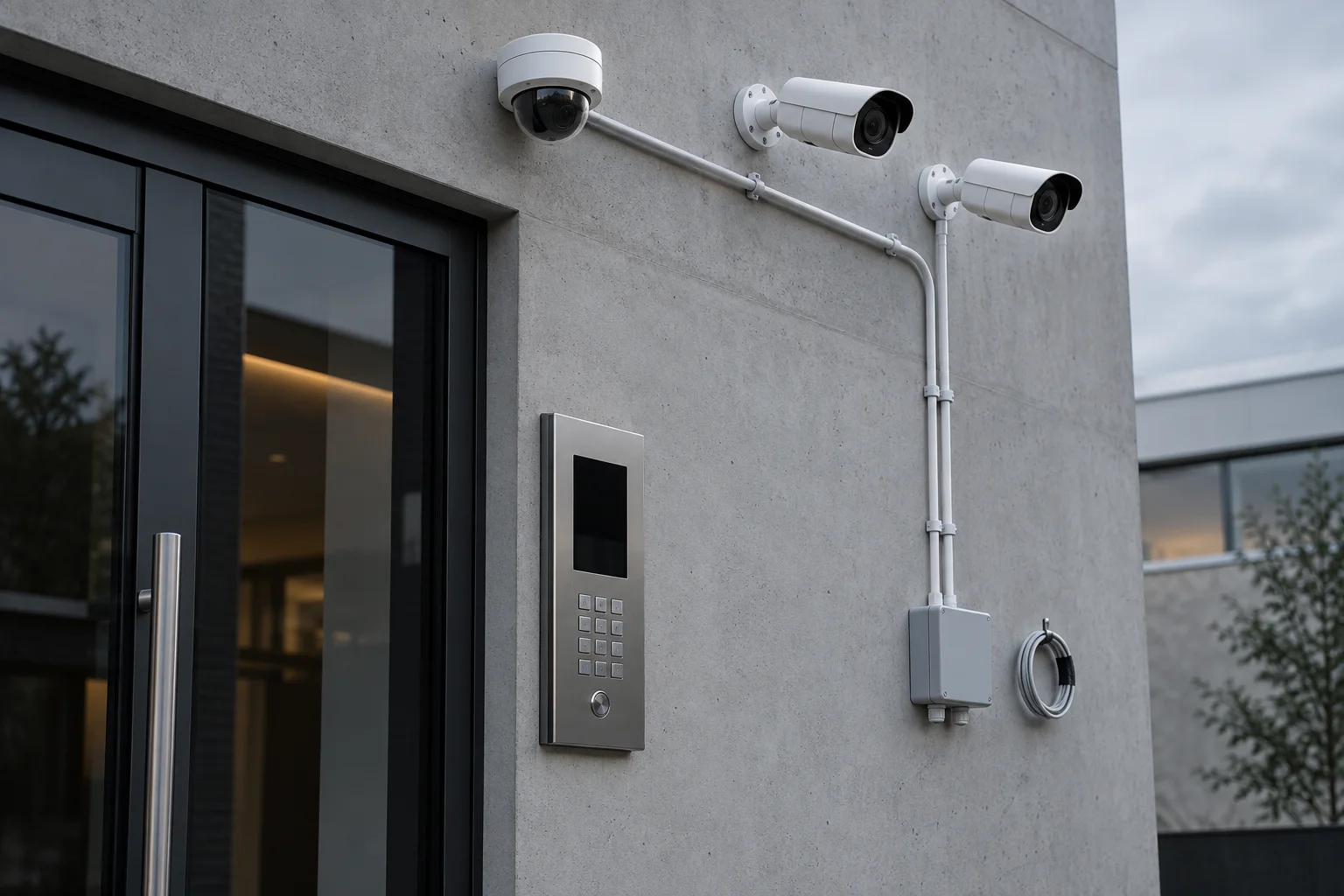
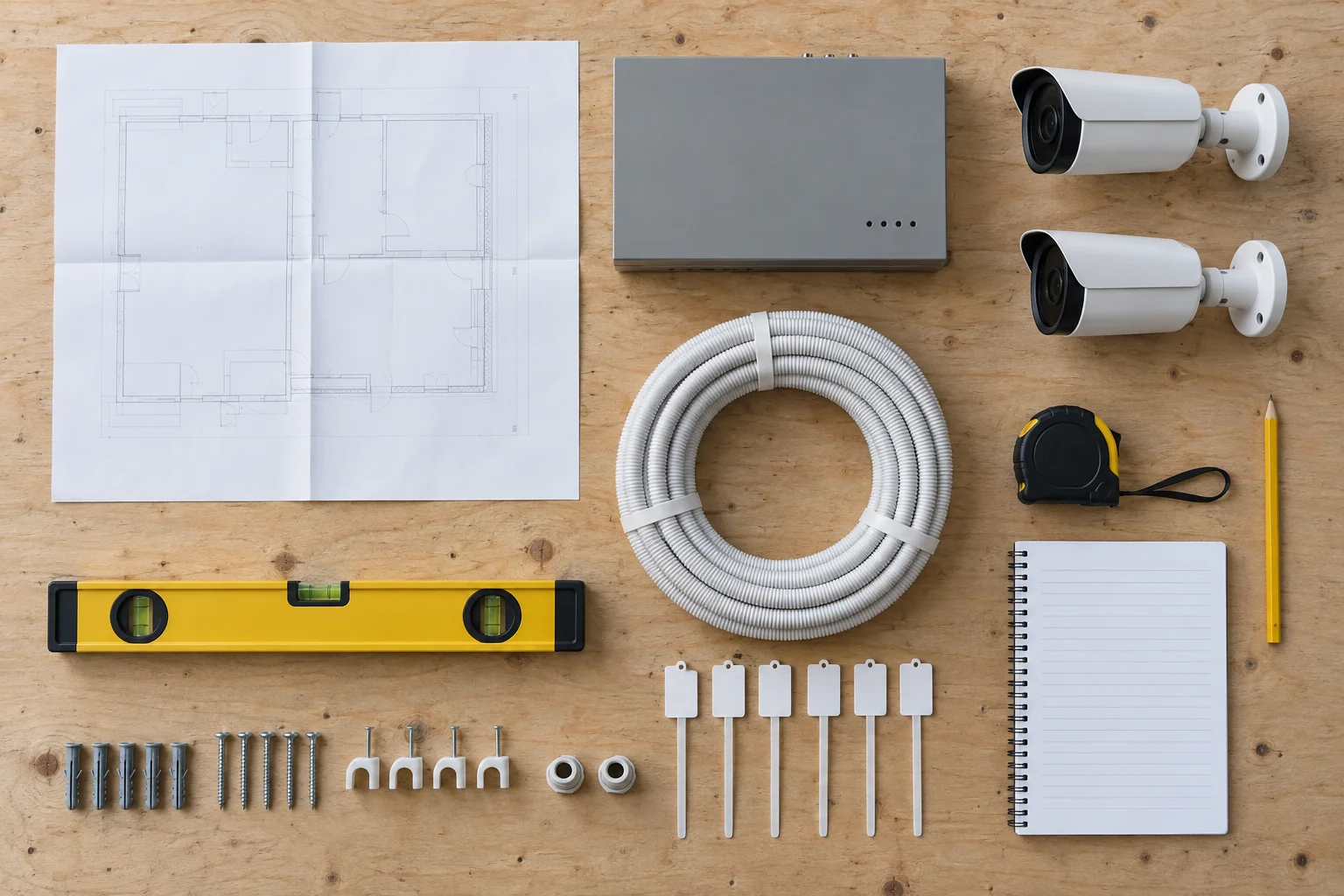
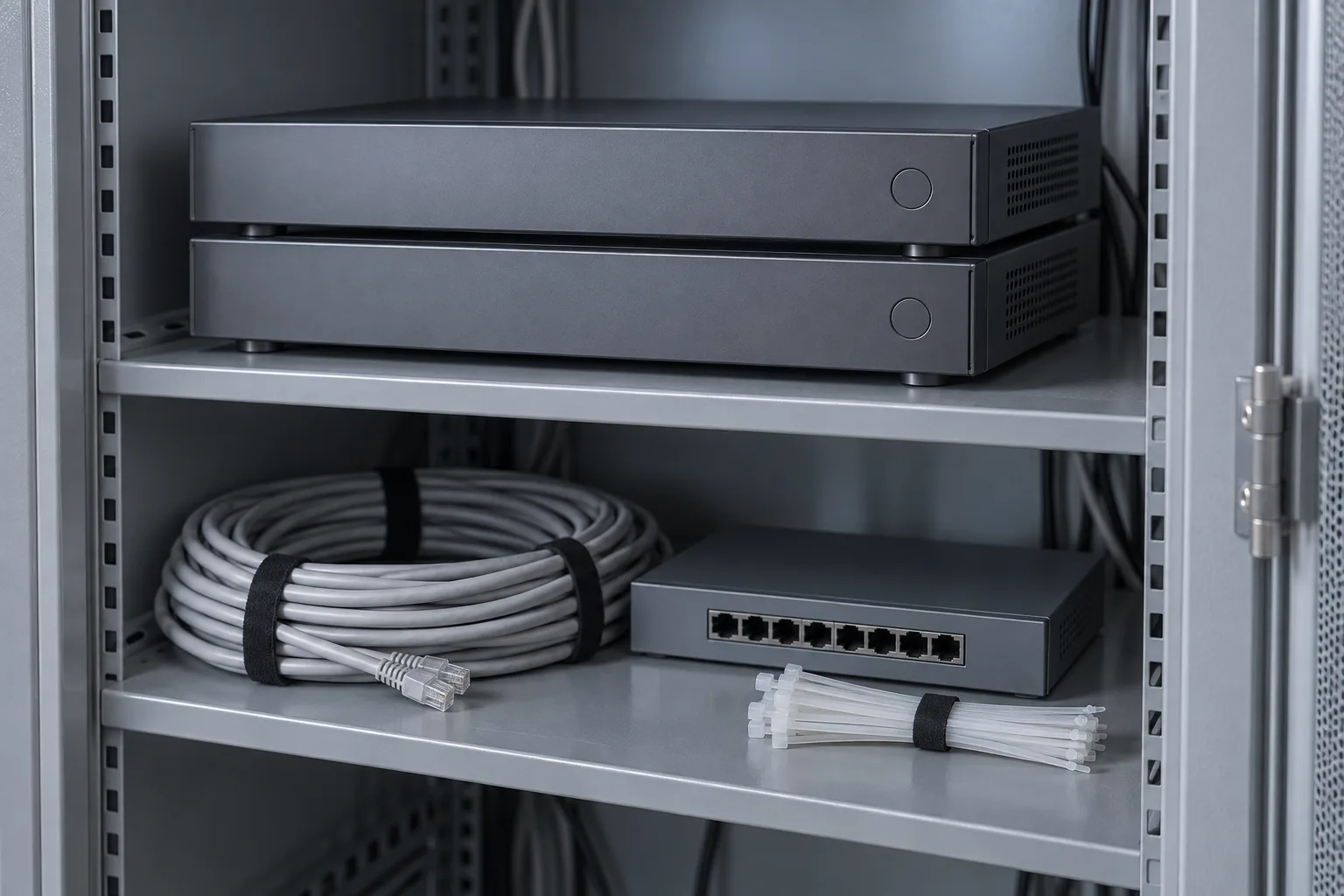
One scoped system for cameras, intercom and door access, quoted from a site visit whose output you keep: the point schedule, the cable route, the recorder position, the retention period and the limits of what the system will not do.
The standard the design is specified to, the registration that covers the personal data your cameras collect, and the public liability cover behind the work are each stated in the quotation with the body that issued them, before anything is ordered.
One architecture
Cameras, intercom, gate and door access and the network they share are designed as one job with one quotation, so a door station that cannot talk to the recorder is our problem rather than a dispute between three suppliers.
Surveyed, not guessed
A camera system cannot be priced from a description or a photo of a door. The visit establishes the points, the route, the recorder position and the retention, and the quotation follows those answers.
What we will not do
We will not quote a figure before the visit and change it on the day, fit a camera to a view you may not record, or describe ourselves as certified in anything we cannot produce a certificate for.
What the work is
Three ways the job arrives.
New systems, additions to a system that already exists, and the maintenance that keeps the recording alive.
A camera install fails on expectations rather than on hardware. These are the limits we put in writing in the quotation, before anything is ordered.
It will not identify what it can only detect
A wide view tells you that something happened. Recognising a face needs a stated distance per point, which is why the schedule carries one.
It will not read a plate at speed in the dark
That is a specialist requirement with its own lens and lighting, designed as its own job rather than promised as a setting on a standard camera.
It will not record what you may not record
Views over a boundary, into a neighbouring window or along a public path are dropped in the survey, and you are told which ones and why.
It will not keep footage it has no storage for
Retention follows storage. The days you choose and the storage they need are stated together, so nobody promises a month on a fortnight of disk.
Where systems fail
The site decides, not the spec sheet.
Two sites with identical cameras behave differently at night. What decides the outcome is where the cameras point, what the light is after dark, and how long footage is kept.
Judged after dark, not on the box
Resolution is a number on packaging. What matters is whether a point resolves what you need at night, so the survey records the lighting on each approach and states what each camera will and will not resolve.
Recognition distance, not field of view
A camera may cover a whole car park and recognise a face only at the gate. The schedule states a distance per point, so a camera that detects is not sold as one that identifies.
Privacy is a design input
What a camera may look at belongs to the design, not to a note afterwards. Where a view crosses a boundary we drop it in the survey and say so, and the notices a site needs are part of the handover pack.
Retention is a decision
Thirty days is a common working figure, not a default we choose for you. We state the period and the storage it needs, and a shorter period is a legitimate answer because it holds less personal data.
The network is part of the system
Cameras, recorder, intercom and access readers share a network and a power budget. Counting them as separate purchases is how a site ends up with a system that works in pieces.
Each of those documents is named in the quotation we write: the standard the design follows, the registration that covers the footage, and the liability cover behind the work, with the body that issued each. Where a job needs a building’s or an authority’s approval, the application stays with you and we say so before the order goes in.
Before a number
What the survey settles.
Some work can be priced remotely and some cannot, and we say which is which on the first call. These four answers are what a quotation for a surveyed system is built from.
The points and their purpose
What each camera has to catch, a face at the gate, a plate at the ramp, a till, a corridor, a loading bay, and where a camera can be fixed to see it.
Route, containment and power
Where the cable runs, what it is concealed in, whether power or PoE reaches each point, and which part of the existing cabling can be reused rather than replaced.
Recorder, storage and access
Where the recorder can live, who holds the footage, how many days are kept, which phones or desks are given a view, and who is taken off that list.
Then the figures
An itemised scope built from the answers above, with the price drivers named and the lead time for this type of site. Nothing is ordered before you have it in writing.
Our side of it
What we put in writing.
Cameras collect personal data and a dead recording fails silently, so these four are settled in the quotation rather than discussed after the van has gone.
Who is on site, and what covers them
Our own installers, named on the schedule, with public liability cover and its limit stated in the quotation. Nobody is subcontracted into your ceiling void or onto your roof without it being named first.
Who is accountable for the footage
The registration that covers the personal data your cameras collect is named in the quotation, along with the export policy: who may view, how footage leaves the system, and what happens to it when the retention period ends.
The warranty, and what cancels it
Two years on our installation work and the manufacturer’s period on the hardware, both in writing. A second installer opening the enclosure, a firmware change made elsewhere, water ingress or building works that move a camera ends it.
What happens when the recording stops
A warranty visit to a system we installed carries no call-out fee, and the maintenance line sets out the check interval in writing, because a stopped recording is discovered by a person looking rather than by an alarm.
How the price is built
Points, route, retention.
Cost follows three things on every site: how many points, how the cable reaches them, and how long footage is kept. Monitoring or maintenance is a separate line so the install figure stays comparable.
Illustrative concept pricing, not a quotation. Each figure is a supply-and-install range for a standard exposed route up to 15 m from the recorder, an existing power point or PoE switch at each point, single-storey access without hoisting, and the retention stated in the row. Excluded: a concealed, underground or ducted route, new containment and making good, a new power point or switch, a recorder or storage upgrade beyond the retention shown, network changes, and any approval a building or an authority requires. Confirm current rates with the installer.
Work
Lead time
From
Camera point Fixed, cabled and commissioned
Homes: one day for up to six points
S$220
Recorder & storage Sized to the retention chosen
Same visit where stock allows
S$600
Intercom or door station Wired to the recorder and network
Homes: same visit. Commercial: by site
S$450
Gate or door access point Reader, controller and release
Same visit where the network allows
S$380
Retention upgrade Storage to the new period, points kept
Booked, one visit
S$300
Monitoring, maintenance or rental Its own line, never bundled into the install
Contract or rolling
S$360
What moves the number: points beyond six on one recorder, a route that is concealed, underground or shared with other services, containment and making good, a new power point, hoisting or scaffold access, and a storage change forced by the retention you choose. Each one is a line in the quotation rather than a surprise on the invoice. Where a site cannot be priced at all before it is seen, we say so and give the visit fee instead of inventing a range. Commercial and multi-site work is quoted per site from the same three drivers, with the lead time stated per site.
Three sites, and what the survey produced
Where the papers came from.
Every job ends with the same set of papers: the point schedule, the route drawing, the retention in days with the storage it needs, and the views that were dropped.
SURVEY OUTPUT / POINT SCHEDULE / TWO-UNIT SHOPHOUSE
Four points, two dropped
Point schedule / Route drawing / Retention set at 21 days
The survey decides which views the system may take before it decides which camera takes them.
What the survey changed ↗
A shophouse frontage across two units. Six points were proposed and four were agreed: two views over the pavement crossed onto the neighbouring unit and came out of the schedule before anything was ordered. The sign's uplighting was re-aimed so the entrance resolved at night instead of silhouetting whoever stood at the door, and the cable followed the existing tray along the five-foot way. Retention was set at 21 days with the storage priced for it in the same quotation.
RECORDER & STORAGE / SIZED TO THE RETENTION / 21 DAYS
Storage, sized to the days
Recorder / Storage / Retention stated in days
Retention is chosen first and the disk follows it, so nobody promises a month of footage on a fortnight of storage.
What the figures looked like ↗
Six points at 4 MP recording continuous motion: 21 days came to a 4 TB drive running at about 70 per cent capacity, which leaves room for the weeks that are busier than usual. The customer had assumed a month was standard; when the storage for 30 days was priced beside the 21, they chose the shorter period because it held less personal data and cost less to power. The recorder went into the back office rack, and the retention figure went into the quotation rather than into a settings menu nobody would open again.
GATE INTERCOM / DOOR READER / ONE RECORDER
Access on the same recorder
Door reader / Entry log / Access list written into the scope
Cameras, a gate intercom and a door reader scoped as one job on one recorder, so an entry and its image are the same event.
What was scoped ↗
A warehouse yard: two cameras on the ramp, an intercom at the gate and a reader on the pedestrian door. Because they share one recorder and one network, the entry log and the video of that entry sit together, and the access list is written into the scope with the person who maintains it. The route used the existing services tray, so trenching and its reinstatement came out of the quotation before it was signed.
Survey, spec, install, hand over.
Survey
Points, route, retention and night views established on site, in writing.
Spec
An itemised scope with the price drivers and the lead time for this site.
Install
Own team on the agreed scope, commissioned point by point.
Hand over
Commissioning record, remote viewing on your devices, warranty and retention.
The visit, and what it produces
Six steps, six documents.
A survey is a job, not a sales call. Each step ends with something you keep, and the quotation is written from those papers rather than from an opinion about your site.
01What the system is for +
The risk conversation: what has happened, what worries you, what has to be caught, and what the site does day to day. Output: a one-page brief of the purpose, agreed before the walkaround.
02Where the cameras go +
A walkaround of every point that must be caught, checked from camera height rather than from the floor. Output: the point schedule, with purpose, position, direction, field of view and a recognition distance per camera.
03Night performance +
Lighting, glare, headlights, and the difference between a lit doorway and a dark yard. Output: a night note stating what each point resolves after dark and which ones need light added rather than a better camera.
04Route, power and recorder +
Cable routes, containment, power or PoE at each point, where the recorder can live, and which existing cabling can be reused. Output: a route drawing with the recorder position, the reused cable marked as reused, and the containment named.
05Privacy and boundaries +
Which views cross a boundary, look into a neighbouring window or cover a public path, and which are dropped for that reason, plus the notices the site needs. Output: a dropped-views list, so nothing ends up quietly pointed at a neighbour.
06Retention, storage and handover +
Retention is chosen, not assumed: the days kept, the bitrate, the number of points and the storage those imply are written together, and the recorder is sized to match. Output: the retention and storage figure in the quotation, then at handover the commissioning record, remote viewing set up on your own devices, a walkthrough for whoever will use it, the warranty terms and the service interval we recommend.
A shopkeeper's view
“They told me before I paid that the camera over the door would not recognise a face at night, and priced a different lens instead of selling me a fourth camera.”
Shophouse frontage, two units · sample story
Sample story. Not a real customer review.
Before you commit
Questions owners actually ask.
Can you quote from photos?+
Sometimes, partly. Adding a camera to a system we installed, or replacing a failed camera with the same model, can be priced from a photo. A new system, a route change, an intercom, or anything that depends on night performance cannot: the answer depends on the site, and a number given from a photograph is a guess that will not survive the first visit.
How long should we keep footage?+
As long as the site uses it, and no longer. Thirty days is a common working figure, twenty-one is often enough for a small shop, and a shorter period holds less personal data. Whatever you choose, the storage is sized to it in the quotation, and we state what happens when the period is reached: overwritten in order, oldest first.
Do we need notices about the cameras?+
Where the site needs them, notices are part of the handover pack. Whether they are required for your premises is one of the things to confirm with the authority that applies to you, because we are not that authority. What we do is state the views the design covers and the ones we dropped, so the question can be answered with the drawing in front of you.
Will it work at night?+
That is decided by light and distance, not by the brand. The night note says what each point resolves after dark. Reading a plate on a moving vehicle at range is a specialist design with its own lens and lighting, and if that is what you need it is quoted as its own job rather than promised from a standard camera.
Who can see the footage?+
As few people as the site can manage, named in the scope. Each viewer is an account, exports are recorded, and a departing staff member is taken off the list as part of the handover. If nobody at the site should hold the footage, the recorder stays off the network and exports run from a local port.
What happens when a camera fails?+
A stopped recording is the failure that matters, because it is silent. The warranty terms and the service interval are handed over with the system, and a maintenance or rental line covers the checks that catch a dead recording before you need the footage. Warranty visits to a system we installed are booked for the next working day, and the maintenance line states the check interval in writing.
Start with the site
Tell us what has to be caught.
Points, access, retention, and what the site does through the day. A floor plan or a photo of the frontage moves the survey along faster.
Concept only. Nothing is sent or booked, and no one is dispatched.