A year of scheduled servicing sold as a product: the visit count, what each cover level contains, the attendance window when a unit fails, and the record you keep after every visit.
Every option below is the same visit at a different cadence. What changes is how often we attend, what the visit contains and what you keep afterwards.
An annual plan is priced from the unit count, the property, the visit frequency and whether a contract is already running. This narrows all four before anyone travels, and nothing is submitted until you send it yourself.
What we need to price the year
How many indoor units are in scope, and how they are mounted — wall, cassette or concealed
What the property is: a home you occupy, a unit you let out, or a commercial site with trading hours
The cadence you want: two, four or twelve visits a year, per unit
Whether an existing contract is still running, and the month its notice period ends
What you get back
A per-unit annual rate for each cadence you asked about, in writing
The visit schedule with the months named, not a number of visits to be arranged later
The rate your unit count qualifies for, and the count at which it drops to the next band
The attendance window for a breakdown, as it will be written into the agreement
Three shapes of term, each with the unit count, the cadence and the document that comes back every round.
OFFICE BUILDING / 96 FAN-COIL UNITS / QUARTERLY ROUNDS
Office building on a commercial contract
96 units · quarterly rounds · one named contact
Twelve floors of mixed indoor units, serviced on night rounds because the building is occupied every weekday.
How the term is written ↗
Rounds sequenced floor by floor from the site walk, a per-unit rate fixed for the term, a capped allowance for recovery work found on the first round, a report after every round and the annual condition audit for the facility file.
MULTI-UNIT SITE / 4 VISITS A YEAR / REPORT PER VISIT
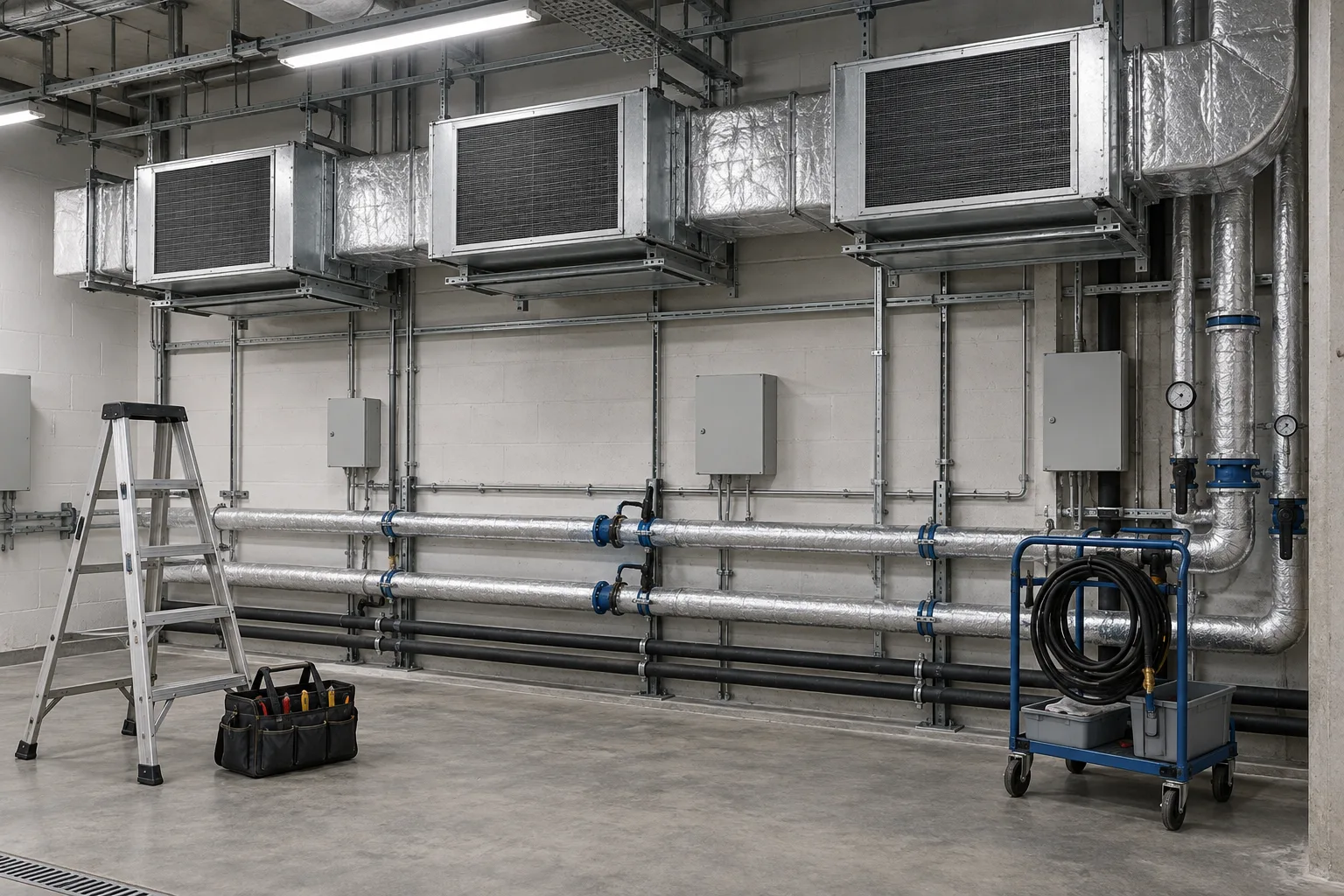
Plant room and risers on a plan
12 units · 4 visits a year · from S$246 a unit
Ducted and cassette units on one schedule, attended outside trading hours so the site never closes for a service.
What each round covers ↗
Filter clean and drainage flush at every unit, coil surfaces cleaned mid-year, insulation and mounting checked, operating readings logged, and anything found costed and approved before it is touched.
14 apartments · 2 visits a year · from S$138 a unit
Systems in units nobody occupies full time, where the real risk is a defect a tenant finds before we do.
How the portfolio is scheduled ↗
Visits booked in a window the tenancy agrees to, defects costed as a variation and approved in writing, and the plan held against the unit so it survives a change of tenancy.
Know what happens next.
Send the unit count
Indoor units and how they are mounted, the site type, and the postal code that decides which round you fall on.
Survey, at no charge
Access, ceiling height, the drainage route and where the isolators are — on a commercial site this happens before any figure is fixed.
A per-unit rate and a schedule
The cadence, the months we attend, the checklist per visit, and the unit count at which the rate drops to the next band.
Term and exit in writing
Twelve months, the notice period, and what happens to unused visits if the units change hands.
A record, every visit
Readings per unit, what was cleaned, what was found, and the annual condition audit that consolidates the twelve months.
The service level
What a visit contains, and what you keep.
A plan is only worth the visit behind it. So the visit is specified, the attendance window is written down, and every attendance ends with the same set of documents.
Every scheduled visit
Filter clean, accessible coil and blower surfaces, drain pan and drainage flush, a pressure and temperature reading per unit, a check of insulation and mounting. The record set below is handed over at the end of it.
The record set
A visit sheet per unit with the readings before and after; the filter and drainage record; the parts used and priced; photographs of anything that needs a decision; and the name of the engineer who attended. At the end of the term the annual condition audit consolidates the twelve months into one document a facility file can hold.
Higher cover adds
Chemical coil wash on a stated cycle, condensate line clearing, an electrical connections check, and the annual condition audit that consolidates the year.
Season sets the depth
The checklist has a major and a minor version. Which one you get depends on the cover level and the time of year, and it is written into the agreement rather than decided on the day.
When a unit fails
The agreement states the attendance window for a breakdown, and plan holders are attended ahead of non-contract work. A diagnostic visit is charged once, and its finding decides the repair rather than a replacement.
Units added mid-term
Units added during the term join at the same per-unit rate and are visited on the next round. Nothing is added to an invoice without a written instruction first.
Two contract types, two risk positions
Preventive only: scheduled labour and cleaning, with repairs and parts costed as they arise, so the repair risk sits with you. Parts-inclusive: a stated allowance for parts and refrigerant inside the fee, with anything beyond it costed. We will tell you which of the two we are quoting before you compare the prices, because an inspection-only agreement is not a preventive one and should not be sold as if it were.
Frequency chosen by runtime
Units running eight hours a day or more go on quarterly visits; bedrooms running under about six hours a day go on half-yearly visits; heavy use, dusty sites and hospitality premises go monthly. The runtime assumption behind your visit count is printed in the quotation, so you can disagree with it before you sign.
The round is decided by the address, and the survey comes first
Attendance is scheduled on rounds that already run past your address. A site outside them is quoted as its own trip at a stated rate rather than folded into the plan rate as a hidden loading.
A commercial site is surveyed before it is quoted, at no charge: unit count and type, access and ceiling height, the drainage route, and where the isolators are.
Survey visits are named as their own lines in the quotation, so you can see how many are included.
Records are the point of a plan. Your visit sheets accumulate into the servicing history that a warranty condition is checked against, and we will read your warranty document and your lease with you and write the plan to match what they ask for.
The rate basis
Published per unit, then per site.
Two numbers decide a plan: how many units, and how many visits a year. The rates are written per unit so you can multiply them yourself, and every plan is printed with its monthly equivalent and its annual total.
Illustrative concept pricing, not a quotation. Each figure is a per-unit annual rate for a standard wall-mounted unit in ordinary condition, attended on a single-visit round within normal hours with reasonable access. The monthly column is that annual rate divided by twelve, offered as a payment basis of the same term, not a second price. Cassette, ducted and ceiling-concealed units, night-only windows, recovery work on the first round, refrigerant beyond the stated allowance and after-hours attendance are quoted separately. Confirm current rates before you commit.
Plan
What the visit contains
Per unit, a year
Or monthly
Two visits a year Light use, bedrooms
Filter clean, drainage flush, pressures and temperatures, a written record each visit
S$160
S$13.33
Four visits a year Standard home, ordinary use
Adds a mid-year coil surface clean and a check of insulation and mounting
S$290
S$24.17
Twelve visits a year Heavy use, hospitality, dusty sites
Adds one chemical coil wash and the annual condition audit
S$760
S$63.33
Commercial contract Per site, quarterly rounds
Scheduled rounds, one named contact, a report per round, the yearly audit
From the matrix below
Illustrative concept pricing, not a quotation. The same three cover levels, laid out so you can read down a level and see exactly what it adds. Figures are the per-unit annual rates above. Confirm current rates before you commit.
Included
Two visits S$160 a unit a year
Four visits S$290 a unit a year
Twelve visits S$760 a unit a year
Scheduled visits at the agreed cadence
2
4
12
Filter clean and drainage flush, every visit
✓
✓
✓
Pressure and temperature readings, per unit
✓
✓
✓
Visit sheet and record set handed over
✓
✓
✓
Priority attendance ahead of non-contract work
✓
✓
✓
Mid-year coil surface clean
–
✓
✓
Insulation and mounting check
–
✓
✓
Chemical coil wash
–
–
1 a year
Annual condition audit for the facility file
–
–
✓
Illustrative concept pricing, not a quotation. Rates are per unit unless the basis says otherwise, are charged only when the work is instructed, and sit at the preferential rate the plan already holds. Confirm current rates before you commit.
Priced separately
Basis
From
Scheduled service, no plan
Per unit, one visit, no term
S$105
Chemical coil wash
Per unit, outside the tier that includes it
S$180
System overhaul
Per unit, quoted from the inspection finding
S$320
Diagnostic visit
Per visit, outside the plan
S$95
Night or after-hours attendance
Per visit, added to the visit rate
S$120
Illustrative concept pricing, not a quotation. Assumes one site attendance per round, units of a single type and size, and access during the site's normal hours. Above sixteen units the rounds are scheduled after a walk-through, because access and unit type change the round more than the unit count does. Confirm current rates before you commit.
Units on site
Two visits a year
Four visits a year
Monthly, four visits
1–2 units
S$160 per unit
S$290 per unit
S$24.17
3–5 units
S$150 per unit
S$270 per unit
S$22.50
6–15 units
S$138 per unit
S$246 per unit
S$20.50
16 units and above
S$125 per unit
S$220 per unit
S$18.33
The same unit, paid per visit
One scheduled service outside a plan is S$105. One breakdown outside a plan is a diagnostic visit at S$95 plus the service on top — call it S$200.
A unit that is serviced twice a year on no plan and breaks down once therefore costs about S$410 for the year. The same unit on the four-visit plan costs S$290, and is visited twice more than that.
Run the comparison against your own year, and we will run it with you: if the unit needs nothing beyond its scheduled visits, we will say so, and the cheaper answer is the one we will quote.
What moves the number: unit type and count, the access window, the condition of the plant on the first round, refrigerant beyond the allowance, and any escort or hoisting time the site requires. Two things are quoted rather than printed — recovery work on a neglected system, and anything on a site we have not walked. Both come back in writing with the assumption each one rests on. A site above sixteen units, or more than one property, is quoted as its own round from the same per-unit basis; send the unit count and the postal code and the figure comes back the same day.
Written scope
Inside the term, outside it.
Both lists are agreed before the first round, because the exclusions are where a plan invoice grows.
Scheduled visits at the agreed cadence, with the checklist stated per visit
Cleaning labour, water and standard consumables for the visit
The drainage flush and drainage checks listed in the schedule
Readings per unit and a written record after every visit
Priority scheduling ahead of non-contract work, at the attendance window in the agreement
The annual condition audit where the tier includes it
Outside it, unless the tier names it
Chemical wash, overhaul and deep cleaning
Parts, boards, motors and compressors — costed with the finding, approved before work
Refrigerant beyond the stated allowance, and any leak repair
Piping or insulation replacement, and any new installation
Night or after-hours attendance, at the rate in the table above
Access works, hoisting or escort time the site requires
Nothing proceeds on approval by silence: a costed finding is sent to you, and the work starts when you say so in writing.
Who signs, and what is in the agreement
Credentials, not badges.
A plan is a twelve-month relationship, so what is written into the agreement matters more than what is printed on a van.
Written into the agreement
The registered company name and registration number, printed on the quotation
Public liability cover, with the insurer and the limit named, and the certificate sent with the document
Who attends the rounds: employed or subcontracted, and who supervises a multi-unit site
The term, the exit notice, and what happens to unused visits if the units change hands
The workmanship period that applies to a visit, and what voids it
Held by you for the term
The visit sheets: readings, what was cleaned, what was found, and who attended
The parts record, priced as instructed rather than as discovered
The photographs of anything that needed a decision
The annual condition audit, in a form a facility file or a warranty claim can use
The signed scope: what the fee covers and what it does not
The registration number, the insurance certificate and the workmanship period go out with the agreement. Where a licence or a registration applies to the work — refrigerant handling, electrical connections, working at height — the number and the issuing body are printed on the same page, and the documents go out with it.
A facility manager's view
“The rounds happened on the nights we agreed, and the report named every unit. Four defects were caught before a tenant found them.”
96-unit office contract · sample story
Sample story. Not a real customer review.
Terms and objections
Before you sign a term.
Term
Twelve months from the first scheduled round, priced per unit for the whole term.
Exit
Written notice sixty days before the renewal date. Stopping earlier ends the plan on the date the notice states, and unused visits either move to another property you hold or are credited pro rata.
What breaches it
Access refused for two consecutive scheduled visits, work commissioned on the plant by another party without notice, or unauthorised work on a system under the plan followed by a claim for the damage. Each one is written into the agreement rather than applied quietly.
Payment
Monthly, quarterly, or in full at the start. The invoice separates scheduled visits from any approved variation.
Why pay for visits we may not need?+
Because the alternative is finding out at the worst moment, and the arithmetic is above: a unit serviced twice a year and attended once for a breakdown runs to about S$410 outside a plan, against S$290 for the year on the four-visit plan. What the fee buys beyond that is attendance ahead of non-contract work, a per-unit record of what the plant has been doing, and a servicing history that your warranty condition can be checked against.
Can we pay monthly rather than for the year?+
Yes. The monthly figure in the table is the annual rate divided by twelve, on the same twelve-month term — S$24.17 a month per unit on the four-visit plan, S$13.33 on the two-visit plan. Nothing is added for paying monthly, and stopping early is the exit notice in the agreement rather than a penalty.
How often do we actually need a visit?+
Count the hours the units run. Eight hours a day or more is a quarterly cadence, under about six hours a day is half-yearly, and heavy use, dust or hospitality premises go monthly. The runtime assumption we used is printed in the quotation, so you can disagree with it before signing rather than after the first round.
What happens when a unit fails?+
Report it and the attendance window in your agreement applies, with plan holders attended ahead of non-contract work. A diagnostic visit is charged once; the finding is costed, and repair, replacement or no action stays your decision. Out-of-hours attendance is available at the stated rate rather than by negotiation.
What is never in the plan?+
Chemical wash and overhaul unless your tier names them, parts and boards, refrigerant beyond the allowance, leak repair, piping replacement and new installations. All of it is costed before it starts, and none of it is added to an invoice afterwards.
Can one contract cover a building, or several units?+
Yes. Multi-unit sites get one schedule, one named contact and a per-unit rate that falls as the count rises. Sites above sixteen units are scheduled after a walk-through, because access and unit type change the round more than the count does.
What do we receive after each visit?+
A visit sheet naming every unit attended: the readings taken, what was cleaned, what was found, and the engineer who attended. Parts used are listed and priced as instructed, and at the end of a year the condition audit consolidates the twelve months into one document a facility file can hold.
Start with the site
Tell us the units. We will price the year.
Give us the unit count, the unit types and how the site is used. A commercial figure follows a walk-through; a residential plan can be priced straight from the matrix above.