Calm dental treatment room with a grey chair, instrument cart and daylight through a sheer curtain
COMPONENTS, NAMED / CONCEPT PRACTICE

Implants & restorative · Staged treatment, staged payment

Built in stages.
Priced the same way.

Assessment and scan, surgery, the graft if it is needed, then the abutment and the crown — each stage priced on its own line, so you know what you are paying for before it is done.

Book a consultation
Staging
Priced per stage, billed per stage
Urgent cases
A loose crown or a painful implant, seen same week
Quotes
System, crown material and warranty in writing
Implant assessmentCrowns & bridgesFailed workWhy there are no before-and-after photos ↓

The rules we work under

What a clinic
may not publish.

Healthcare advertising in Singapore is regulated. That is why this page carries no photographs of anyone’s teeth, no patient reviews and no claim about how long a restoration will last — and it is worth knowing before you judge a clinic by its website.

Not allowed

  • Photographs or videos showing anyone’s appearance before and after treatment, or after only.
  • Patient reviews, testimonials or endorsements of the service or of a clinician.
  • Superlatives and claims of prominence — “best”, “leading”, “most advanced”.
  • Comparing one clinic’s service with another’s, or claiming a saving over another clinic.
  • Success rates, percentages of fixtures that integrate, or “lasts a lifetime”.
  • Anything that creates an expectation of a particular outcome, or urgency invented to hurry a decision.

Allowed, and published here

  • What a procedure involves, its risks and the alternatives to it.
  • What a fee includes, what is billed separately, and the price of each stage.
  • The implant system and the crown material, named in writing on your quote.
  • Who treats you, and the qualification you can check.
  • Appointment times, branch hours, transport and parking.
  • Warranty terms, what voids them, and the maintenance visit they depend on.

What we publish about the practice

  • Who places the fixture and who makes and fits the restoration, with the registration to check.
  • How many implant cases the practice places in a year — a capacity number, used as a fact and not as a quality claim.
  • Which laboratory makes the crown, because the laboratory is part of the price.
  • How instruments are sterilised, and which items are single-use.
  • Whether the practice holds any certification or accreditation you ask about — answered plainly, including when the answer is no.
  • No award is claimed here. If one were, the awarding body and the year would sit next to it.

What treatment cannot promise

  • That the bone will accept the fixture. Integration is what the months of healing decide, not the surgery.
  • That the final teeth feel like the ones you lost. Sensation does not come back, and bite force is not fully restored.
  • That a graft is avoidable. If the bone is short, it is a stage of the plan rather than an optional extra.
  • That a crown is permanent. It wears, and it is replaced on a cycle rather than once.
  • That a fixture cannot fail early. It can, and removal has a published price.
  • That smoking or untreated gum disease leaves the plan unchanged. Both are stated in the limits before booking.

The advertising rules for healthcare in Singapore are published, and they change. This page summarises what we choose to do under them; confirm the current requirements with the relevant authority, and read any clinic’s claims against them.

Three scopes, priced separately

One tooth, several,
or a full arch.

The cheaper routes, on the same axis

An implant is one answer, and it is usually the most expensive one. These are the others, with the trade-off stated rather than buried — every figure is in the same fee table below.

  • A removable denture. The lowest cost, replaced as the jaw changes, and it can move while you eat. It is a reasonable answer where several teeth are missing and bone is already reduced.
  • An implant-retained denture. Two to four fixtures hold a denture that clips on. It costs more than a denture and less than a fixed bridge, and it comes out at night to be cleaned.
  • A bridge on the neighbouring teeth. Cheaper than an implant and faster, but it means preparing two healthy teeth and replacing the whole bridge when one part fails. Where the neighbouring teeth are already restored, the argument for it is stronger.
  • Doing nothing for now. Sometimes the honest answer where the missing tooth is at the back, the bite is stable and the bone is being monitored. We will say so rather than sell the surgery.

What each stage costs

The total is built
out of stages.

Every stage is priced on its own line and billed as it happens. The first appointment is priced because it produces something: a measurement, a written plan and a staged quote you can take away.

Illustrative concept pricing, not a quotation. Figures are stage ranges for a single-tooth case in a healthy mouth with adequate bone, one fixture and a mid-tier or premium system as the row states, and they exclude extraction of the tooth being replaced, sedation, and any work on the neighbouring teeth. Full-arch and denture figures are per arch. Sedation, grafting beyond the stated range and additional fixtures are quoted as separate lines. Confirm the practice’s current fee schedule and the implant system your quote covers before the surgery.
StageWhat it coversFrom
Stage 1 — assessment, scan and plan
One visit · an X-ray or a CBCT scan is taken
Examination, imaging, the bone measurement, a written plan naming the fixture tier and the crown material, and a staged quote. The scan is read with you, and a copy leaves with you on request.S$150–S$350The scan copy included once it has been read
Stage 2 — surgery
Surgery day · 60 to 90 minutes
Placement of the fixture with the surgical kit, local anaesthesia and the post-operative instructions. The brand, the lot number and the system are written on the quote and on the warranty document.S$2,400–S$4,200Mid-tier system at the lower end, premium system from S$5,200 to S$6,400 in total for stage 2
Stage 3 — graft or sinus lift, if the plan calls for it
Same visit or a separate one
The graft material and the extra surgical time, with the measurement that makes it necessary stated in the plan rather than discovered in theatre.S$600–S$2,500Not optional where the bone is short
Stage 4 — abutment and crown
Fitted 3 to 6 months after surgery
The abutment, the impression or intra-oral scan, the crown in the material the plan states — metal-ceramic, zirconia, or lithium disilicate (e.max) — and the bite adjustment at fitting.S$1,600–S$3,200A zirconia crown upgrade is priced inside this range
Stage 5 — reviews and the warranty document
Through healing, then the first-year review
Review appointments while the fixture integrates, the annual maintenance visit, and the warranty issued as a document with its term and its conditions.Included in stages 2–4Annual maintenance after the first year: S$150–S$250
Implant-retained denture
Per arch · two to four fixtures
The fixtures, the abutments the denture clips onto, the denture itself and the fittings during healing.From S$7,000 per arch
Full-arch fixed bridge
Per arch · four to six fixtures
Everything in stages 1–5, the provisional bridge fitted on the surgery day, and the final bridge three to six months later.From S$18,000 per arch
Removal of a failed fixture
Where a fixture does not integrate
Removal and the curettage of the site, with or without grafting.S$1,200–S$1,500S$1,500–S$1,800 where grafting is done at the same time

Inside the quote, and billed separately

  • Inside: the stages listed above, the review appointments through healing, the annual review in year one, and the warranty document.
  • Separately: extraction of the tooth being replaced, IV sedation at S$400–S$800, a zirconia crown upgrade at S$400–S$900 over a metal-ceramic crown, a custom abutment at S$300–S$500, and any additional fixture.
  • Separately, and often assumed: grafting, where the next step is not possible without it. The plan states the measurement and the range before you decide, and it never appears on an invoice as a surprise on the day.
  • Claimable lines: part of the surgery may be claimable from MediSave — a single implant is capped at about S$1,950, made up of an S$1,120 surgical component and up to S$830 of day-surgery costs, and the practice files the claim. The fixture, the crown and the graft are not claimable. Ask which lines of your quote are claimable before the surgery, and ask who files the claim and when.
  • Systems we quote, by name: on the mid-tier rows, Osstem (TS III), MIS (C1) and Neodent (GM); on the premium rows, Straumann (BLX) and Nobel Biocare (Parallel Conical Connection). The fixture brand and its catalogue reference are written on your quote and on the warranty document. If you already carry a named system on the other side of your mouth, name it and we will quote the same one rather than a different product at a similar price.

Add-ons, and what we would say about each, line by line

Illustrative concept pricing, not a quotation. Each line is the difference over the figure in the stage table above. Whether an add-on is worth paying for depends on which tooth it is, and that judgement is stated rather than left to the chair. Confirm current prices and the system your quote covers with the practice.
Add-onWhat it changesCost, and whether we would pay it
Premium implant systemA named premium brand — Straumann or Nobel Biocare — over a named mid-tier one such as Osstem, MIS or Neodent: the fixture and its published track record, not the surgical procedure around itS$1,000–S$2,000 more. Worth it where the site is difficult or a failure would be costly to fix; on a routine single tooth a mid-tier system from a named manufacturer is the reasonable buy
Custom abutmentThe angle the crown comes out at, and how well it seats on the fixtureS$300–S$500 more. Worth it on a front tooth or an angled fixture; a stock abutment is usually fine further back
Zirconia instead of metal-ceramicAppearance, no dark edge at the gum, and less wear on the tooth oppositeS$400–S$900 more. Worth it where the crown can be seen when you smile; elsewhere the metal-ceramic crown is the cheaper, serviceable answer
IV sedationHow the surgery feels, not how it turns outS$400–S$800. Worth it if you know you do not tolerate surgery; not something to choose by default
Bone graftWhether the fixture can be placed at allPriced in stage 3. Not an add-on to decline where the plan shows the bone is short — ask for the measurement in millimetres and what it means for the fixture length

Paying as the stages happen

Illustrative concept pricing, not a quotation. The schedule below shows when each payment falls due on the worked example of S$4,950 in the note underneath. A practice may set its own deposit percentage and terms; ask for the schedule in writing with the staged quote, and ask what is refundable if the plan stops after the assessment.
Payment momentWhat triggers itWhat is due
At the planWhen you accept the plan and the surgery slot is secured10–20% of the surgical stage — S$420 on the worked example below
On the surgery dayThe day the fixture is placed, including any graft done at the same timeThe balance of the surgical stage — S$2,380 on the example
At the crown stageWhen the impression is taken and the final crown or bridge is fitted, three to six months laterThe restorative stage — S$1,900 on the example. Finance, where it is used, can start here on the balance rather than on the whole fee
MaintenanceAnnually, from the second year, as a condition of the warrantyS$150–S$250 a year, stated in the warranty document

Worked example, single tooth, mid-tier system: stage 1 S$250, surgery S$2,800 and the crown stage S$1,900, which is S$4,950 in total. Paid as the stages happen that is S$420 at the plan, S$2,380 on the surgery day and S$1,900 when the crown is fitted — nothing is billed before the stage it pays for, and if the plan stops after the assessment you pay for the assessment. Where the surgical stage is claimable from MediSave, the claim is filed at the surgery rather than refunded later.

Three scopes, staged and named

How a case is qualified,
and staged.

An implant quote is defensible when the stages, the system and the warranty are all on the same page. Each scope below shows what sat on each line, which materials were named, and which decision would have moved the total.

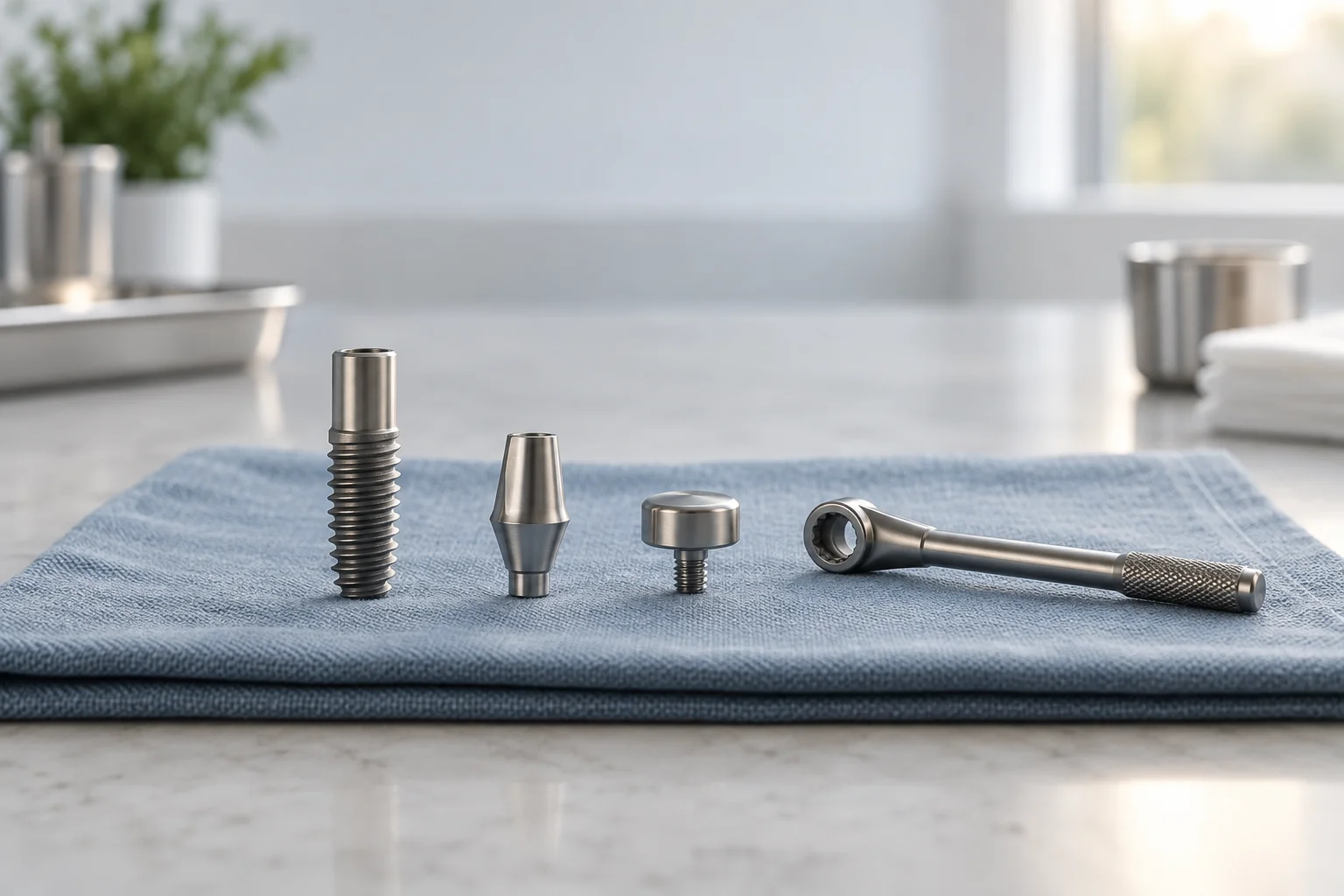
Illustrative implant components on a sterile cloth: a titanium fixture, an abutment, a healing cap and a torque wrench
SINGLE TOOTH / FIVE STAGES / 4–6 MONTHS

One tooth, five stages

Assessment / Fixture / Abutment and crown

Every stage is a line on the quote and a payment moment, so nothing is billed before the stage it pays for.

One tooth missing at the front ↗

The assessment measured the ridge and found the bone adequate, so no graft was planned. The bridge on the two neighbouring teeth was priced alongside the implant and named as the cheaper route; it would have meant preparing two sound teeth and replacing the whole bridge when any part of it failed. The staged quote read S$250 for the assessment, S$2,800 for the surgery, S$1,900 for the abutment and crown, and S$180 a year for maintenance from the second year. What would have moved it: a graft, or a decision to treat the neighbouring teeth at the same time.

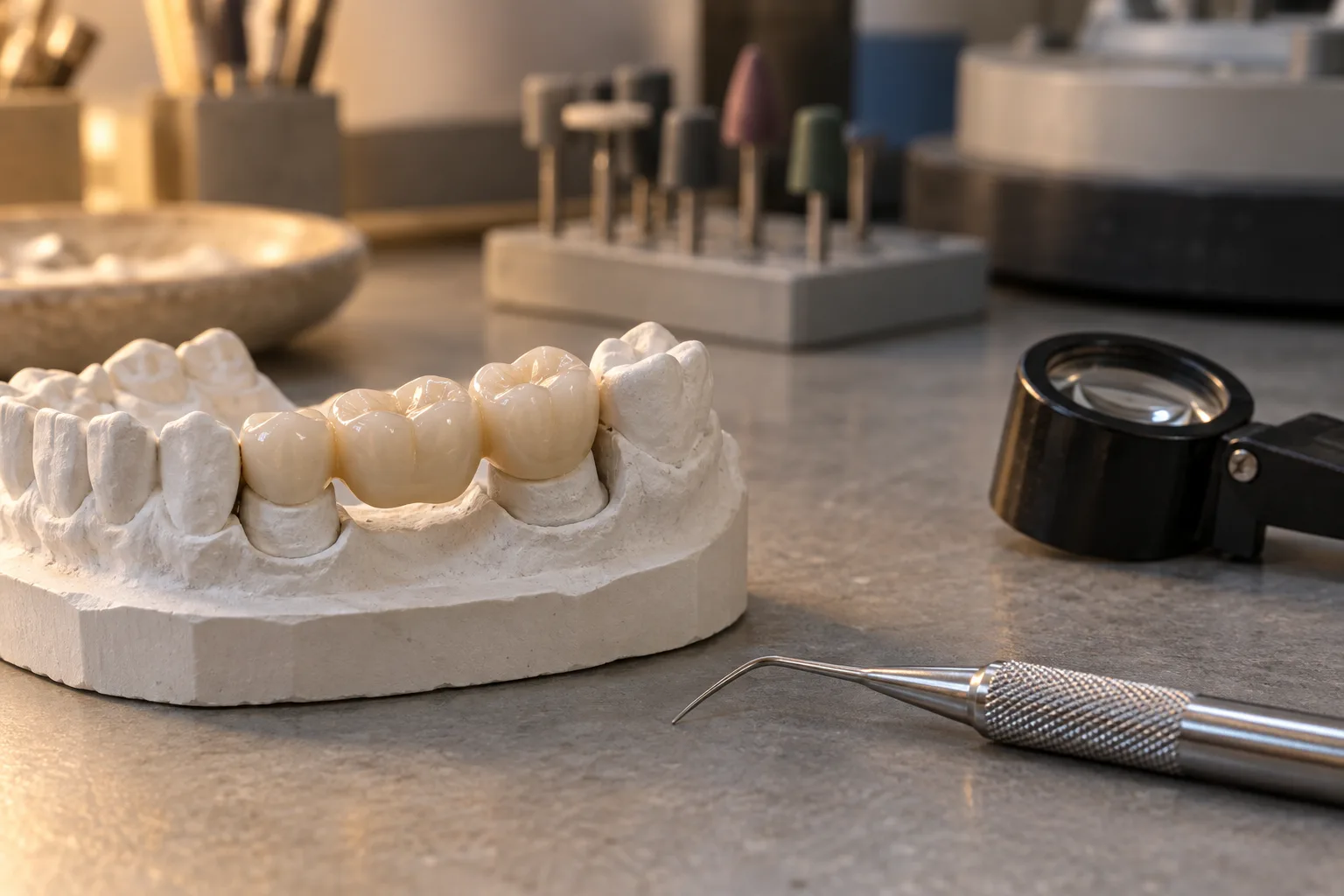
Illustrative three-unit ceramic bridge resting on a white plaster dental model on a laboratory bench
IMPLANT BRIDGE / TWO FIXTURES / THREE UNITS

A bridge on two fixtures

Two fixtures / Three-unit bridge / Zirconia or metal-ceramic

Where several teeth are missing in a row, two fixtures can carry a bridge instead of one fixture per tooth.

What the bridge costs and what it gives up ↗

Fewer fixtures means less surgery and a lower total than one fixture per missing tooth. It also means a longer span to clean underneath, and if one part of the bridge fails the whole unit comes off, which the plan states rather than leaves to be discovered. The bridge material is named on the quote — zirconia where it will be seen, metal-ceramic behind — and the laboratory that makes it is named with it.

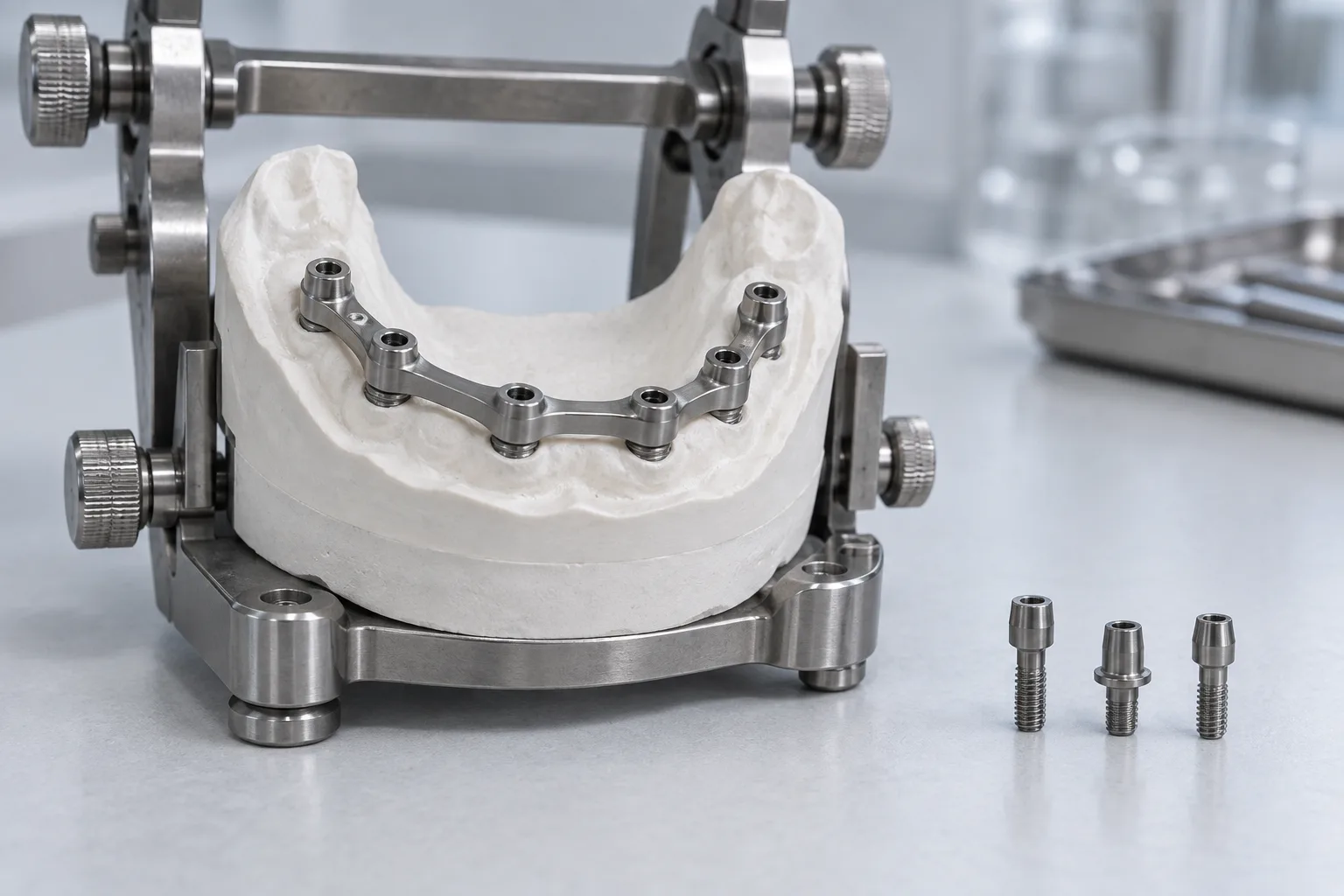
Illustrative full-arch dental model on an articulator with a titanium bar fitted across it and component screws beside it
FULL ARCH / FOUR TO SIX FIXTURES / TWO FITTINGS

A full arch, in two fittings

Provisional on the surgery day / Final bridge at 3 to 6 months

A fixed provisional bridge goes on the day the fixtures go in, so no working day is spent without teeth.

A worn full arch ↗

Four fixtures, planned with a provisional fixed bridge on the surgery day so that no working day was spent without teeth, and the final bridge fitted four to six months later once the fixtures had integrated. The plan named the material of the final bridge, what the provisional would be made of, the system and lot number of each fixture, and the fees for every stage including the reviews in between. What would have moved it: six fixtures instead of four, or a decision to wear a removable prosthesis during healing and defer the fixed bridge.

Ask about your own case

They show how a case is qualified, staged and named — and no before-and-after photographs appear in this section or anywhere else on the site.

Who does the work

A name, a role,
and a qualification.

Who places the fixture

The clinician who performs the surgery. Ask for the name and check it on the register, with a current practising certificate, and ask whether the same person completes the restoration or hands that stage to someone else.

Who makes the crown

The laboratory is part of the price and part of the fit. Ask which laboratory makes the crown or bridge, what material it will be, and whether the laboratory is named on the quote — a named laboratory is a line you can question.

A live practice page would name its laboratory and the materials it uses.

Who does which part

Extraction and grafting are the surgeon’s, the fixture is the surgeon’s, and the impression, the abutment choice and the final crown are the restoring clinician’s. Full-arch cases are planned with a prosthodontist involved, and where the site needs a specialist assessment that fee is theirs and quoted separately.

A map of who does what, so nothing is decided at the chair without you knowing who decided it.

Capacity, stated

How many implant cases the practice places in a year, and how many clinicians place them. Those are capacity numbers and they are not a claim about quality — but they predict how long a review takes to book and who answers when something goes wrong in the healing months.

Examine, explain, agree, review.

  1. Examine

    History, examination and imaging where it is needed for a diagnosis.

  2. Explain

    Findings in plain language, with the options and the risks of each.

  3. Agree

    Fees confirmed in writing, and nothing started without your decision.

  4. Review

    A recall interval set to your mouth rather than to a fixed calendar.

Read this before you book

Who this is
not for.

A published limit is more useful than a promise. These are the situations where a fixture is the wrong answer, or the wrong answer now — and what happens instead.

  • Inadequate bone. A graft is planned first, or the site is left alone. The plan shows the measurement that decides it.
  • Active gum disease. Treated and stabilised first. Placing a fixture into untreated gum disease is how early failure happens.
  • Uncontrolled diabetes. We ask for the condition to be managed and, with your consent, a note from the doctor treating you before surgery.
  • Heavy smoking. It reduces the blood supply the bone needs to integrate. Stopping before surgery is the single most useful thing you can do; a plan that ignores it is a plan that fails quietly.
  • Grinding, untreated. A night guard is planned, because the final crown fails before the fixture does.
  • A site where the alternatives are better. Sometimes a bridge or a denture is the honest answer, and the plan says so with the numbers next to it.
Surgery day
60 to 90 minutes, local anaesthesia, home the same day
First two weeks
Soft diet, review at day 7 to 10, what to do if it swells
Healing months
3 to 6 months while the fixture integrates
What you wear meanwhile
A temporary crown, or the denture you already have, adjusted
Final crown or bridge
Fitted three to six months after surgery
Visits to expect
About six: surgery, two early reviews, the crown stages, a first-year review
With a graft
Add three to four months before the final teeth go on
Warranty on the fixture
Ten years on the fixture itself, and it is a document rather than a promise: issued at the crown stage, carrying the system, the lot number and the date of surgery
Warranty on the restoration
Five years on the crown or bridge, shorter than the fixture because a crown wears as it is used
What the document carries
The system and lot number, the date of surgery, the term on each part, what is covered, what voids it, and who to contact if a fixture becomes mobile
If a fixture fails inside its term
The replacement fixture and the surgery to place it are at our cost where the maintenance visits are up to date; the final crown or bridge is charged at the published fee
What voids it
A missed annual review, work on the implant done elsewhere, and the smoking or diabetes conditions named at the start
Maintenance
S$150–S$250 a year from the second year, and it is a condition of the cover
If a temporary fractures
Replaced by us at no charge where it broke in normal use; charged where it was dropped or bitten through
If a crown chips later
Repaired or remade at the published fee once the restoration is outside its warranty term
One tooth missing, and the alternatives

Bring the X-ray if you have one, say how long the tooth has been gone, and ask whether a graft is likely. The assessment answers that in one visit, and the alternatives are priced on the same sheet as the implant.

Book an assessment
Several teeth missing

Two routes are usually available: fewer fixtures carrying a bridge, or an implant-retained denture that clips on and comes out at night. Both are quoted with the number of fixtures each needs, because the fixture count is what moves the price.

Compare the routes
A full arch, or teeth that cannot be saved

Removing the remaining teeth is part of the plan, not a surprise in it, and the provisional bridge on the surgery day is what keeps you eating while the fixtures heal. Ask what you will be wearing between surgery and the final bridge.

Discuss a full arch
A crown, inlay or bridge on existing teeth

Restorative work is quoted with the material named, and with the alternative always offered: a repair where the tooth can hold it, or a replacement where it cannot. Ask what the old crown will be replaced with and what it costs in ten years.

Ask about a crown
Something is wrong now

Swelling, a crown that has come loose, a fixture that feels mobile, or pain that is getting worse rather than settling. Ring the practice; a loosened crown can usually be re-cemented, and a mobile fixture is assessed the same week rather than waited on.

Request an urgent visit

Inside the plan: the review appointments through healing and the first-year review. Billed separately: a hygiene visit, a crown repaired outside its warranty term, a replacement provisional, and a review after the plan ends. Ask for that list in writing with the staged quote, and ask what happens to the deposit if you stop after the assessment.
A sample story, labelled as one

“The quote listed the fixture, the crown and the graft as separate lines, and the deposit was only taken once we agreed the surgery date. Nothing appeared later that was not on that paper.”

Staged implant treatment · sample story

Sample story. Not a real customer review.

Before you commit

The questions that
decide the purchase.

What happens if the implant fails?

It is a published cost rather than a closed subject. Removing a failed fixture is S$1,200–S$1,500, or S$1,500–S$1,800 where grafting is done at the same time. Whether the fixture itself is replaced at no charge depends on the manufacturer’s term and the practice’s own warranty, and that is written on the document issued at the crown stage — ask to see it before the surgery rather than after. The surgery and the graft are not replaced free.

How long from the first visit to the final crown?

The assessment is one visit. Surgery is 60 to 90 minutes on a separate day. The fixture then integrates for three to six months, and the final crown or bridge is fitted after that, so the whole process usually runs four to seven months — longer where a graft is needed, which adds three to four months before the final teeth go on. In between you wear a temporary crown or your own adjusted denture, and that is decided at the plan.

Am I a candidate?

It depends on bone height and width, the state of the gum, and the conditions you live with. Inadequate bone means a graft first, or a different answer. Active gum disease is treated and stabilised first. Uncontrolled diabetes and heavy smoking change what we recommend and are named in the limits above. If we think you are not a candidate, we will say so and tell you what the alternatives are rather than book the surgery.

Is a bridge or a denture not simply cheaper?

Often yes, and sometimes it is the better purchase. A bridge is faster and costs less now, but it is made by preparing the two neighbouring teeth, and when any part of it fails the whole bridge is replaced. A denture is the cheapest route and moves while you eat; an implant-retained denture sits between the two, clipping onto two to four fixtures and coming out at night. An implant is the only one of the three that does not touch the neighbouring teeth. Which is right depends on the tooth, the bone and the neighbouring teeth — and all of it is priced on the same table.

What is claimable — MediSave, CHAS, insurance?

Part of the surgical stage is usually claimable from MediSave: a single implant is capped at about S$1,950, made up of an S$1,120 surgical component and up to S$830 of day-surgery costs, filed by the practice. The fixture, the crown, the graft and the laboratory work are not claimable, and the Community Health Assist Scheme does not apply. Insurers generally treat implants as elective; ask yours before the surgery and we will supply the itemised quote and the diagnosis code they ask for.

What voids the warranty, and what does the annual visit cost?

Missing the annual review, having work done on the implant somewhere else, and the smoking or uncontrolled-diabetes conditions named when the plan was made. The review runs S$150–S$250 a year from the second year, and it is a condition of the cover rather than an optional extra. Ask which of the two warranties — the fixture or the crown — you are relying on in any given year, because the terms are different and one usually expires well before the other.

Start with the assessment

Send the case.
Get a staged quote.

Which tooth, how long it has been missing, and whether anyone has told you a graft is needed are enough to begin. Attach the X-ray or CBCT if you already have it.

Concept only. Nothing is sent or booked.

Branch 1 · hours
Weekdays 9am–7pm, Saturday 9am–1pm
Branch 1 · getting there
Two minutes from the MRT exit, paid parking in the building
Branch 2 · hours
Weekdays 10am–8pm, closed Saturday
Branch 2 · getting there
Bus stop at the door, limited season parking
Where this comes from
Preview your message
Send this enquiry on WhatsApp

Opens WhatsApp with this enquiry ready to send. Nothing is sent or booked until you press send there.

Stages and prices · Who it is not for · Ask a question

Book a consultation