Calm dental treatment room with a grey chair, instrument cart and daylight through a sheer curtain
RECORDS, KEPT / CONCEPT PRACTICE

Orthodontics · Assessment, treatment, retention

Planned in months.
Priced the same way.

Treatment is quoted in instalments with the length stated as a range, the records taken at the first visit, and the retention that follows written into the same plan.

Book an assessment
Assessment
One hour, records taken on the day
Urgent cases
A broken appliance, seen within the week
Quotes
Written, with the duration in months
AssessmentBraces & alignersRetainersWhy there are no before-and-after photos ↓

The rules we work under

What a clinic
may not publish.

Healthcare advertising in Singapore is regulated. That is why this page carries no photographs of anyone’s teeth, no patient reviews and no finish date promised in advance — and it is worth knowing before you judge a clinic by its website.

Not allowed

  • Photographs or videos showing anyone’s appearance before and after treatment, or after only.
  • Patient reviews, testimonials or endorsements of the service or of a clinician.
  • Superlatives and claims of prominence — “best”, “leading”, “most advanced”.
  • Comparing one clinic’s service with another’s, or criticising another clinic.
  • Success rates, percentages or counts of finished cases presented as results.
  • Anything that creates an expectation of a particular outcome, or urgency invented to hurry a decision.

Allowed, and published here

  • What a treatment involves, its risks and the alternatives to it.
  • What a fee includes, and what is priced separately in writing.
  • Treatment length as a range in months, with what would lengthen it.
  • Who treats you, and the qualification you can check.
  • Appointment times, branch hours, transport and parking.
  • Retention terms and aftercare, including the replacement cost.

What we publish about the practice

  • How many clinicians here carry orthodontic cases, and how many cases are in treatment at any one time.
  • What that capacity means for appointment length and for how long a review takes to book.
  • How instruments are sterilised, and which items are single-use.
  • The register a clinician’s name can be checked on, and whether they hold a current practising certificate.
  • Whether the practice holds any certification or accreditation you ask about — answered plainly, including when the answer is no.
  • No award is claimed here. If one were, the awarding body and the year would sit next to it.

What treatment cannot promise

  • A finish date fixed at the assessment. Duration is a range, and it moves.
  • That aligners and fixed braces are interchangeable. Which one suits you follows the diagnosis, not the price.
  • That braces alone close every case. Extractions, or jaw surgery with a surgeon, may be the honest plan.
  • That teeth stay put. They move again if retainers are not worn as instructed, for years rather than months.
  • That movement is always safe. Root length, gum condition and bone can limit how far a tooth should travel.
  • That a plan which finishes on time will not still need a retainer worn at night.

The advertising rules for healthcare in Singapore are published, and they change. This page summarises what we choose to do under them; confirm the current requirements with the relevant authority, and read any clinic’s claims against them.

Three starting points

Adult, teen,
or a first assessment.

Every figure shown here is a range, because growth, extractions and how faithfully elastics or aligners are worn all move the finish line. Ask for your own range, and the assumptions behind it, in writing at the assessment.

Before you start

What treatment costs,
and what a monthly buys.

Nothing here is a quotation. The figure you pay is written on a quote after the assessment, with the duration in months, the down payment, the term and the total payable on the same page.

Illustrative concept pricing, not a quotation. Each figure is a starting price for a case of moderate complexity treated over the months shown in the row, including records, every scheduled adjustment visit, one set of retainers and 24 months of aftercare. It excludes extractions, jaw surgery, whitening, replacement appliances, and treatment continued after a transfer from another practice. Figures are shown before GST and with GST. Confirm the practice’s current fee schedule, in writing, before starting.
TreatmentWhat the fee includesFrom
Metal braces, both arches
Typically 18–24 months · adjustment visits every 6–8 weeks
Records and the written plan, the appliance, every scheduled adjustment, the first set of retainers and 24 months of aftercareFrom S$4,200S$4,578 with GST · about S$143 a month over 24 months
Ceramic braces, both arches
Typically 18–24 months · tooth-coloured brackets
The metal-braces list, with tooth-coloured brackets that show less against the teethFrom S$4,900S$5,341 with GST · about S$167 a month over 24 months
Clear aligners, both arches
Typically 12–20 months · worn 20–22 hours a day
The metal-braces list, with the aligner sets and a refinement stage where the plan provides for oneFrom S$7,050S$7,685 with GST · about S$240 a month over 24 months
Phase 1 early treatment
Typically 9–12 months · a second phase is quoted separately
Records, the appliance for the first phase, its adjustments and the retainer that follows itFrom S$3,200S$3,488 with GST
Student rate, metal braces
Full-time students, on a valid student pass at the first visit
As the metal-braces row, at the published rate for students rather than on applicationFrom S$3,600S$3,924 with GST · about S$123 a month over 24 months
Replacement retainer, per arch
After the included set, or after loss
One arch, clear or fixed, made from the record taken at the end of treatmentS$250S$273 with GST

What moves the number: the complexity assigned at the assessment; an extraction or a surgical procedure; the appliance you choose; a case that needs longer than the range because appointments were missed; and retention beyond the included period. Each one is a line on the quote, not a surprise on the invoice. The tier is assigned at the assessment and you can see why — light, moderate and complex cases are priced differently because they consume different amounts of clinical time.

Inside the fee

  • The assessment and the written plan, with the duration as a range.
  • Records before and after treatment: X-rays, photographs, and models or a digital scan.
  • The appliance, and every scheduled adjustment visit for the length of the plan.
  • Repairs that are not accidental damage or loss, including a loose band or a broken wire.
  • The first set of retainers — fixed, removable, or both, exactly as the plan states.
  • 24 months of aftercare reviews from the day the appliance comes off.

Priced separately, in writing

  • Extractions and any surgical procedure, quoted by the clinician who performs them.
  • Jaw surgery and the orthognathic plan that goes with it.
  • Whitening, which is cosmetic and never bundled into a clinical fee here.
  • A replacement appliance or retainer after loss, or after damage in sport or an accident.
  • Treatment continued after a transfer, re-quoted on the treatment time that remains.
  • Appointments not attended, which extend treatment and can add visits at the published rate.
  • Reviews after the 24-month aftercare period ends.

How the payment paths compare

Illustrative concept pricing, not a quotation. These figures run on the S$4,200 metal-braces row above, with GST, to show how a term and a rate change what you pay in total. The practice’s own plan carries no interest; an outside lender’s does, and the lender decides who is approved. Ask for the representative APR, the term and the total payable in writing before signing anything.
Payment pathWhat it requiresWhat you pay
Paid upfrontFull settlement within seven days of accepting the quoteS$250 off the fee — S$4,306 with GST on this row
In-house plan, 24 months
The practice carries the balance
A 25% down payment on the day treatment starts, then a fixed monthly figureS$1,145 down, then 24 × S$143 — S$4,577 in total, no interest and no credit check beyond the practice’s own file
Outside finance, 36 monthsAn application to a finance company; approval is theirs to give or refuseAbout S$143 a month and S$5,157 in total at a representative 7.90% APR, with the full schedule on the quote

Worked so the arithmetic is visible: S$4,200 before GST is S$4,578 with it. Paid upfront within seven days that is S$4,306. On the practice’s own 24-month plan it is S$1,145 down plus 24 × S$143, which is S$4,577 in total. Through 36 months of outside finance the monthly looks almost identical — about S$143 — but the total is S$5,157, because interest is paid for three years instead of none. The monthly figure is not the price; the total payable is.

Orthodontic treatment is not claimable from MediSave and the Community Health Assist Scheme does not apply to it. That is how the schemes are written, so it is stated here rather than at the counter. Some insurers pay part of a fee after an accident and some cover children on a family policy; ask yours before starting, and we will provide the itemised quote and records they request.

Three scopes, priced by the month

How a case is qualified,
and priced.

A quote is only as good as the records behind it. Each scope below shows how the duration and the tier were arrived at, what the review rhythm is, and which line of the plan would have moved the price.

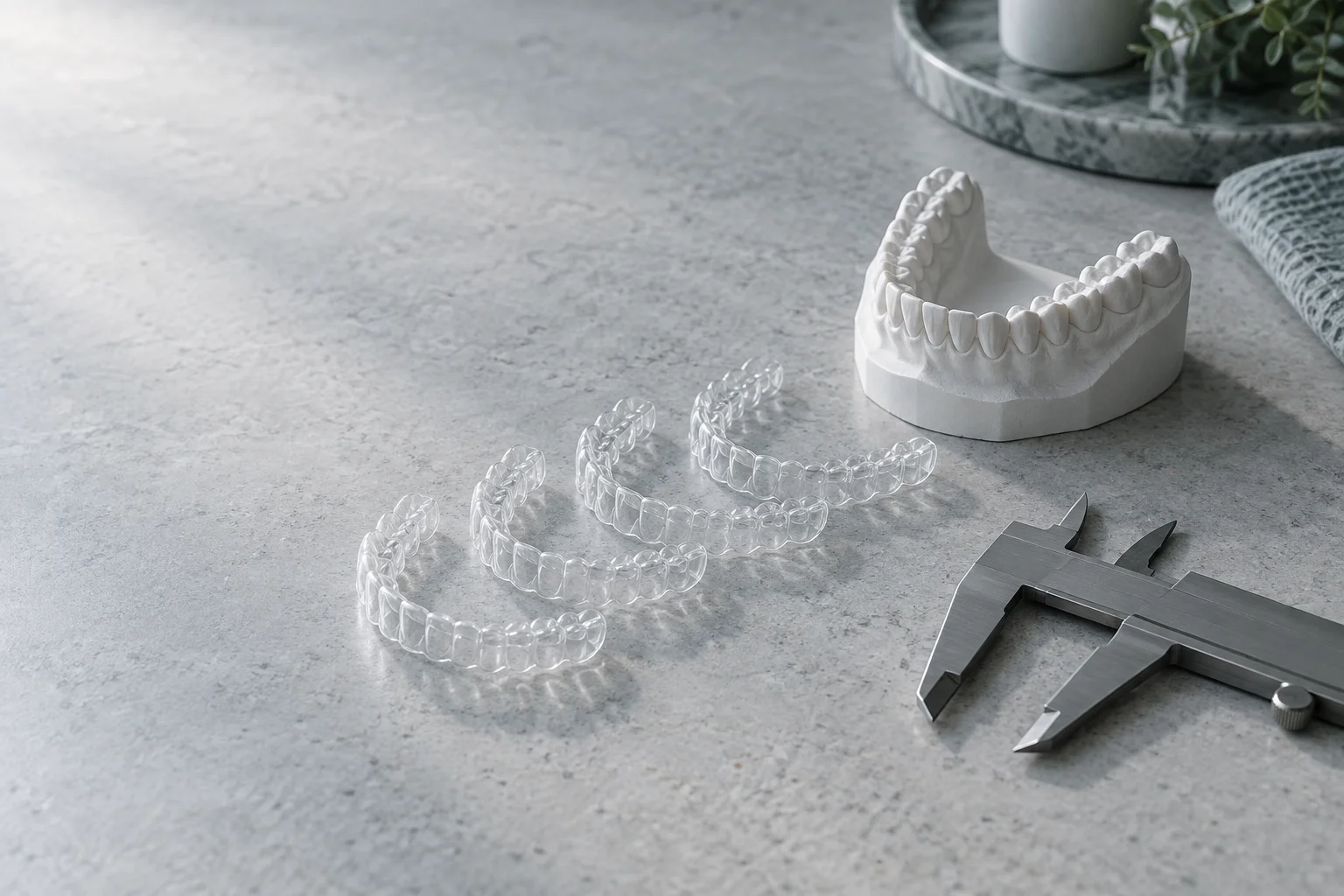
Illustrative orthodontic tray with an aligner, a printed model and unmarked measurement calipers on a pale surface
ADULT / FIXED BRACES OR CLEAR ALIGNERS / 18–30 MONTHS

Adult treatment

Records / Every scheduled adjustment / First set of retainers

A moderate case runs about 14 to 18 adjustment visits over 18 to 30 months, and the fee holds all of them.

Adult crowding treated with clear aligners ↗

Records taken at the assessment: photographs, a scan and a panoramic X-ray. The plan set a 14–18 month range, a new aligner set every one to two weeks at home, and a review in the chair every 6 to 8 weeks to check the fit and the attachments. Extraction of no teeth was proposed, and a refinement stage sat inside the fee in case the last millimetre did not close. Retention: a fixed wire on the six front teeth with a removable night retainer, reviewed at 1, 3, 6, 12 and 24 months after the appliance came off. What would have moved the price: a decision to extract, or a case that ran past 18 months and needed more than 18 adjustment visits.

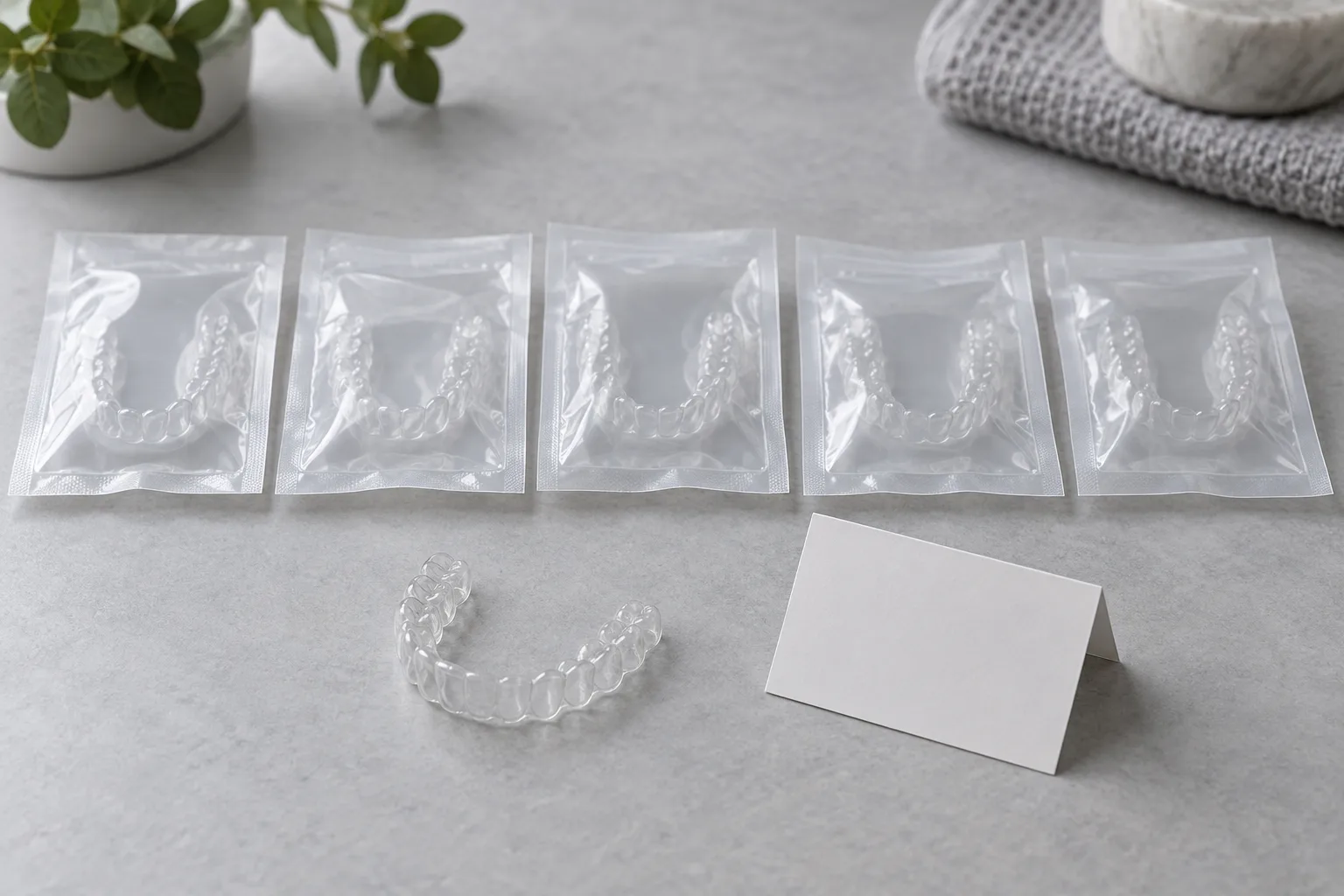
Illustrative row of sealed clear aligner pouches in sequence with one clear aligner resting in front of them
TEEN / 12–24 MONTHS / SCHOOL-HOURS APPOINTMENTS

Teen treatment

Both arches / Review every 6 to 8 weeks / Retainers included

Usually while the last adult teeth are coming through, which is when some crowding is easier to correct.

How the teen rhythm differs ↗

Adjustments are every 6 to 8 weeks, and the appointment is held open for 20 to 30 minutes so the appliance can be checked properly rather than rushed at the end of a school day. Clear aligners change at home every one to two weeks instead, with the same review in the chair. Appointments are set around school hours wherever the diary allows, and the 24-month aftercare clock starts the day the appliance comes off, not the day treatment starts.

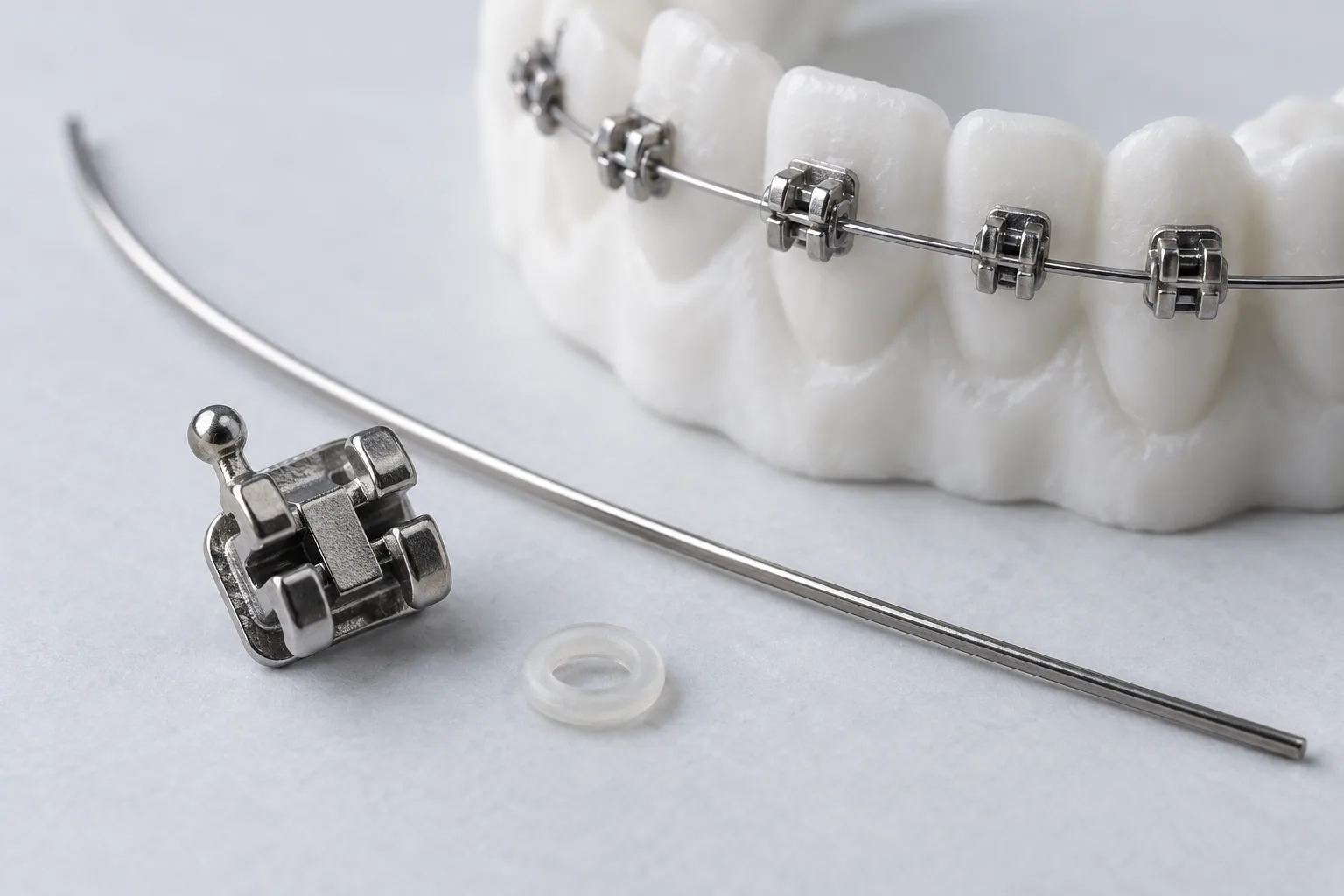
Illustrative stainless bracket, length of archwire and ligature tie beside a bracketed white dental arch model
EARLY TREATMENT / PHASE 1 / 9–12 MONTHS

Early treatment, first phase

One problem / Baby teeth present / Second phase quoted separately

One specific problem corrected while growth is available, on its own records and its own fee.

Early treatment, first phase ↗

A narrow upper arch with a crossbite in a child still holding baby teeth. Phase 1 was planned at 9–12 months to correct the crossbite while growth was available, with a removable retainer afterwards. The quote said plainly that a second phase in the permanent dentition is often needed and would be quoted on its own records — not folded into the first figure to make it look smaller. Reviews run every 6 to 8 weeks while the appliance is in, and the retainer that follows it is checked at the end of phase 1 and again a year later. What would have moved the price: a decision to defer treatment until the adult teeth arrive, which costs nothing now and may cost more later.

Ask about your own case

They show how a case is qualified, priced and reviewed — and no photographs of any patient’s teeth appear in this section or anywhere else on the site.

Who treats you

A name, and a
qualification to check.

The orthodontist

Examines you, writes the plan, fits the appliance and reviews the finish. Ask for the name and check it on the register, with a current practising certificate.

The clinical team

The assistant who takes the records and prepares instruments for each visit, and the person who answers the phone about instalments, missed appointments and the aftercare date on your plan.

Who does which part

The assessment, the plan, the fitting and the retention review are the orthodontist’s. Scheduled adjustments are carried out by the orthodontist or, where the plan provides for it, by a trained clinician working under their supervision. If your case needs jaw surgery it is planned jointly with an oral and maxillofacial surgeon, and the surgical fee is theirs, quoted separately and paid to them.

A map of who does what, so nothing is decided at the chair without you knowing who decided it.

Capacity, stated

How many clinicians here carry orthodontic cases, and how many cases are in treatment at one time. Those are capacity numbers, not a quality claim — but they predict how long a review takes to book and how much time you get at each visit.

Examine, explain, agree, review.

  1. Examine

    History, examination and imaging where it is needed for a diagnosis.

  2. Explain

    Findings in plain language, with the options and the risks of each.

  3. Agree

    Fees confirmed in writing, and nothing started without your decision.

  4. Review

    A recall interval set to your mouth rather than to a fixed calendar.

The first appointment

What the assessment
produces.

The first visit is priced and it ends with a document. If a practice will not tell you what the appointment produces before you book it, that is the question to ask.

  • Records: X-rays, photographs, and models or a digital scan of both arches.
  • A diagnosis in plain language, and what it means for you specifically.
  • The appliance options, with the duration in months attached to each one.
  • A written quote with the tier, the fee, the instalment terms and the total payable.
  • The retention plan, its 24-month aftercare date and what a replacement retainer costs.

A digital simulation may be shown as part of the plan. It is a planning aid, not a promise of the finished position — what the teeth do is what the teeth do.

Aftercare included
24 months from the day the appliance comes off
Retainers included
One set — fixed wire, night retainer or both, as the plan states
Replacement retainer
S$250 per arch, S$273 with GST, after the included set or after loss
Where the cover ends
The stop is a date printed on your plan, not a rolling promise
Visits to expect
A moderate case runs about 14 to 18 adjustment visits
Missed visits
They extend treatment, and we say so in writing rather than adding visits quietly
Who reviews the finish
The orthodontist who wrote the plan, at the retention review appointment
Wire adjustments
Every 6 to 8 weeks in the chair, about 20 to 30 minutes a visit
Aligner changes
A new set at home every 1 to 2 weeks, checked at each review in the chair
Mid-point review
The month range is restated against progress, in writing, at the half-way visit
Retention reviews
At 1, 3, 6, 12 and 24 months after the appliance comes off
Retainer wear
Nights for the first year, then the schedule printed on your plan
Your dentist referred you

A referral should arrive with the reason for it, the X-rays and any plan your dentist made. We assess, write our own plan, and send the findings back to the referring dentist, so the two records agree.

Send a referral
You are mid-treatment elsewhere

Bring the original plan, the records and the appliance details. The transfer is assessed as its own case: a S$150 consultation fee, credited against the remaining treatment if you continue, and the fee recalculated on the treatment time that is left rather than on the original total.

Ask about a transfer
Adult crowding or spacing

The assessment decides which appliance suits the case rather than which is cheaper. Mild cases may need nothing more than a removable appliance or a retainer; complex ones may need extractions, and the quote will say so before you commit.

Book an assessment
A child, first assessment

The assessment answers one question: treat now, or wait. Waiting is a legitimate answer where growth will do the work, and it costs nothing. Where treatment is right, phase 1 is quoted as phase 1 — with any second phase quoted separately later.

Book a child’s assessment
Something has broken or hurts

A wire digging into a cheek, a band that has come loose, a lost aligner, a tooth that has moved more than the plan expected. Ring the clinic; a rubbing wire can often be relieved the same day over the phone. A bracket that is off with no pain can usually wait for the next scheduled visit, and we will tell you which of the two you have.

Request an urgent visit

Inside the fee: every scheduled adjustment, a comfort visit during office hours if a wire is rubbing, and repairs that are not accidental damage. Billed separately: a replacement appliance after loss or a break in sport, an appointment outside office hours at the published rate, and reviews after the 24-month aftercare period ends. Ask for that list in writing with the quote.

A sample story, labelled as one

“I asked what the total would be if the treatment ran a year longer than the plan. They showed me the term, the monthly figure and what an extra year of visits would cost, then wrote it into the quote.”

Adult aligner treatment · sample story

Sample story. Not a real customer review.

Before you commit

The questions that
decide the purchase.

How is the monthly figure calculated, and what is the total?

The quote should carry four numbers, not one: the fee, the down payment, the term in months, and the total payable. On the S$4,200 row above, the practice’s own plan is S$1,145 down plus 24 × S$143, so S$4,577 in total with no interest — while 36 months of outside finance at a representative 7.90% APR looks the same per month and costs S$5,157. If a clinic quotes a monthly figure without a term and an APR, that is the number to question first.

Is 12 to 24 months realistic?

For a moderate adult case, usually yes — but the range depends on what the records show, the appliance, whether extractions are needed, how the teeth and bone respond, and how faithfully aligners or elastics are worn. Nothing about the process is faster for one appliance choice in every mouth. What we can do is state a range at the start, say what would move it, and tell you at each review whether it is running long rather than at the end.

I am mid-treatment at another practice. Can you take it over?

Usually, and it is priced rather than refused at the counter. Bring the original plan, the records and the current appliance details. The transfer is assessed as its own case: a S$150 consultation fee, credited against the remaining treatment if you continue. The fee is recalculated on the treatment time that remains, so you do not pay twice for the part already finished — and you do not get an estimate on the phone, because it depends on the records.

What happens after the braces come off?

Retention is part of the fee rather than an upsell: 24 months of aftercare reviews from the day the appliance is removed, and one set of retainers — a fixed wire, a removable night retainer, or both, as the plan states. A replacement retainer is S$250 per arch, S$273 with GST. The reviews do not hold the teeth; the retainers do, for as long as they are worn. If you stop wearing them, we will tell you plainly that the case can relapse.

Is any of it claimable — MediSave, CHAS, insurance?

Orthodontic treatment is not claimable from MediSave, and the Community Health Assist Scheme does not apply to it. Saying so plainly is more useful than leaving it to the counter. Insurance is different: some policies pay part of a fee following an accident, and some cover children. Ask your insurer before starting, and we will provide the itemised quote, the records and the treatment report they ask for.

When is treatment not the right purchase?

When the crowding is slight and relapse after a previous course could be held with a retainer instead. When the problem is a jaw relationship that braces alone cannot correct, so the honest plan involves a surgeon and a different budget. When the fee outweighs what the change is worth to you. And it is worth knowing why mail-order aligners are not a cheaper version of this: nobody takes the records, nobody examines the roots or the gum, no clinician is responsible for the finish, and the retention stage is usually where the process stops.
Start with the assessment

Send the case.
Get a written plan.

How long the crowding has been there, whether anyone has treated it before, and which side shows most are enough to begin. Bring any X-ray or plan you already have.

Concept only. Nothing is sent or booked.

Branch 1 · hours
Weekdays 9am–7pm, Saturday 9am–1pm
Branch 1 · getting there
Two minutes from the MRT exit, paid parking in the building
Branch 2 · hours
Weekdays 10am–8pm, closed Saturday
Branch 2 · getting there
Bus stop at the door, limited season parking
Where this comes from
Preview your message
Send this enquiry on WhatsApp

Opens WhatsApp with this enquiry ready to send. Nothing is sent or booked until you press send there.

Fees and instalments · What the assessment produces · Ask a question

Book an assessment