Healthcare advertising in Singapore is regulated. That shapes what you will and will not find on this website — and it is worth knowing before you judge a clinic by its site.
Not allowed
Photographs or videos showing anyone’s appearance before and after, or only after, treatment.
Patient reviews, testimonials or endorsements of the service or the clinician.
Superlatives or statements of prominence — “best”, “leading”, “most advanced”.
Comparing the quality of one clinic’s service with another’s, or criticising another clinic.
Implying results other clinics cannot achieve, or creating unjustified expectations.
Anything factually inaccurate, exaggerated or misleading, and anything that solicits or encourages you to use the service.
Allowed, and published here
The dentist’s qualifications and registration.
What a procedure involves, its risks, and the alternatives.
Fees and what a fee includes.
Opening hours, location and how to make an appointment.
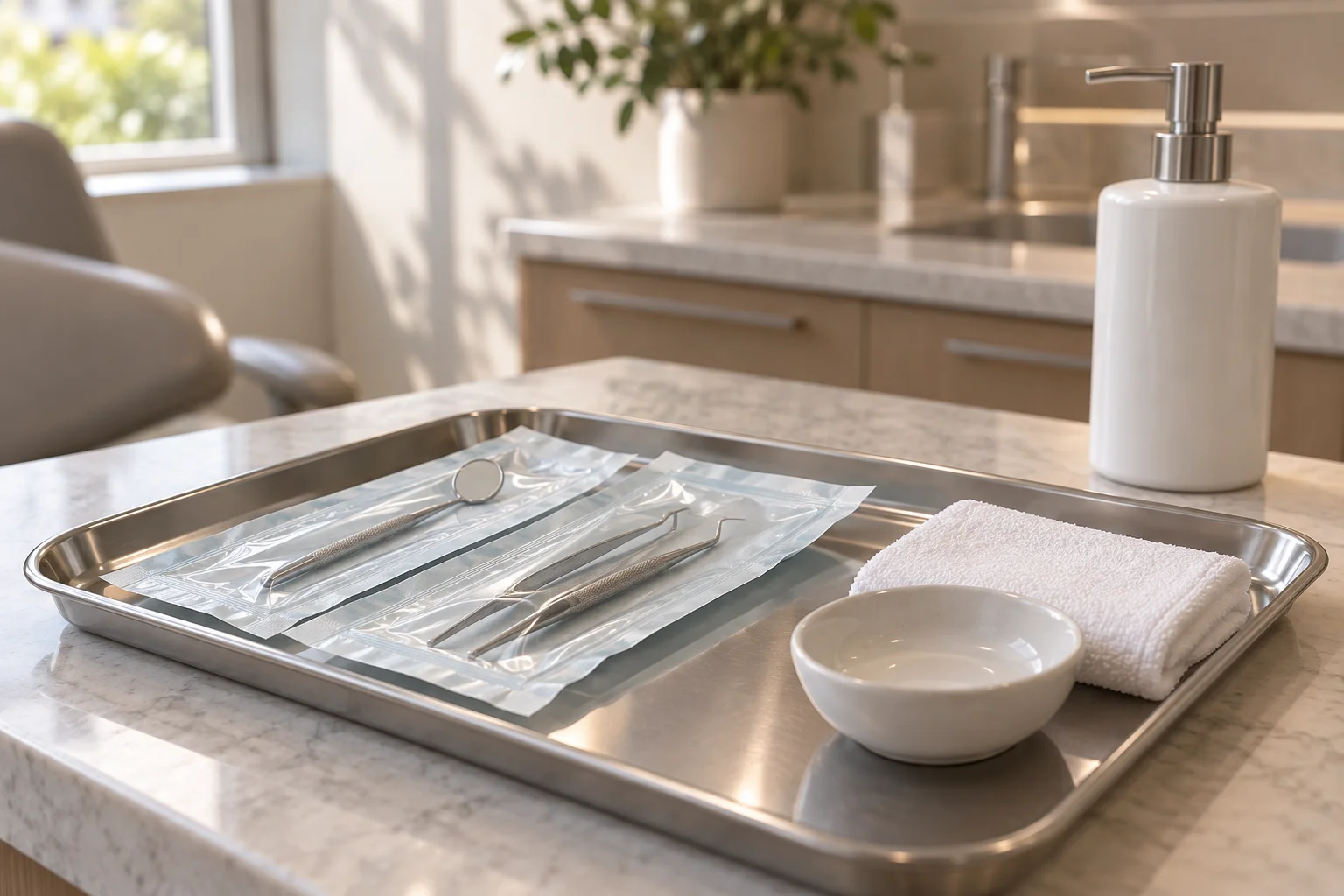
Infection control and how instruments are sterilised.
Factual, substantiated statements about the practice.
Summarised from the Healthcare Services (Advertisement) Regulations 2021, which apply across healthcare professions including dental. Penalties for a breach by a licence holder can reach a S$20,000 fine or 12 months’ imprisonment. Confirm the current requirements with the relevant authority.
Fees should be visible, and the cost of a treatment should be confirmed in writing before it starts. The whole schedule is published rather than the three treatments most often advertised, because the visit you are planning may be the boring one.
Illustrative concept pricing. Confirm the current fee schedule, what each fee includes and any charges for materials or laboratory work with the practice.
Treatment
Basis
From
Consultation and examination
Per visit, about 30 minutes
S$45
Scaling and polishing
Per visit, about 30 minutes
S$90
Filling
Per tooth, one visit, about 45 minutes
S$120
Crown
Per tooth, two visits: about 60 and 30 minutes
S$850
Root canal treatment
Per tooth, one or two visits, 60 to 90 minutes each
S$650
X-ray, per film
Per film, taken during the visit that needs it
S$35
Extraction, simple
Per tooth, one visit, about 30 minutes
S$180
Denture repair or reline
Per denture, laboratory work, one to two days
S$180
Night guard, hard acrylic
Per guard, two visits: impression, then fitting
S$380
Emergency visit, registered patient
Per visit, seen the same week
S$65
Wisdom tooth, surgical
Per tooth, one visit, 45 to 60 minutes
S$650
Veneer, porcelain
Per tooth, two visits: about 60 and 45 minutes
S$950
The time in each row is chair time for that visit, not the total time you are in the building: a first visit adds record-taking and any imaging, and a crown or root canal visit adds the wait while laboratory work or anaesthetic takes effect. If you are booking around work or school, ask which rows on this table are a single sitting and which are two.
Three visits, priced before they start
Findings, then options, then a decision.
A first visit should end with you knowing three things: what the dentist found, what the options are, and what each option costs. Each scope below states its chair time and its fee before you book it.
ROUTINE CARE / 60 MIN / S$90 SCALING AND POLISHING
Routine care
Examination / X-rays where needed / Scaling and polishing
One visit of about 60 minutes, ending in a written note of anything worth watching before the next one.
What the hour covers ↗
Record-taking, an examination of every tooth and the gums, X-rays only where a question needs one, scaling and polishing, and the written note. Nothing is started that day without a fee in front of you.
RESTORATIVE CARE / 45–90 MIN PER VISIT / S$120 TO S$850
Restorative care
Filling / Crown / Root canal treatment
Each option is priced against the others, and quoted in writing before the tooth is prepared.
What the quote compares ↗
A filling at S$120, a crown at S$850 and a root canal at S$650 are set out side by side with what each one keeps and what it gives up: a filling is one visit and less of the tooth is removed; a crown covers a tooth that has cracked or lost a wall; a root canal is the choice when the nerve is involved. The comparison leaves with you, and nothing is started until you have picked one.
URGENT / SAME WEEK / ASSESSED FIRST
Urgent appointment
Pain / Swelling / Broken tooth or lost filling
An assessment first, then the options, then what each one costs — in that order.
What an urgent visit is not ↗
It is not a treatment booked on the phone, and it is not a decision made for you at the chair. The visit is an examination of about 30 minutes: what the tooth is doing, whether it can hold a repair, and what the choices cost. If the honest answer is an extraction, that is quoted before it happens rather than after.
The person who examines you, explains the findings and carries out the treatment. Ask who will be treating you and whether they hold a current practising certificate.
02
The clinical team
The dental surgery assistant who prepares instruments and supports the treatment, and the reception contact who handles your appointment and bill.
Examine, explain, agree, review.
Examine
History, examination and imaging where it is needed for a diagnosis.
Explain
Findings in plain language, with the options and the risks of each.
Agree
Fees confirmed in writing, and nothing started without your decision.
Review
A recall interval set to your mouth rather than to a fixed calendar.
A clearer starting point
What brings you in?
Pick the closest description. It starts the right conversation instead of a general enquiry.
01It hurts now +
Say which side, whether it wakes you at night and whether there is swelling. Pain that disturbs sleep or swelling that is spreading should be seen promptly.
“We do not publish patient reviews. What we publish is what a treatment involves, what it costs, and who will be treating you.”
Practice policy on patient reviews · sample story
Sample story. Not a real customer review — healthcare advertising rules in Singapore do not allow a clinic to publish one.
The practical questions
Before your first visit.
Will I know the cost before treatment?+
You should. Ask for a written estimate that separates the examination, the treatment, any laboratory work and any follow-up visit, and ask what happens if the treatment turns out to be more extensive than expected.
Why are there no photos of results?+
Singapore’s healthcare advertising rules do not allow a clinic to publish before-and-after images of anyone’s appearance, or reviews and testimonials. A clinic showing them is a reason to ask questions rather than a reason for confidence.
Who will be treating me?+
Ask for the dentist’s name and registration, and whether they hold a current practising certificate. It is a reasonable question and should be answered without hesitation.
What if I need a specialist?+
Some treatment belongs with a specialist, and a referral should come with the reason and the records needed. Ask what is sent across, and who explains the specialist’s quote to you.
Start a conversation
Let’s look at what is happening.
Which tooth, how long it has been going on, and whether there is pain are enough to begin.