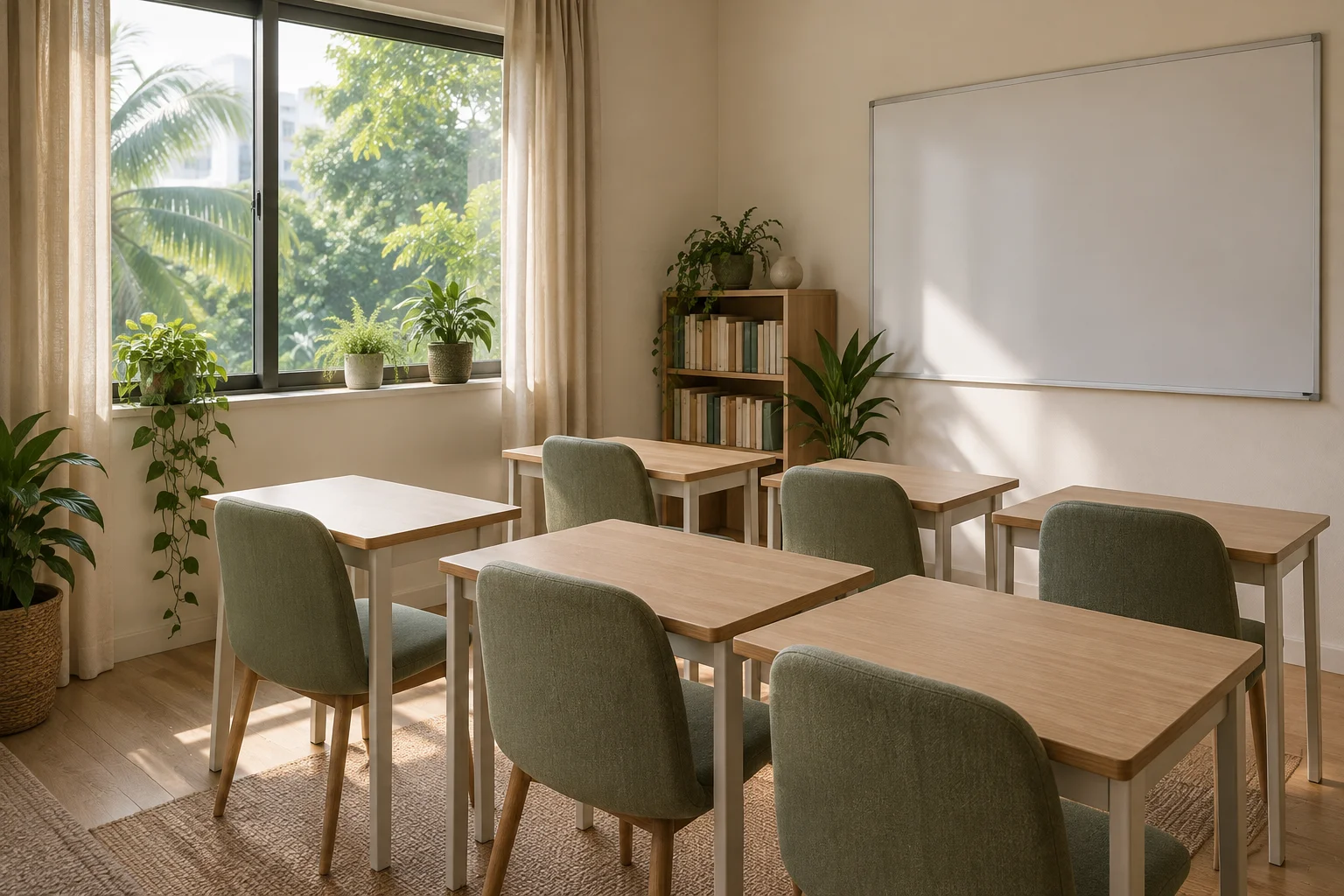
A term starts with where the child is now: the school, the topic in class and the marks so far. Then the weekly lesson does the steady work, and the review comes back in language a parent can act on.
Weekly · 10 lessons a term · six to a Primary group
Weekly tuition · Primary 1 to Secondary 4
One slot a week held for the term, in a group set by the level the child is working at rather than the year on a birth certificate.
Who takes the group
The same teacher takes the group through the term, and teachers are observed before they take a group. A change of teacher is explained to parents in advance rather than quietly substituted.
Every lesson · every term
The record · a note a week, a report a term
A short note after each lesson on what was covered, topic tests marked and returned inside the term, and a written report when the term ends.
What the termly report says
It names what improved and what to work on next, and it is written by the teacher who took the group rather than generated from a scoreboard. Progress is reported as work done and marks moved, never as a promise about a result.
Exam preparation · before a school paper or PSLE
Exam preparation · papers, timing and marking
Past-paper practice under time, with the mistakes listed so the next week has something specific to work on.
What is confirmed before it starts
The papers covered, the number of sessions left before the exam, and the day each piece of practice work comes back marked are all confirmed in writing before the block starts.
What arrives week by week matters more than a promise about a result.
Trial, level check, then weekly work.
Book a trial
Bring the level, the subject and what has changed at school.
Check the level
A short diagnostic decides the group and the starting topics.
Work weekly
The same teacher, a stated focus and homework that gets looked at.
Review the term
What improved, what did not, and the recommendation for next term.
A clearer starting point
Where should we start?
Choose what sounds closest. It starts the right conversation rather than a general enquiry.
01Marks are slipping +
Weekly tuition begins with the topic the class is on now, not the whole syllabus. Groups are set by the level a child is working at, and a change of level is decided by the teacher with the parent.
A short programme suits a specific gap better than a full term. The dates, the number of sessions and the group size go out with the programme, and the fee is per programme rather than per term.
Groups are set by the level a child is working at, not by the year on a birth certificate.
Level
Subjects
Group & lesson
Primary 1–3
English, Maths
Up to 6 · 1 h 30
Primary 4–6
English, Maths, Science · PSLE preparation
Up to 6 · 1 h 45
Secondary 1–2
English, Maths, Science
Up to 8 · 1 h 45
Secondary 3–4
English, Maths, Science, Additional Maths · O-Level and IP
Up to 8 · 2 h
Junior College
H2 Maths, Chemistry, Economics
Up to 8 · 2 h
A diagnostic decides the group and the starting topics. If the right group does not exist this term, we say so rather than placing a child in the wrong one.
One slot a week, held for the term. Slots are allocated after the level check, not before.
Slot
When
Note
Weekday early
Tuesday to Friday, 4.00–6.00 pm
Primary groups, collected straight from school
Weekday evening
Tuesday to Friday, 6.30–8.30 pm
Secondary and Junior College
Saturday
9.00 am – 1.00 pm
The slots that go first; booked by the term
Sunday
By arrangement
Small groups only
Terms run ten weeks. Registration closes at the end of the first week, and a missed lesson is made up inside the same term where a slot exists. The term dates are confirmed in writing before the first lesson.
What a term costs
Fees, and what they cover.
Term fees, so the first conversation can start at the right level.
Illustrative concept pricing, not a quotation. Fees are per subject per term; materials, registration and holiday programmes are confirmed at enrolment. Confirm current fees with the centre.
Level
Fee per term
What it includes
Primary 1–3
S$480
Weekly lesson, worksheets, termly written report
Primary 4–6
S$560
Weekly lesson, exam practice, termly written report
Secondary
S$640
Weekly lesson, topic tests, termly written report
Junior College
S$760
Weekly lesson, timed practice, termly written report
Outside the fee: a one-off registration charge, holiday programmes and private lessons. Sibling and second-subject rates are stated in the quotation rather than inferred.
How you will know
Progress, without a scoreboard.
We do not publish exam results. What we can be held to is what happens every week, and what you receive at the end of it.
A short note after each lesson on what was covered
A fortnightly update on homework and attention in class
Topic tests inside the term, marked and returned
A written termly report naming what improved and what to focus on next
Who teaches your child
Teachers are hired for the level they teach
They are observed before they take a group
The same teacher takes the group through the term
A change of teacher is explained, never quietly substituted
A parent may sit in on one lesson by arrangement
A parent’s view
“We finally knew what the lessons were aiming at. The end-of-term note explained what changed and what to keep working on.”
Primary 5 weekly tuition · sample story
Sample story. Not a real customer review.
The practical details
Before the first lesson.
How large is a class?+
Six in a Primary group and eight from Secondary 1 upwards, with one teacher to the group. The cap is printed on the enrolment form, and it is not raised to fill a slot.
How will we know it is working?+
A note after every lesson, topic tests marked and returned inside the term, and a written report at the end of the term naming what improved and what to work on next. The review point is the end of term, every term.
What does a term cost?+
Fees are per subject per term and they are on the fee table above: S$480 at Primary 1 to 3, rising to S$760 at Junior College. A term is ten lessons, worksheets and the termly report are included, and a lesson missed is made up inside the same term where a slot exists.
Who teaches the class?+
Ask about the teacher’s subject background and whether the same teacher runs the whole term. A change of teacher should be stated in advance.
Start a conversation
Let’s start with this term.
The school level and the subject are enough to begin.