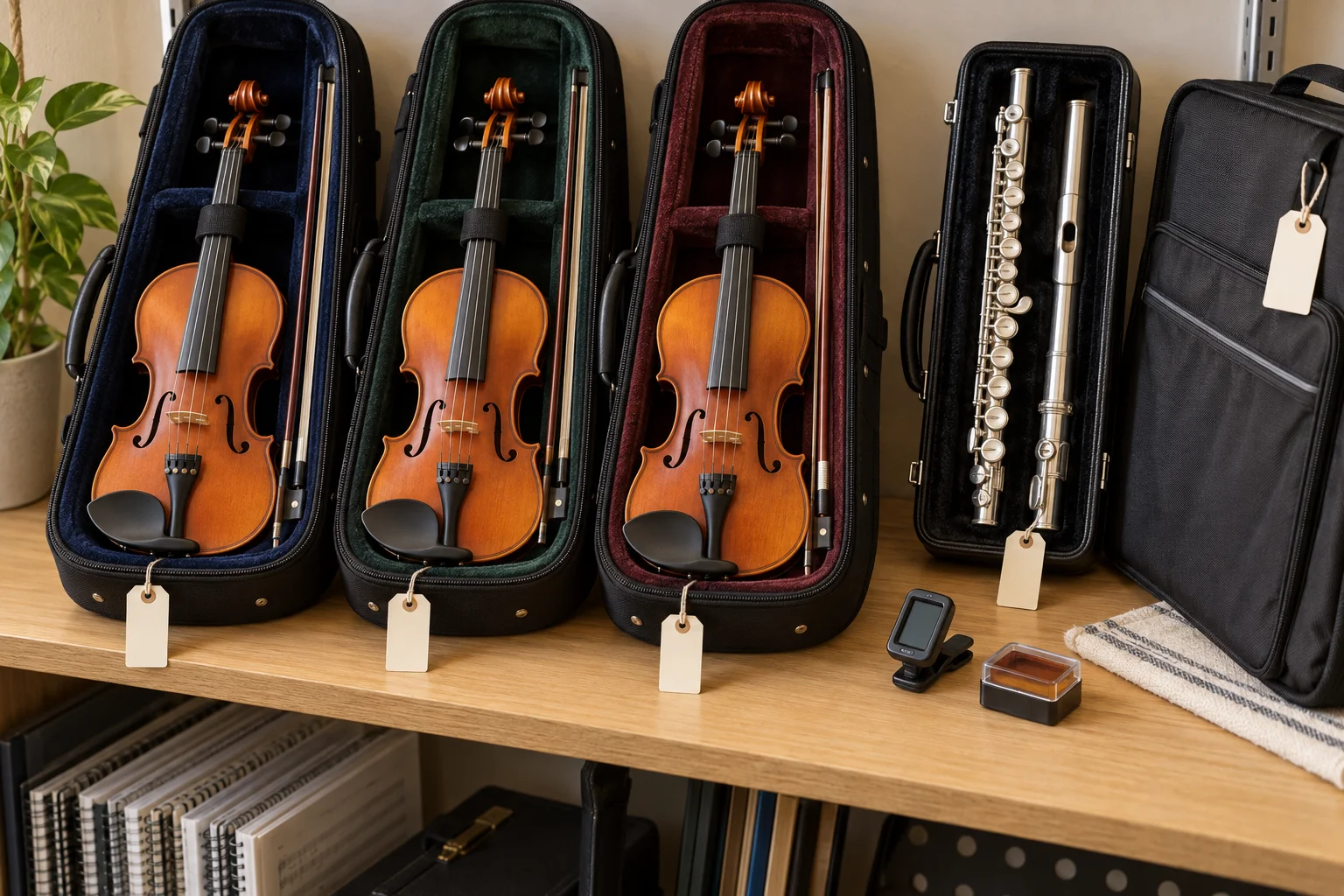
Instrument lessons for children and adults on an external grade ladder, with the board, the term arithmetic, the instrument position and the hire terms stated before anyone enrols.
Trial lesson S$45 · 30 minutesMusicianship group S$25 a lessonTerm fees from S$585See the fee ladder ↓
Three ways in
Lessons first. The exam is optional.
Every student takes a weekly lesson on one instrument. The graded route is one way to take it, not the only one, and what you are buying should be named before the first term is paid.
Graded pathway
Weekly lessons worked through an external board's graded material, with the exam entered only when the teacher and the family both agree the student is ready. Nobody is entered for a grade they have not been prepared for, and the exam is a choice rather than the definition of progress.
Play for pleasure
The same lesson and the same material, with no exam at the end. The standard is still known, because the graded syllabus is published and the teacher will say which grade the student is working at. Families choose this more often than the pages in this category admit.
Second study & ensemble
Students already playing add a second instrument or join the weekly ensemble, which is where sight-reading and counting get used on real parts. Both are priced per term like a first lesson.
We do not enter a student for a grade to meet a school's form deadline, and we do not sell lesson credits that expire unused.
What the term ends in
Three dates a term, and only one is an exam.
A graded school needs more than one exam date. These are the three things a family actually attends: the end-of-term concert, the weekly ensemble, and the exam sitting, entered only when it is worth entering.
Whole school · last Saturday of each term
End-of-term concert · three rooms, unmarked
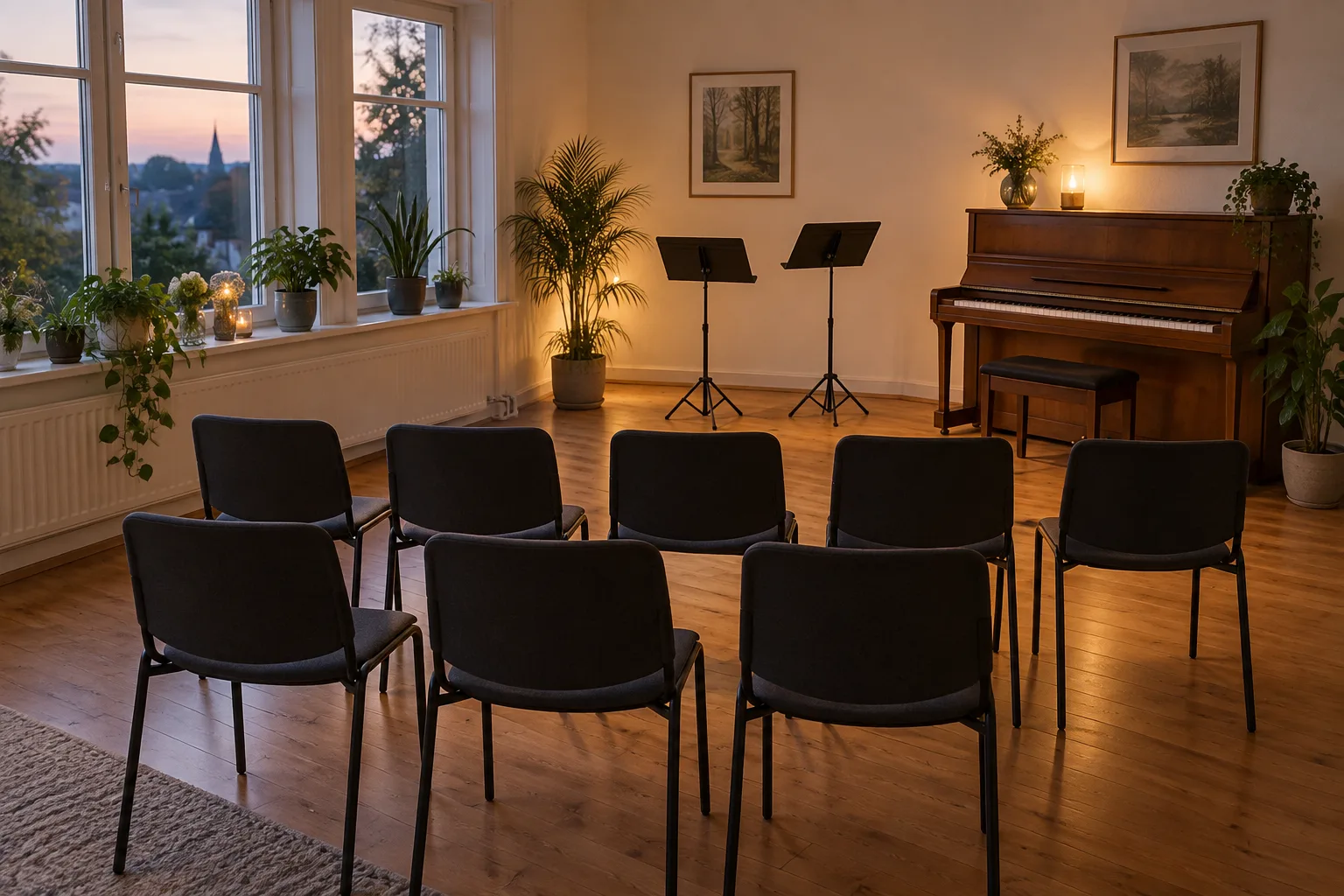
Every student who wants a turn plays one piece to the other families, in the room they already learn in.
The programme and the rehearsal
The programme goes to parents two weeks beforehand, naming the piece each student has chosen. Rehearsal with the accompanist happens inside lesson time rather than as a paid extra, and a recording goes home, so the first year has something to show before any exam exists.
Weekly · 45 minutes · all grades
Ensemble · a second instrument or a place in the group
The ensemble meets weekly through the term and plays at the concert, which is where sight-reading and counting get used on real parts.
Where a place is listed, and what it costs
Places are on the enrolment form, with the day and the instrument each group needs. A student entered for a festival, a competition or a school audition is prepared inside the weekly lesson, and the teacher says whether the entry is realistic in the time available. Festival entry fees are the family's decision and the family's cost.
Exam · entered only when it is worth doing
Grade exam · three windows a year
The paper is sat on a date the teacher names, with the preparation inside the weekly lesson and the entry paid by the family to the board.
What we do not do to make a date
We do not enter a student for a grade to meet a school's form deadline. And no festival result, pass rate or prize list appears here: we do not publish a number we cannot show you the source of.
In the years before a first exam, this is most of what a family is buying.
Trial, placement, then a term of weekly work.
Book a trial
Thirty minutes with the teacher who would take the slot, on the instrument the student wants to play.
Written placement
The level to start at, the lesson length we recommend, and the practice routine for the first month.
Weekly work
The same teacher each week, with the note a parent reads the same day and the term report at the end of it.
Review the term
What is secure, what is not, and whether an exam is worth entering yet.
Before you enrol
Five steps, each with a document.
The placement and the exam decision are the two things a family should be able to hold in writing. Each step below ends in something you keep.
GRADED
1 · Trial lesson
Thirty minutes with the teacher who would take the slot. Output: a written placement note naming the level to start at, the recommended lesson length, and the practice routine for the first month.
2 · Teacher fit
Matched on the instrument, the day you are free, and how the student learns. Output: the teacher's name with the instrument and teaching qualification they hold, and the background check we run before a teacher takes a class — ask to see it.
3 · Instrument decision
Piano and drums are in the room; other instruments have to come from somewhere. Output: the hire terms if we can supply one, or advice on a first instrument if you would rather buy, including the size question for a growing child.
4 · Term booking
Individual or group lesson, and the term you start in. Output: a term invoice showing the lesson count, the first and last lesson date, and the day the fee falls due.
5 · The exam choice
If and when an exam is entered. Output: the board, the grade, what the paper actually asks for, who books and pays the entry, and the date we would enter if the family agrees.
The exam is external, and it is optional
Two kinds of board cover most of what we teach: the classical graded boards, where a practical paper is usually three pieces plus scales, sight-reading and aural work, and the rock and pop board, which substitutes session skills and can be submitted as a recording made in lesson time. We tell you which board and which syllabus we prepare for each instrument when you enrol, and we re-read the board's current syllabus each year, because it changes. Many students work through the graded material without ever sitting the paper, and they still know what standard they are playing at. Whoever sits an exam books and pays the board directly; the entry fee is never part of our term fee. The venue is stated in writing with the entry: our candidates sit at the board's own centre, and the entry letter names the centre and the date.
The trial is a purchase, and it is credited
The trial is not a free sample. It is thirty minutes of a teacher's time whose deliverable is a placement and a recommended lesson length. If the family enrols, part of the trial fee comes off the first term, and one credit is allowed per family. The figures sit with the fees below.
Instrument hire and its terms
Piano and drum students need nothing. Everyone else needs an instrument from the first lesson. We hire a small number on a half-termly basis with a refundable deposit, requested at least five working days before the term starts and collected from the centre. We also say plainly when we cannot supply one, rather than promising it and leaving a beginner to find out in week one.
The same teacher every week
We do not price teachers at different tiers by diploma, because a family that shops for the cheapest teacher in the building ends up with a different teacher every few weeks. Continuous teaching is what the weekly note and the term report rest on.
The ladder belongs to the exam board, not to us. Below the first graded paper there is no external exam at all: a beginner starts on pre-grade material, and the first grade is usually about two years away. That varies by instrument and by how much practice happens between lessons, so we would rather give the range than a date.
Level
What the student works on
Typical time at this level
Pre-grade No exam exists here
Hand position, reading, a steady pulse, first scales and short pieces from memory. No prior playing is needed to start.
One to two years
Grades 1–2
Set pieces, scales, sight-reading and aural work from the board's published syllabus, ending in the first short exam.
Six to twelve months a grade, for a student practising four times a week
Grades 3–5
Longer pieces, the keys and time signatures the next paper brings, and the first ensemble playing.
Nine to eighteen months a grade
Grades 6–8
Repertoire that takes months rather than weeks, longer sight-reading, and the written theory paper where the board's syllabus asks for one.
A year or more a grade; many students stop here and keep playing, which is a good place to stop
Beyond Grade 8
Diploma-level repertoire and performance.
Not something we would plan for you in a first meeting
The times are a guide and each individual's differs. A teacher who names a grade by a date without having taught the student is guessing. We give the range for the instrument and the practice week at the trial instead of a date.
Lessons run in 30, 45 or 60 minute slots, on weekday afternoons and through Saturday morning. The slot is chosen at the trial and kept for the term, because a timetable that moves is the fastest way to lose a practice habit.
Term
Dates and lesson count
Enrolment closes
Autumn
First week of September to the second week of December · 12 lessons
Five working days before the first lesson
Spring
First week of January to the last week of March · 10 lessons
Five working days before the first lesson
Summer
Second week of April to the third week of June · 9 lessons
Five working days before the first lesson
Slots and rooms
Tuesday, Wednesday and Friday 4–8pm, Saturday 9am–2pm. Beginner group lessons run on Saturday morning only. A slot that is taken is taken: rooms are not double-booked to squeeze a lesson into twenty minutes.
The holidays are not invoiced
The school closes for the local school holidays and for two weeks at the end of the year. Those weeks are not charged, which is why the three terms count 12, 10 and 9 lessons rather than the same number each time.
Extra lessons before an exam
Arranged with the teacher, priced per lesson, and agreed in writing before they are taken. Nothing is added to a term invoice without the family saying yes to it first.
Enrolment after the deadline is possible only into a slot that is still free, and the term fee is not reduced for the lessons already given.
What a term costs
The unit is the week, not the hour.
A week of study on the graded route is a 30-minute individual lesson and a small musicianship group lesson, priced separately because they are different purchases: S$65 and S$25. Comparing the individual lesson alone to another school's hourly rate compares half of what is taught.
Illustrative concept pricing, not a quotation. Individual 30-minute lesson at S$65 and group musicianship at S$25 a lesson, invoiced per term in advance. The terms count 12, 10 and 9 lessons because the school does not teach in the local school holidays, which is why the summer invoice is smaller. The board's exam entry fee, books and sheet music, instrument purchase or hire, and any extra lesson sit outside the term fee. A 45 or 60 minute lesson is charged per lesson at the lesson rate. Confirm current rates with the school before you enrol.
Term
Rate per lesson
Term total, one individual lesson a week
Autumn 12 lessons
S$65
S$780
Spring 10 lessons
S$65
S$650
Summer 9 lessons
S$65
S$585
The trial
S$45 for a 30-minute trial with the teacher who would take the slot, and S$35 of it comes off the first term's fee if you enrol. One trial credit per family, not transferable, and the placement note is yours to keep either way.
Annual quantities, billing and deposits
A full year is 31 lessons. If paying a term in advance does not suit you, monthly billing is available at no extra charge. A one-time enrolment fee of S$30 applies at registration, and a new family places a one-month refundable deposit, returned when lessons stop with the notice below.
What is not in the term fee
The instrument, the books, and the exam entry. The board sets and revises its own entry fee, so we never quote it from memory: the board's own current fee page goes out with the entry letter, with the date we checked it written beside the figure — checked in September 2026 for this session, and checked again before every entry. We add nothing to it, and the family books and pays the board directly.
Payment rhythm and the notice rule
The next term's fee is due by half-term of the term before, which is what lets the timetable be built in time. The same half-term is the deadline for stopping: half a term's notice, in writing. Nobody is tied in beyond that.
If a lesson is missed
A lesson we cancel — teacher illness, a closed room — is credited on the next invoice. A lesson the student misses is not refunded; with a day's notice it is recorded, and the teacher sends the week's work and a short recording to practise against. Non-attendance on the day is not refundable, and that sits in the booking terms you sign rather than arriving as a surprise later.
What moves these figures: lesson length, how many lessons a term holds, monthly versus term billing, and whether one instrument or two are being studied. Each one is a stated line rather than a phone call.
While they wait for the exam
Reported every week, by the teacher who was there.
A first grade can be two years away. A page that only shows the ladder leaves a family with nothing to hold in the meantime, so three things come out of the teaching, and none of them is a score.
A note every week
The teacher writes what was covered, what to practise before the next lesson, and which week the practice did not happen. It is visible to the parent the same day, and it is written for the week rather than saved up for a report.
A page every term
Attendance, the pieces in hand, the scales and reading that are secure, and what the next term adds. It goes to parents at the end of every term, whether or not an exam is planned.
A milestone note at the first rung
When the pre-grade material is finished, the teacher writes a short note saying which grade the student is working at and what is still missing. It is our own record and not a qualification: no board recognises it, and it is not a certificate we are able to award. We say that plainly rather than dressing it up.
A grade belongs to the board
The only externally verified statement about a student's level is the certificate the board issues after the exam, dated the day of the exam. Everything else here is our own assessment, and the notes say which is which.
A student who practises four times a week moves faster than one who does not, and the weekly note is where that shows up first.
Family perspective
“At the trial they told us the first grade was about two years away, not two terms. The weekly note started arriving in the first week, so we could see the work even with no exam in sight.”
Graded pathway · sample story
Sample story. Not a real customer review.
Before you commit
What parents ask before paying a term.
Do we have to sit exams?+
No. The exam is entered only when the teacher and the family agree it is worth doing, and a student can work through the graded material for years without sitting a paper. Working through graded material without the exam is not a lesser route: the syllabus is published, so the standard is known either way. What the exam buys is an external certificate dated to a day; what it costs is the entry fee, the preparation time, and a certain amount of nerve.
Do we need to own an instrument?+
Piano and drum students need nothing, because the instrument is in the room. Every other instrument has to be available at home between lessons, or the practice does not happen and the family is paying for a lesson a week that goes nowhere. We hire a small number half-termly with a refundable deposit, five working days' notice required, and we say plainly when we cannot supply one. If you are buying, we will tell you what to expect to pay for a student instrument and when a child should move up a size.
What does the trial lesson involve, and is it credited?+
Thirty minutes with the teacher who would take your slot, ending in a written placement note: the level to start at, the lesson length we recommend, and the practice routine for the first month. It is charged, and part of it comes off the first term's fee if you enrol — the figure and the credit sit with the fees, together with the rest of the money terms. One credit per family. If you decide not to enrol, the placement note is still yours.
What happens if a lesson is missed?+
A lesson we cancel is credited on the next invoice. A lesson the student misses is not refunded. With a day's notice, the teacher sends the week's work and a short recording so the student can practise against it, and the lesson is recorded as missed rather than made up. Cancellations on the day are charged, because the teacher's slot was held.
What is not included in the term fee?+
The instrument, whether hired or bought. The books and sheet music. The board's exam entry fee, which the family pays to the board. Extra lessons taken before an exam. And the accompanist for a grade that requires one, which is arranged and confirmed separately. None of these appear on the term invoice, and each one is listed with its price at the trial so the term's total is not a surprise.
How do we stop lessons?+
Half a term's notice in writing, with the same half-term deadline the next term's fee runs to. The refundable deposit is returned at that point. We ask for the notice because the teacher's slot is held for the student and cannot be refilled mid-term, and because a student who is about to stop deserves a proper ending rather than a disappearing teacher.
Start with a trial
Tell us the instrument and the free hours.
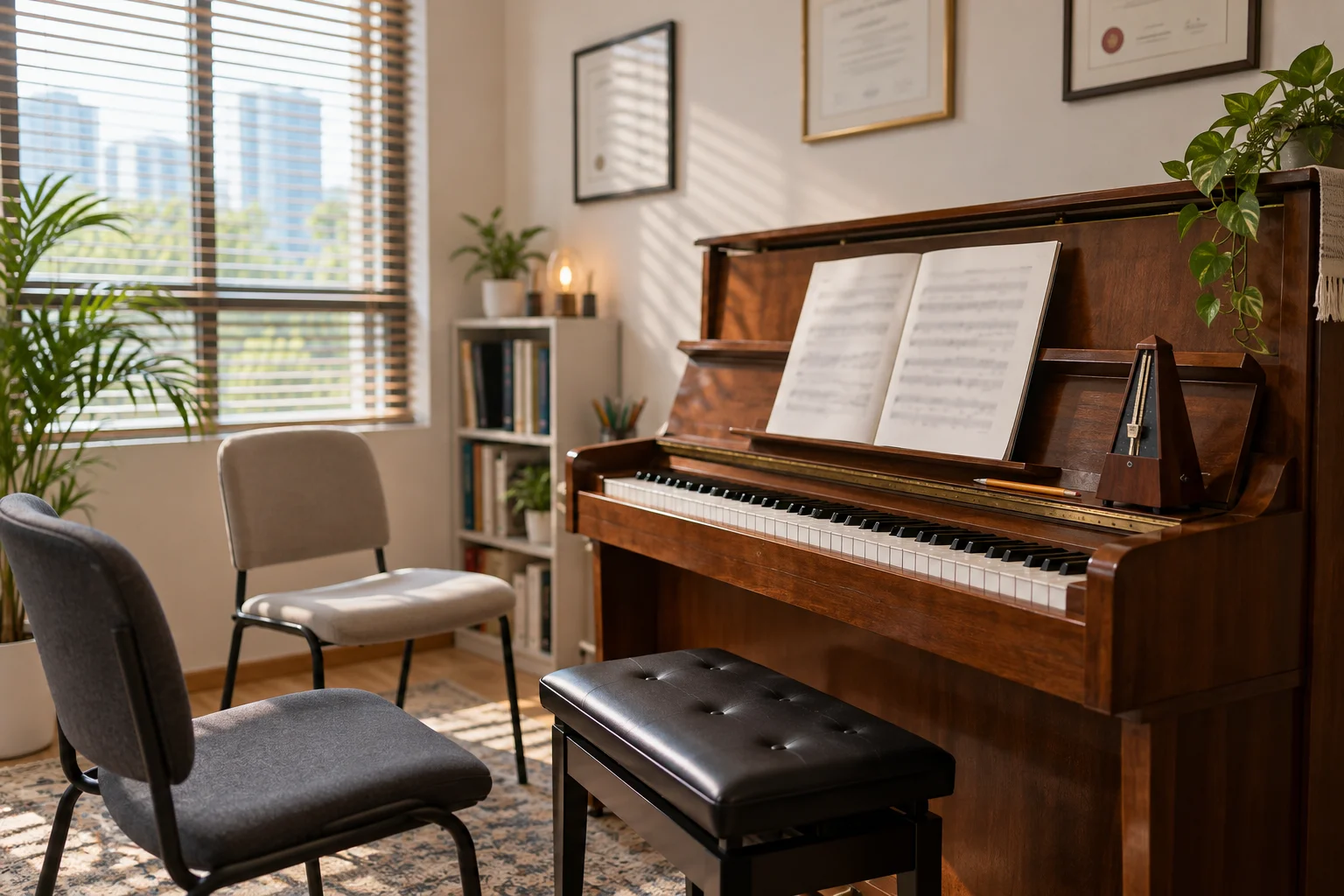
Rooms: three teaching rooms, each with an upright piano, one with a drum kit, and a larger room used for ensembles and the term concert. The address and the nearest MRT stop go out with the trial confirmation. Rooms can be hired for practice by the hour when they are not being taught — ask at the desk, because the weekday evenings are usually full.