
Line 03 of 04
Automation & Integration
Connect the tools you use and reduce repeated entry, manual handoffs and missed steps.
- What gets built
- Workflows, API connections, data sync and notifications, with AI assistance where the task supports it.
- How you use it
- Run repeatable steps between tools, with clear checks and a person responsible for exceptions.
- How the scope is agreed
- Agree on triggers, inputs, outputs, tool access, failure handling and running costs. Test the agreed flow with your examples before handover.
- Where to start
- Show one repetitive task, the tools involved and an example of its input and output.
Offers and prices
Each offer has a stated scope and price.
The listed price covers the stated scope; anything beyond it is quoted after review.
File or Workflow Automation
Automation of repetitive file handling, data transfer, report generation, notifications or record updates.
Delivery4–10 working days
From S$480Business Documents & Reusable Templates
A consistent set of reusable quotations, forms, reports, SOPs or operational documents.
Delivery3–7 working days
From S$300Workflow Review
Assessment of processes affected by delays, recurring errors, unclear ownership or missed handovers.
Delivery3–4 working days
S$300 fixedSaaS or API Integration
Controlled data exchange between two software platforms or business systems.
Delivery6–12 working days
From S$720AI Knowledge Assistant
Faster, controlled access to answers and related documents across internal material.
Delivery7–15 working days
From S$900AI-assisted Automation
AI-assisted research, classification, drafting, review and report generation within an operating workflow.
Delivery7–15 working days
From S$900
The line’s starting offer
File or Workflow Automation
Automation of repetitive file handling, data transfer, report generation, notifications or record updates.
A working automation for the agreed steps, test results from your own sample inputs and outputs, and written operating instructions. The written scope states which steps run automatically, which exceptions stay with your team, where the automation runs, and what a person does when the automation cannot continue — so the handover covers the whole task, not only the steps that run by themselves.
How the work runs.
- 01
One task, described end to end
Automation starts from work you already do, not from a tool. Send one example of the task as it runs today: the file, message or record that starts it, the steps your team takes, the rules they follow and the cases they handle by hand. That example becomes the reference the delivered automation is tested against.
- 02
A written scope before anything is built
The scope states which steps run automatically, which exceptions stay with your team, which tools and access are involved, where the automation runs, which samples count as accepted, and any third-party costs. Work starts only after you confirm that document, so a disagreement later is about facts rather than memory.
- 03
Built and tested against your own samples
Before handover the automation is run against the agreed samples and the exceptions you listed. The test results are delivered with it, so you can repeat the same cases and see the same output rather than taking the result on trust.
- 04
Handover with instructions and named responsibilities
The operating instructions name who starts, stops and checks the automation, what to do when an exception appears, and where to ask when the process changes. Changes to the agreed steps after acceptance are separate work, priced when they come up.
- 05
Where this has been delivered
Two published projects on this site show the range. In the knowledge and document workflow, agreements, quotations, candidate profiles, evaluations and reports are produced from approved sources through reusable templates instead of being rebuilt by hand each time. In the operations management loop, daily operating evidence flows into weekly priorities, named actions, escalation and delivery status. Both are described in the project stories below, with the scope and deliverables that were agreed.
- 06
Start smaller than you think you should
The common mistake is scoping a whole department at once. One task, delivered and tested, proves the approach and shows what the next one should be; the second task is usually quicker because the samples, rules and exception list already exist. If any step depends on a decision nobody has made yet, that decision is worth settling before the build starts.
Related work
Built on this line.
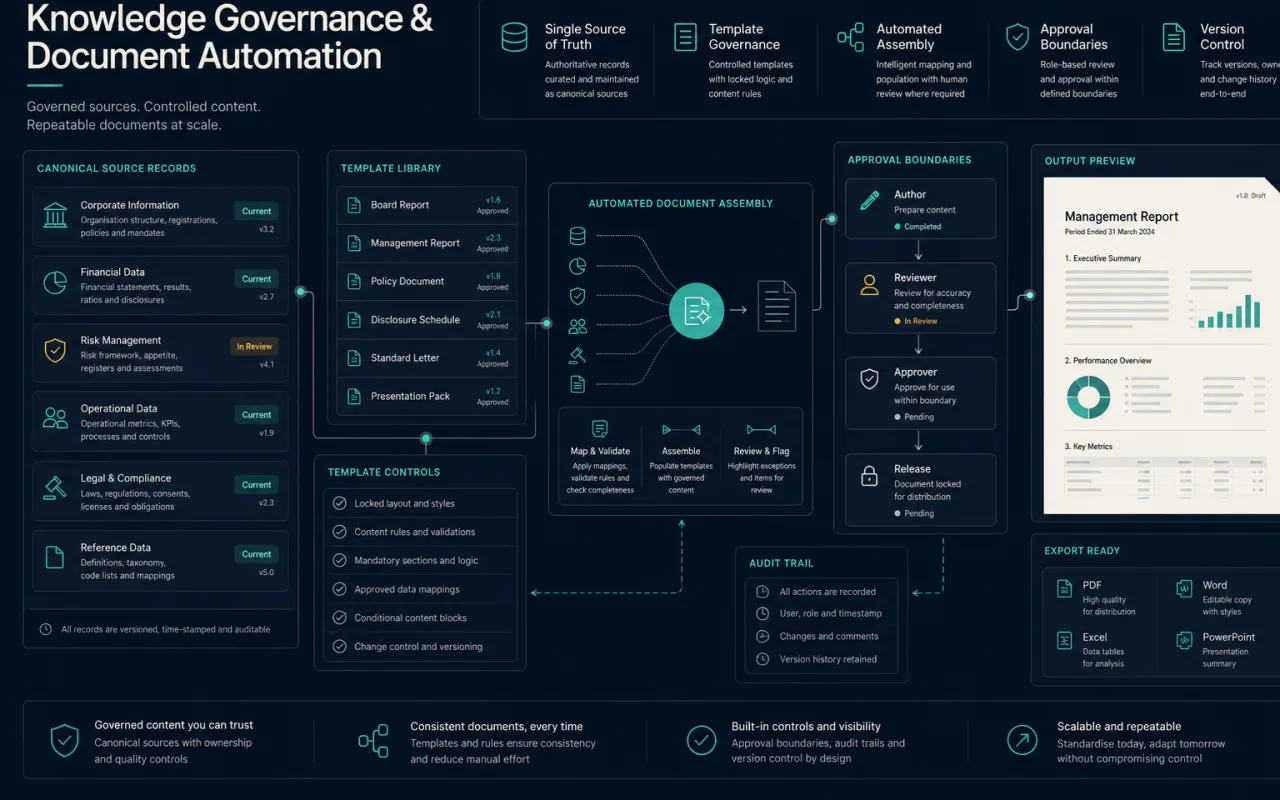
Knowledge Governance & Document Automation
A governed production system for agreements, quotations, candidate profiles, evaluations and reports built from approved business knowledge.
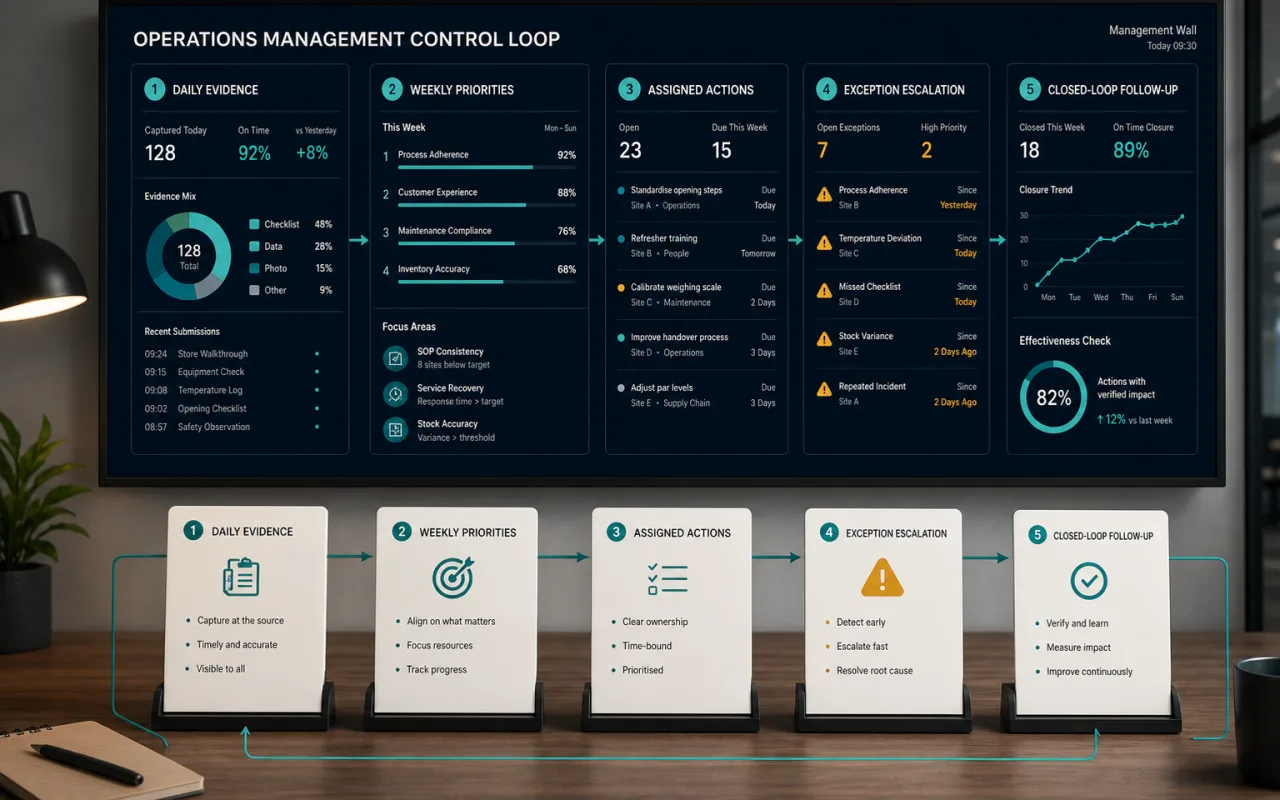
Operations Management Control Loop
A management loop that carries daily evidence into weekly priorities, assigned actions, escalation and delivery status.
What buyers ask.
Repeatable steps with clear rules
Typical work includes file handling, transferring data, generating reports, sending notifications and updating records. Provide an example of the input and the expected output.
Include the exceptions
Missing fields, duplicate submissions or work that needs a person can change the flow. Define these alongside the normal steps so the agreed process can be tested.
Choose the right kind of automation
Connecting two software platforms may need SaaS or API integration. Research, drafting or classification that relies on AI belongs under AI-assisted automation.
What does workflow automation cost in Singapore?
Automation starts at S$480 for one agreed task and ships in 4–10 working days after the scope is confirmed, with test results and operating instructions. The fee follows the agreed steps, the tools involved and how many exceptions stay with your team; company size does not change it. If the process itself is unclear, the fixed S$300 Workflow Review comes first and gives you the current steps in writing plus improvements in priority order.
What decides the quote for an automation?
The number of steps, the number of tools involved, whether each tool offers a supported way to read and write data, how many exceptions stay manual, whether a person must approve each run, how often the work runs, and whether results have to be written back into an existing system. Send one real example of the task and those answers are usually visible in it.
What if the tools we use cannot be connected?
The scope confirmation answers that before any work starts. If a tool offers no supported way to read or write its data, we say so and agree an alternative such as an export and import path, or the task is not worth automating in its current form. Connecting two business systems instead is a separate service, SaaS or API Integration from S$720.
How do we know it works before it handles real work?
The automation is run against your own sample inputs and the exceptions you listed, before handover. Those test results are part of the delivery, so you can repeat the same cases yourself and see the same output. The scope names which samples count as accepted.
What happens when a step fails or a record is missing?
Exceptions are agreed in the scope, and the delivered instructions state what the automation does when it cannot continue and which person takes over. Ongoing monitoring is not part of this service; if you want the automation watched on a schedule, that is arranged as ongoing maintenance from S$250 per month.
Can one automation cover a whole process with several people?
Start with one task end to end; that is what makes an automation testable. A process with several roles, permissions, approvals and records to keep is usually a custom business system from S$1,500, where the roles and rules are part of the agreed scope.
Is this different from AI automation?
Yes. This service automates steps whose rules can be written down: move data, generate a file, update a record, send a notice. Work that needs reading unstructured content, classifying it, or drafting a first version is AI-assisted automation from S$900, where the review steps stay visible in the design.
The other three lines
- Websites & Online ExperiencesMake your business easier to understand, trust and contact online.
- Web Apps & Business SystemsTurn work scattered across chats and spreadsheets into software your team can use.
- Data & ReportingBring scattered data together and make recurring business reporting easier to maintain.