
Line 02 of 04
Web Apps & Business Systems
Turn work scattered across chats and spreadsheets into software your team can use.
- What gets built
- Web applications, customer portals and internal tools for records, orders, bookings or approvals.
- How you use it
- Let people sign in, work with the records they need and move a task through agreed steps.
- How the scope is agreed
- Define users, roles, records, workflow rules and acceptance examples. The proposal sets the implementation, deployment, handover and support scope for this project.
- Where to start
- Walk us through one process, who uses it and where it breaks down today.
Offers and prices
Each offer has a stated scope and price.
The listed price covers the stated scope; anything beyond it is quoted after review.
Custom Business System
A dedicated system replacing fragmented chat, spreadsheets and manual follow-up.
DeliveryConfirmed after requirements are reviewed
From S$1,500Small Technical Fix
Targeted remediation for a defined fault in a website, script, automation or system integration.
Delivery1–3 working days
From S$180Code or System Review
A structured review of technical risks, impact and remediation priorities in existing code or systems.
Delivery4–8 working days
From S$480Website or System Migration
Planned migration of hosting, platforms, websites, data storage or other operating infrastructure.
Delivery4–10 working days
From S$480Ongoing Maintenance
Ongoing technical support for an existing website, automation or business system.
DeliveryTiming agreed with the maintenance plan
From S$250 per month
The line’s starting offer
Custom Business System
A dedicated system replacing fragmented chat, spreadsheets and manual follow-up.
A custom business system or internal tool, including the agreed deployment and operating instructions.
How the work runs.
- 01
One process, one record chain
The point of a business system is fewer handoffs, so the first design question is which record travels through the work and where it has to be visible to the next person. Screens and modules follow from that answer, not the other way round.
- 02
Roles and permissions before screens
Roles state who creates a record, who works on it, who approves it and who may only read it, including the cases where one person must not approve their own work. Permissions are agreed from the operating rules rather than added later as a fix.
- 03
Exceptions are part of the scope
Every process has cases that do not fit: a missing document, a duplicate submission, an order that has to be split. Listing those before implementation is what keeps the system usable on a bad day rather than only on a good one.
- 04
Written scope before implementation
The scope fixes the process, roles, records, permissions, rules, exceptions and acceptance conditions, and states what is deliberately left out. Work begins after you confirm it, which is also what makes the fee understandable.
- 05
Where this has been delivered
The eManage operations platform runs workforce supply, customers, workplaces, orders, assignments, attendance, settlement and reporting on one record chain, with modular workflows, permissions, documents and audit trails. E-User is its worker-facing counterpart, and the operational workbench keeps project state, live tasks, evidence links and follow-up queues in one daily surface. All three are described in the project stories below.
- 06
Start with one chain, not the whole company
A first system that covers one process end to end is more useful than a broad system that covers every process partially, because people will actually use it and the remaining gaps become visible from real records. Modules outside the agreed scope stay on the list for a later stage rather than being half-built now.
Related work
Built on this line.
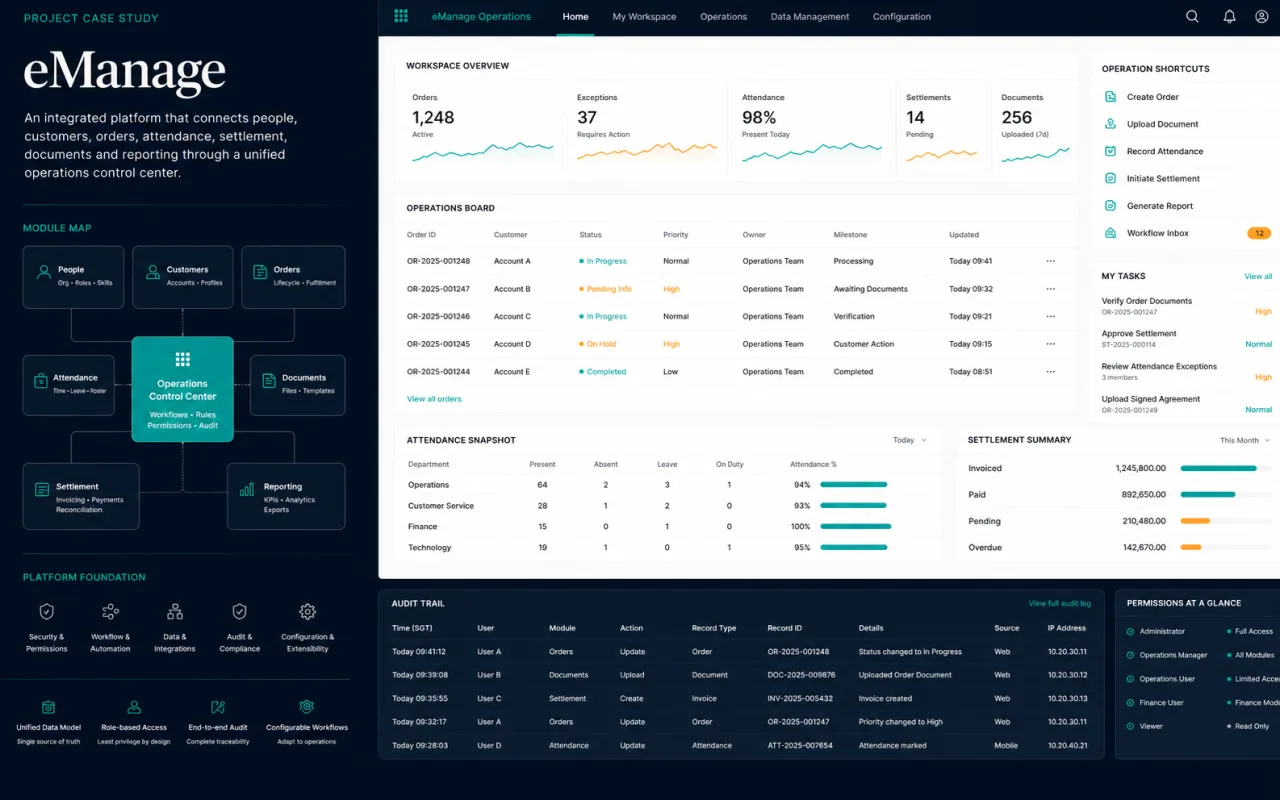
eManage Enterprise Operations Platform
A transactional operations platform connecting workforce supply, customers, workplaces, orders, assignments, attendance, payment, billing and reporting.
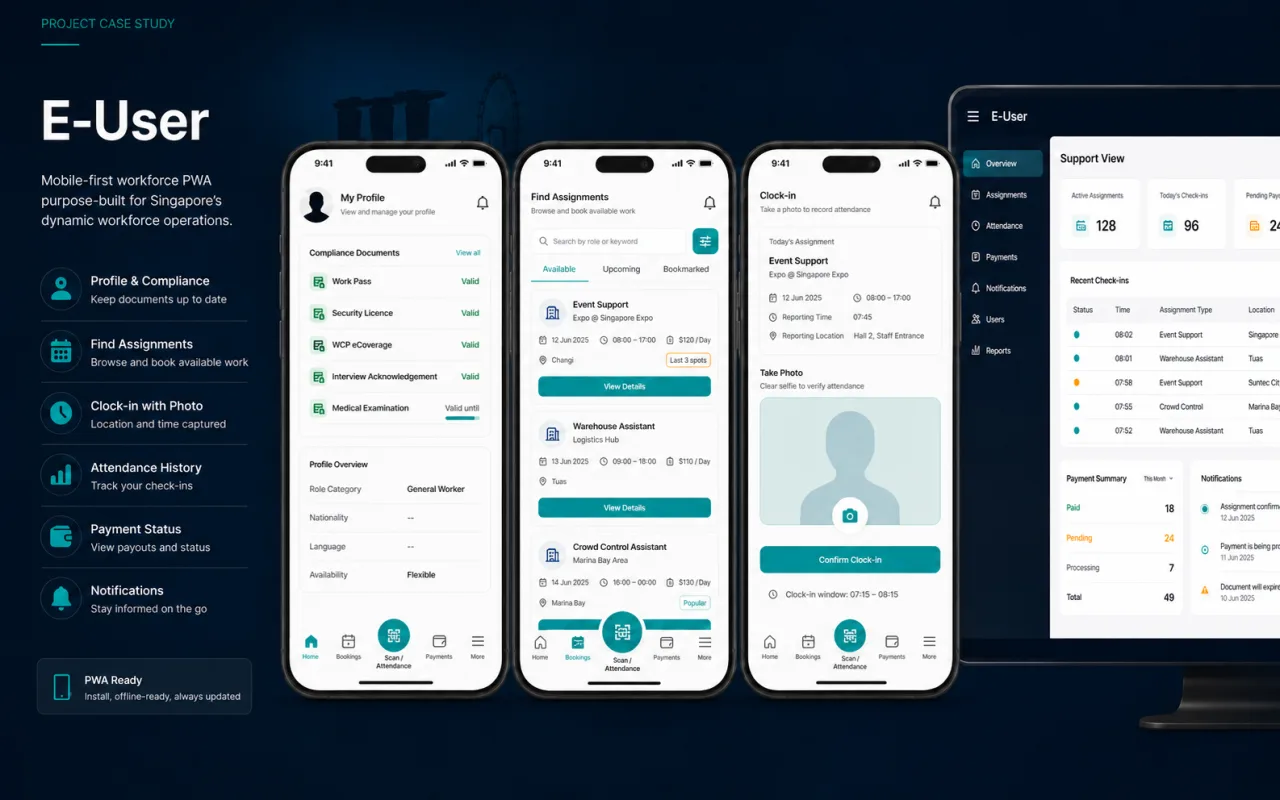
E-User
E-Job’s mobile-first worker portal, designed as the user-facing counterpart to the larger eManage operations platform.
What buyers ask.
How much does a custom business system cost in Singapore?
A custom system starts at S$1,500 and is quoted from the confirmed process, roles, data, permissions, rules, exceptions and acceptance conditions. The fee covers the agreed scope only, so the written scope states which records, roles and rules are included and what is deliberately left out. The project examples on this site show what such systems do; they are not a module list included in the starting fee.
Do we have to replace the tools we already use?
Not necessarily. The scope states which work moves into the system, which work stays in the tools you already use, and whether data has to pass between them. Keeping a tool that works well for you is usually the cheaper decision; a data flow between two business systems is quoted as SaaS or API Integration from S$720.
Who can see and change what?
Roles and permissions are agreed before screens are designed. Tell us who creates a record, who handles it, who approves it and who may only read it, plus any case where one person must not approve their own work. The handover includes operating instructions for each role.
What happens after the system is live?
New features and larger changes are quoted separately. Routine checks and small fixes can continue through ongoing maintenance from S$250 per month, with the response time and monthly expectations agreed in the maintenance plan.
The other three lines
- Websites & Online ExperiencesMake your business easier to understand, trust and contact online.
- Automation & IntegrationConnect the tools you use and reduce repeated entry, manual handoffs and missed steps.
- Data & ReportingBring scattered data together and make recurring business reporting easier to maintain.