Corporate events & MICE · Singapore

Scoped, priced,
and committee-ready.

Corporate events and MICE planned with the scope, the budget band and the document list stated before anyone signs — and with what we do not cover written down.

Send us your brief
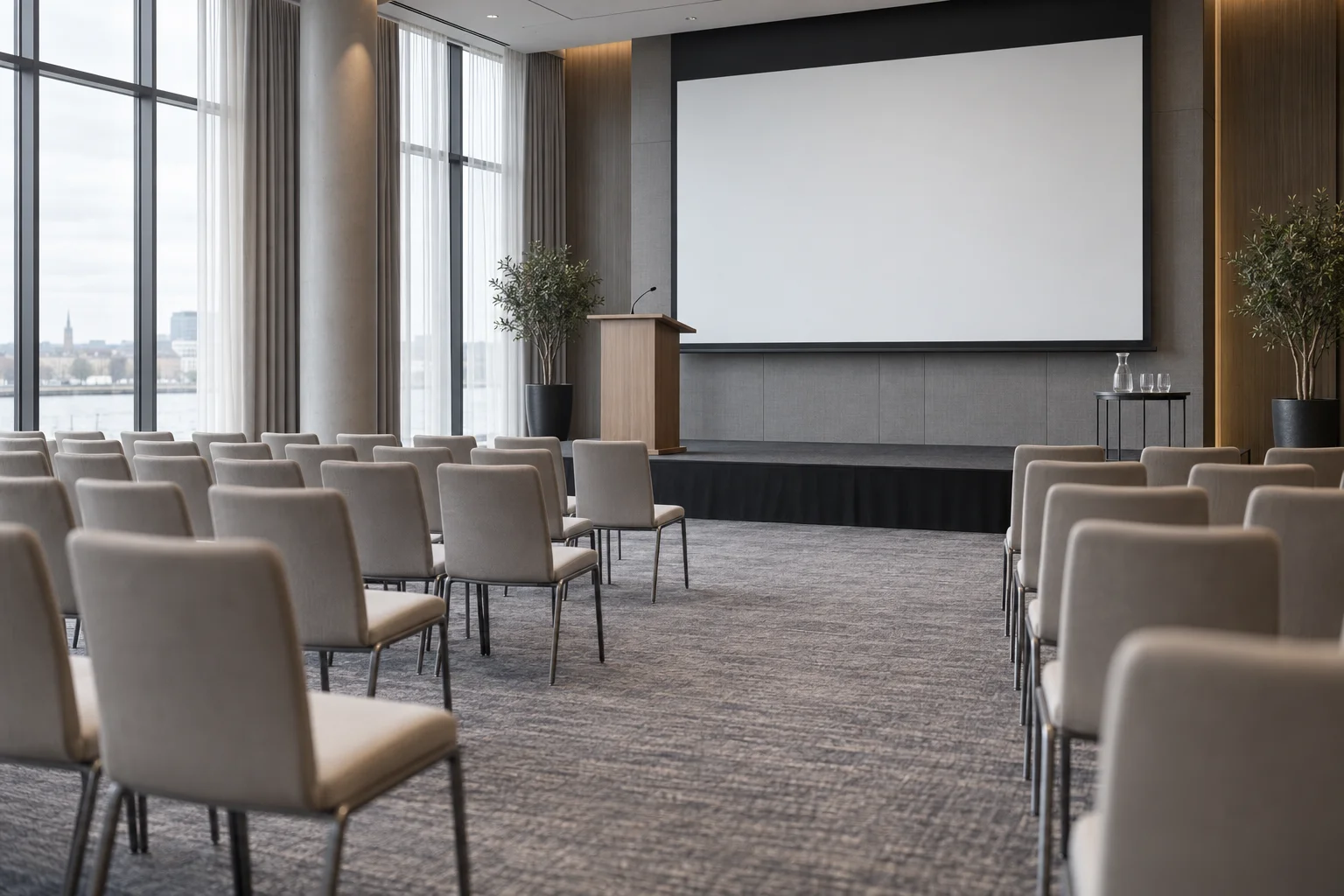
Conference room set for a plenary session, with rows of chairs facing a wide blank screen
ROWS SET / RUN SHEET READY
WeddingsCorporate eventsPrivate celebrationsSee what each scope includes ↓

The three engagements

Comparable
line by line.

A committee compares documents, not intentions. Each engagement below states what the fee carries, what is optional and priced on request, and what stays contracted in your name.

Scope 01

Brief to run sheet

Inside the fee Venue shortlist with indicative cost, budget build and tracking, supplier sourcing and contract review, the programme and run sheet, and one named lead on site.

Quoted separately Venue hire, catering, AV and production, talent, guest transport and every supplier invoice — contracted to you, at cost, with the paperwork in your organisation’s name.

Scope 02

Pick up a decision already made

Inside the fee Reviewing what is already contracted, closing the gaps, supplier management from that point, a reworked run sheet and attendance on the day.

Quoted separately Renegotiating a contract you have already signed, and any cost of reversing a decision that has been paid for.

Scope 03

Approved, execute only

Inside the fee Confirmation with every supplier, the guest list and badge run, the minute-by-minute run sheet, and the load-in and load-out.

Quoted separately Any change to the scope or the venue once the approval paper has been signed, priced as a variation before it is executed.

In every engagement

  • A written quotation, itemised, with its assumptions and exclusions listed separately
  • One named lead from the first conversation to the closeout report
  • Budget tracking against the approved figure, with variance reported before it is committed
  • Status in writing on one agreed day each week
  • A closeout report comparing actual spend with the approved budget

Who contracts what

Workstream by engagement. Inside the fee means it is covered by the planning fee; on request means it is priced as an optional line in the quotation; contracted by you means the supplier agreement and the invoice are in your organisation’s name. Confirm the split in the written quotation before approval.
WorkstreamInside the planning feeOptional, or contracted by you
Venue sourcing and site visitsScope 01 and 02, where the venue is still openScope 03: the venue is contracted by you
Programme, run sheet and rehearsalAll three engagements, reviewed with your internal leadRehearsal attendance beyond one session is priced as a line
Supplier sourcing, contracts and paymentsScope 01 and 02Scope 03: contracts and payments stay with you
Guest registration, badges and seatingOn request, priced as a lineScope 03, where registration is part of the run
AV, staging and productionCoordinated and supervised, never marked upContracted by you at the supplier’s cost
Catering and F&BCoordinated, with the banqueting order reviewedContracted by you, at cost, in your name
Travel, room block and guest transportOn request, priced as a lineContracted by you, so the room-night liability is yours
Documentation, photography and videoOn request, priced as a lineContracted by you, with the usage rights in your name
Closeout reportAll three engagementsNever charged as an add-on

Read this grid before the proposal, not after approval. An exclusion discovered afterwards is the most common reason a corporate quotation is rejected.

The sequence, and what each stage hands over

Every stage
produces a document.

A corporate event is approved on paper and delivered on paper. Each stage below names its output, the working days it takes and who holds it.

  1. Brief call · within 1 working day

    Output: a written brief summary naming the date, the headcount, the budget band, the venue constraints and the requirements of the approving officer. Held by the named lead.

  2. Proposal · within 5 working days

    Output: venue options with indicative cost, a programme rundown, a line-item budget, and a quotation separated into our fee, production and pass-through costs. Held by the named lead.

  3. Approval support · for as long as your process takes

    Output: the quotation in the format your procurement route requires, with assumptions, exclusions and optional add-ons on separate lines, plus insurance and registration documents on request. Nothing is booked until the approval paper is signed.

  4. Supplier contracting · 5 working days from approval

    Output: a supplier register naming each agreement, its value, its deposit, its cancellation terms and its owner.

  5. Run sheet and banqueting review · 10 working days before the date

    Output: the minute-by-minute run sheet and the banqueting order, reviewed with your internal lead and confirmed with every supplier.

  6. Week of the event · status until 48 hours out

    Output: a reconfirmation note per supplier, a staffing list, and the on-site contact numbers in one place.

  7. Event day

    Output: load-in and load-out logs, an incident log, and a supplier sign-off sheet.

  8. Closeout · within 10 working days after the event

    Output: the closeout report — actual spend against the approved budget, variance line by line, the incident log, vendor settlement and what remains outstanding. That is the document your approving officer closes the file with.

Lead time is stated against the format, not against us. Each row assumes the approval path moves at a normal pace; confirm which format still fits your date before the brief goes to committee.
Format and scaleUsually needsWhat decides it
Dinner or internal meeting, up to 50 pax4 to 6 weeksVenue availability, and whether a permit is required
Conference or awards night, 100 to 300 pax3 to 4 monthsThe venue hold, the production lead time, and how long your approval takes
Multi-day programme, 500 pax and above6 months and upThe room block, guest travel, and the number of contractors in the chain
Regional MICE programme with hosted delegates6 to 9 monthsFlight and room-block release dates, not the production

What has to be signed, and when

  • Approval paper signed before any contract is issued — a date is not held until then
  • Deposit paid by the supplier’s stated deadline; a released hold is usually re-sold within days
  • Guest registration closed 10 working days out, because badges, seating and catering follow that number
  • Final headcount confirmed to the venue at its own cut-off, commonly 72 hours to 7 days before the event
  • Insurance and registration documents requested at brief stage, because their absence is what delays appointment

What a missed date costs is stated per supplier in the supplier register: normally a deposit, a move to a higher rate, or the date released back to the venue.

Formats we run

Name the format,
not the mood.

Each of these is a different approval path, a different venue and a different run sheet. Pick the closest and the enquiry starts in the right place.

What we will tell you before anyone commits

  • What each shortlisted venue actually holds, by layout, with the difference stated rather than averaged
  • Which costs are per person, which are per day and which are one-off
  • The production lead time for the stage, the AV and the power available on the site you have chosen
  • Which suppliers must come from the venue’s approved list, and what that does to the cost
  • Which parts of the programme can wait for approval and which cannot

We do not own a venue, a stage or a kitchen. Hire, catering and production are contracted to you at cost, which is why the planning fee is separate and visible.

Before the approval paper

Bands, stated
as bands.

A band is not a quotation and this page will not pretend otherwise. The bands exist so a committee can test whether a plan is affordable before anyone holds a date.

Illustrative concept pricing, not a quotation. Each band assumes a Singapore venue, one day, the stated headcount, the Scope 01 planning engagement, and the venue, catering and production contracted to you at cost. Bands move with the venue tier, the day of the week, the month, the production specified, how late the brief arrives, and how many days the programme runs. A quotation states its validity period and is issued in writing after the brief call.
Format and scalePlanning feeTotal budget band
Executive dinner, 20 to 40 pax
One evening, a restaurant or a private room
From S$3,500S$12,000 to S$30,000
Town hall or internal conference, up to 100 pax
Half a day, one room, in-house speakers
From S$5,500S$25,000 to S$60,000
Conference or awards night, 100 to 300 pax
One day, staging, F&B and an awards segment
From S$9,000S$60,000 to S$180,000
Product launch or activation, up to 200 pax
One to two days, build and teardown inside the access window
From S$8,000S$45,000 to S$150,000
Multi-day programme or regional MICE, 300 pax and above
Two or more days, hosted delegates, a room block
From 12% of the approved budgetQuoted after the brief
Illustrative concept pricing, not a quotation. The fee basis is stated in the quotation rather than assumed. What moves the planning fee: the number of days on site, whether production is managed by us, how many venue options you need compared, the volume of contracting, and whether your procurement route requires documents in a particular format.
Fee basisWhen it appliesHow it is stated
Per eventOne day, one room, one decisionA fixed fee for the scope written down in the quotation
Per event dayMulti-day programmes where the on-site days decide the workA fee per day, with each day listed
Percentage of the approved budgetProgrammes above S$300,000, or where you ask us to carry productionA stated percentage, with the budget it applies to defined in the quotation

Pass-through costs are never marked up quietly. Venue, catering, production, talent, transport and photography are billed to you at the supplier’s cost with the invoice attached; the planning fee is the only line we add.

What is not in the headline figure

  • Service charge, where the venue levies one, and VAT. Two separate lines on the quotation, each named, neither absorbed into the band you approved.
  • Staffing beyond the hours in the plan, and staff called past the run sheet’s close, priced per hour against the run sheet you signed.
  • AV, power, rigging and freight where the venue’s own rig does not cover them, quoted from the venue’s schedule rather than estimated by us.
  • Overtime: extra venue hours, extended access and any tail after the close, billed by the venue to the event and passed through with the invoice attached.
  • The review sheet names which of these are capped and which come back for a second signature. That sheet is issued before the approval paper is signed, not after the invoice arrives.

No figure here is a quotation, and none of it is a promise about your budget. The quotation is issued in your procurement format, with assumptions, exclusions and optional add-ons separated.

Three briefs, as they were scoped

What a corporate
brief actually buys.

Each card names the occasion, the venue type, the headcount and the engagement bought — the same four facts the approval paper asks for.

Illustrative conference plenary in a hotel ballroom: rows of delegates facing a wide screen and a lectern

Two-day regional sales conference · hotel ballroom, Bugis · 280 delegates · Scope 01

One plenary and three breakout rooms per day, with the venue comparison and the programme rundown handed over inside the five working days the committee worked to.

Illustrative awards night reception in a museum atrium: guests standing with drinks beside a candlelit table

Awards night for an association · museum atrium · 180 guests · Scope 01

A seated dinner with a presentation segment, rehearsed in the room that afternoon, and the guest list handled at the door against the headcount the venue was contracted for.

Illustrative conference table detail: a blank folded name card with no lettering, a closed notebook and a pen beside a glass of water

Town hall with a livestream · in-house auditorium · 120 staff · Scope 03

Run sheet, load-in and load-out only: the internal team owned the content, and every supplier was reconfirmed 48 hours before the doors opened.

Explore the conference brief ↗

280 delegates, two days, one plenary and three breakout rooms. Scope 01, with the venue sourced by us and production contracted by the client. The quotation names a venue comparison with costs, a programme rundown, a line-item budget, a supplier register and a run sheet per day.

Send us your brief

Who you are appointing

One named lead,
and the papers to audit.

A committee appoints a company, but it works with a person. Both are named before the proposal is issued.

The planner named on the proposal

The person who signs the proposal runs the event and holds the supplier register. If that changes, you are told in writing and the replacement is introduced before the date, not on the day.

The lead planner is named on the proposal, with the languages they work in and the formats they have run here.

Appointment documents

These are issued at brief stage, because their absence is what delays a committee: a quotation itemised into our fee, production and pass-through costs; a supplier register with contract values; certificates of professional indemnity and public liability insurance with the limits stated; and the invoicing and payment terms your finance team works to.

We say plainly on the quotation whether the firm is registered for the procurement route you are running. A badge on a web page is not a document, so there is none here.

Registration numbers, insurance limits and payment terms belong in the quotation, not on a concept page.

What we put in writing before appointment

The business registration number is on the quotation against the national register, the insurance certificates are attached rather than described, and two clients who ran a comparable format are named as referees.

If your route is an invitation to quote or an invitation to tender, tell us the threshold and the submission format that applies to your approval. The quotation is issued in that format rather than yours being reformatted into ours.

No certification, licence number or registration claim is made here.

Who owns what

We contract suppliers.
You are never the middleman.

The objection that ends corporate quotations is an unnamed handoff. This is the split, stated before the proposal.

We own

  • Venue sourcing, site visits and the comparison you approve from
  • Supplier sourcing, negotiation and the terms we recommend
  • The supplier register: value, deposit, cancellation terms and owner per agreement
  • The budget tracker, with variance reported before it is committed
  • The run sheet, the banqueting review and the on-site lead

You own

  • Approval, and the internal dates that decide whether the date still exists
  • Every supplier contract, unless you ask us to be the contracting party
  • Payment to suppliers at their invoiced cost, on their stated schedule
  • The final guest list, and the headcount the venue is held to
  • Any statutory, licensing or venue requirement that attaches to your premises
Nothing is booked yet

Bring the format, the month, the headcount and the figure you can get approved. Three of the four are enough to start, and the proposal follows within five working days.

Start the brief
The venue is held, approval is pending

Send the venue’s hold deadline and your approval route. We will say which parts of the programme can wait for the signature and which cannot. This is where a held date is usually lost.

Ask about a held date
Approved, and the date is close

Execution only: confirmation with every supplier, the run sheet, load-in, load-out and the closeout report. Say how many days are left and we will say whether the format still fits.

Run the day

A buyer’s view

“They answered the procurement questions before we asked them, and the quote listed what was not included.”

Two-day sales conference · sample story

Sample story. Not a real customer review.

The questions a committee asks

Before you
commit.

Can you be appointed through our procurement process?

Ask, and we will say plainly whether the firm is registered for the route you are running. The quotation is itemised into our fee, production and pass-through costs, with assumptions, exclusions and optional add-ons on separate lines. Insurance certificates and payment terms are provided on request, and the quotation is issued in your submission format. No registration or certification claim is made here.

What do we get back, and when?

Within one working day, a written summary of what we understood. Within five working days, a proposal: venue options with indicative cost, a programme rundown, a line-item budget and the itemised quotation. We revise it until it is committee-ready, and every revision states what changed.

Is the figure here a quotation?

No. The bands are illustrative figures so you can test affordability before a date is held. A quotation is issued in writing, states its validity period, names the assumptions, lists the exclusions, and prices every optional item separately.

Do you take commission from suppliers?

Every engagement answers this in the supplier register. Any commission, referral fee or discount received from a supplier is disclosed in the supplier register against that agreement. Pass-through costs are billed at the supplier’s cost with the invoice attached, and our fee is the only line we add.

What happens if our approval slips?

A date is held only while the supplier’s own deadline allows it, and every deadline is listed in the supplier register with what missing it costs. If approval moves, we re-price against the new date and tell you the difference before anything is rebooked. We do not quietly hold a date we cannot pay for.

How are changes handled once the run sheet is frozen?

Changes inside the frozen window are priced as a variation and approved in writing before they are executed, including any supplier charge for moving a delivery. Where a change is not possible, we say so rather than absorbing it and presenting it on the final invoice.

Start with the brief

Send the brief,
and get a document back.

Within one working day you receive a written summary of what we understood, the budget band you are working to, and the two or three assumptions the proposal will rest on. Within five working days, a proposal: venue options with costs, a programme rundown, a line-item budget, and a quotation split into our fee, production and pass-through costs.

The quotation is itemised on purpose, and it separates assumptions, exclusions and optional add-ons so your committee can compare it with the other two. Registration and insurance documents come with it on request. Tell us your procurement route and it is issued in that format.

Concept only. Nothing is sent or booked.

Preview your message
Send this enquiry on WhatsApp

Opens WhatsApp with this enquiry ready to send. Nothing is sent or booked until you press send there.

Compare the three engagements · What each stage hands over · Ask a question

Send us your brief