Food premises
Stake: the food-safety inspection your operation faces, and the pest documentation it asks for. What our record does: a dated monthly report per area, device counts, and a twelve-month table that can be handed over without rework.
Commercial pest contracts · Singapore
A pest contract sold as documentation: what is installed, how often each area is visited, what the monthly report contains, and what the contract says when a report is late.
Scope my contractFOOD PREMISES / WAREHOUSING / RETAIL
What the contract covers
A commercial pest contract is bought for evidence as much as for treatment, so both are specified and both are reported.
Stake: the food-safety inspection your operation faces, and the pest documentation it asks for. What our record does: a dated monthly report per area, device counts, and a twelve-month table that can be handed over without rework.
Stake: goods-in, racking and loading bays where a finding closes an aisle. What our record does: devices mapped by zone, catches counted per zone, and an escalation note for the areas that keep producing activity.
Stake: a customer or certification audit asking what is monitored and how often. What our record does: the schedule and the device inventory as documents your quality team can attach to their own file.
Stake: premises open to the public, where a sighting becomes a complaint. What our record does: named attendance windows, discreet device placement, and a written finding after every report rather than a verbal reassurance.
Stake: kitchens, canteens and grounds inspected on a schedule. What our record does: the per-area cycle, safe placement of devices out of reach, and application records for anything used on site.
Stake: a landlord duty with several tenants asking the same question. What our record does: one contract, one contact, and a report that covers common areas and the units on the same sheet.
The index the contract is written around
A contract names the species it is bought for. Each row below carries the monitoring method that detects it and the protocol the technician applies, so a visit cannot be argued about after the fact.
| Pest | Monitoring method | Treatment protocol |
|---|---|---|
| Rodents Rats and mice | Tamper-resistant stations and indoor traps on the device inventory, each numbered and mapped by zone, read every visit; entry points traced on the perimeter round. | Entry points identified and sealed as a separate line item, then station placement reviewed against the catch record. Carcass removal, clean-down and deodorising sit inside the routine visit. |
| Cockroaches | Harbourage inspection in service runs, cabinet voids, equipment bases and bin areas, with gel-bait points numbered and read each cycle. | Gel baiting at the harbourage, with a residual only where the surface allows. The harbourage itself is written up as a finding for the site to close, not sprayed over. |
| Flies | Insect light traps on the inventory, with catch counts recorded per unit, plus larval-source inspection at waste and wash-down points. | Trapping and source removal first. Fogging is used only where the breeding site cannot be removed, and is named in the scope rather than assumed. |
| Stored-product insects | Pheromone and pitfall monitors in storage and racking, with goods-in inspection and a check of the lots that have sat longest. | Stock rotation and segregation of an affected lot first. Commodity treatment or fumigation is a named variation with its own notice and its own price, never inside the monthly fee. |
| Birds | Roost, ledge and loading-bay inspection on the perimeter round, with each landing point recorded by location. | Exclusion and proofing specified from the survey finding. Where a nest is active, the site confirms what its own rules allow before exclusion work is scheduled; that check is the operator’s, and the scope says so. |
The table is the index, not the diagnosis: which rows apply to you, and at what frequency, comes out of the survey baseline and is listed on your schedule. Where a species needs a specific process or a licence to treat, the requirement that applies to your premises is written into your scope before that work is scheduled, with the process named.
What is actually installed
Every contract opens with an inventory: what is fitted, where it is labelled, and how the count is read each visit. The three entries below are written the way the inventory reads on site.
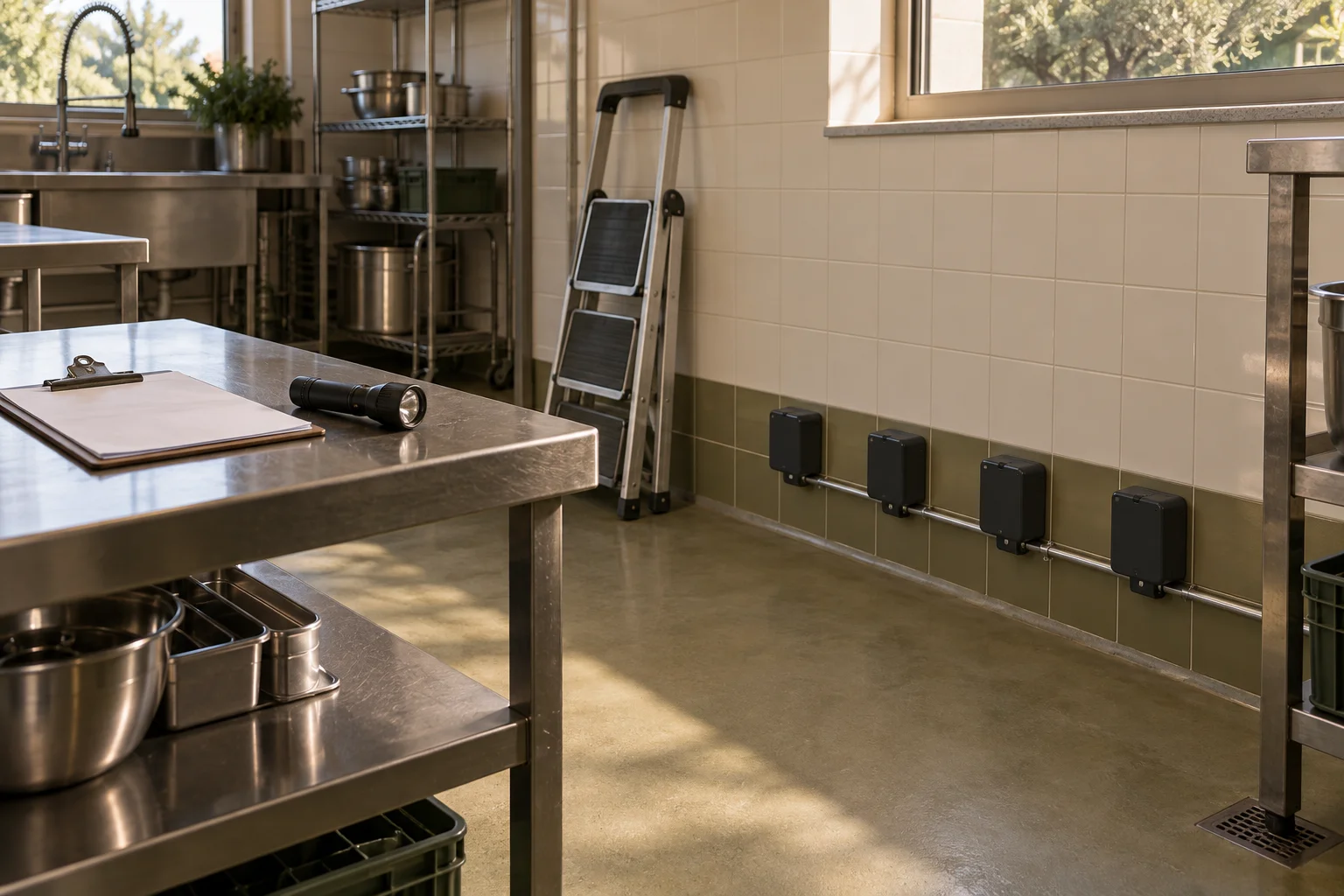
Up to 16 devices / fortnightly in food and waste areas / readings logged per station
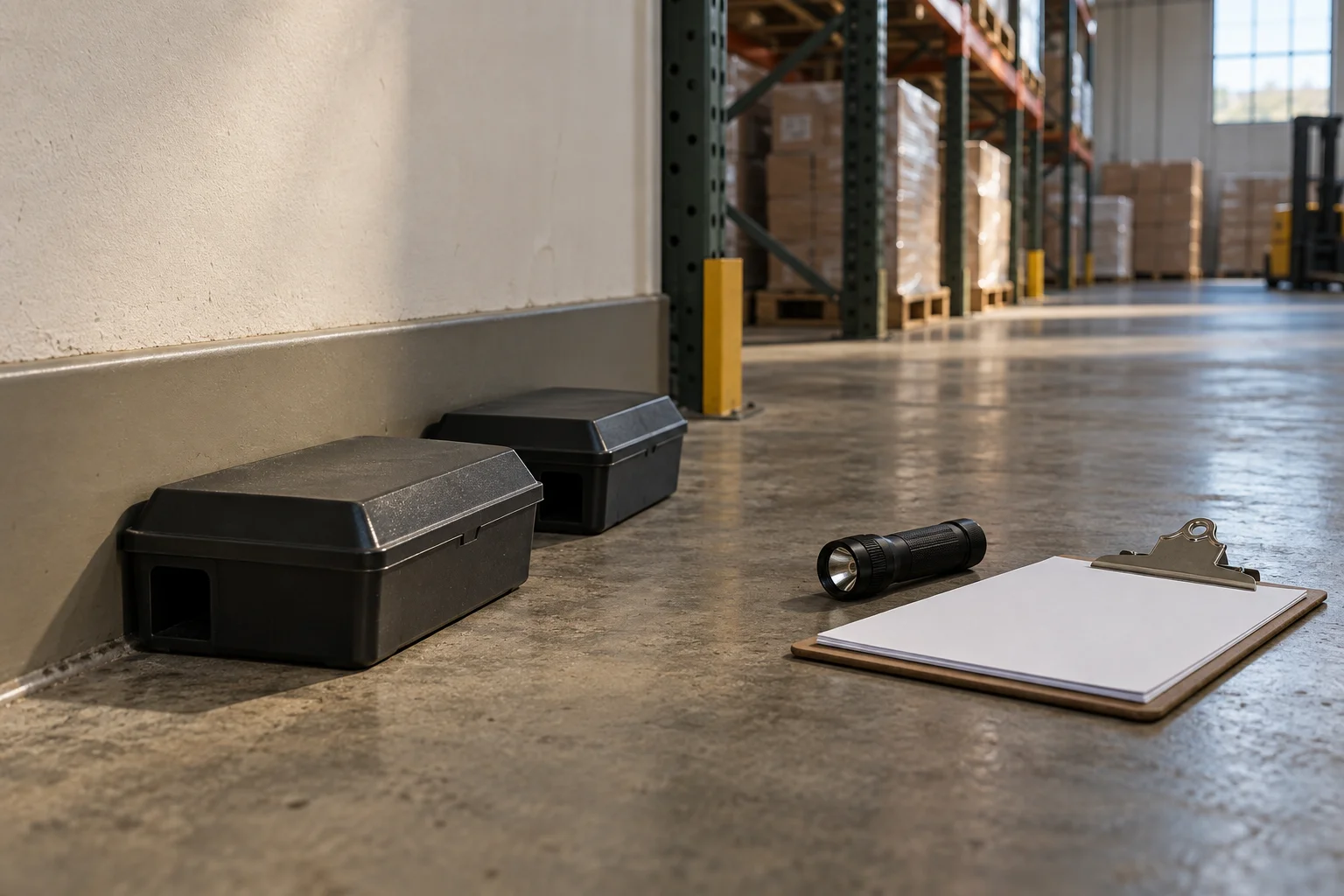
Stations on the inventory, each numbered and mapped by zone, read at every visit whether or not anything is found.
The inventory lists every unit by zone: tamper-resistant stations where access is uncontrolled, boards and traps where monitoring is the point, light traps where flying insects are the problem. Lids are secured, units anchored, and placement is agreed with the operations team before fitting. A device that is missing, damaged or moved is a line in the report, and the inventory is re-issued in writing whenever the count changes — the monthly figure is argued from that document.
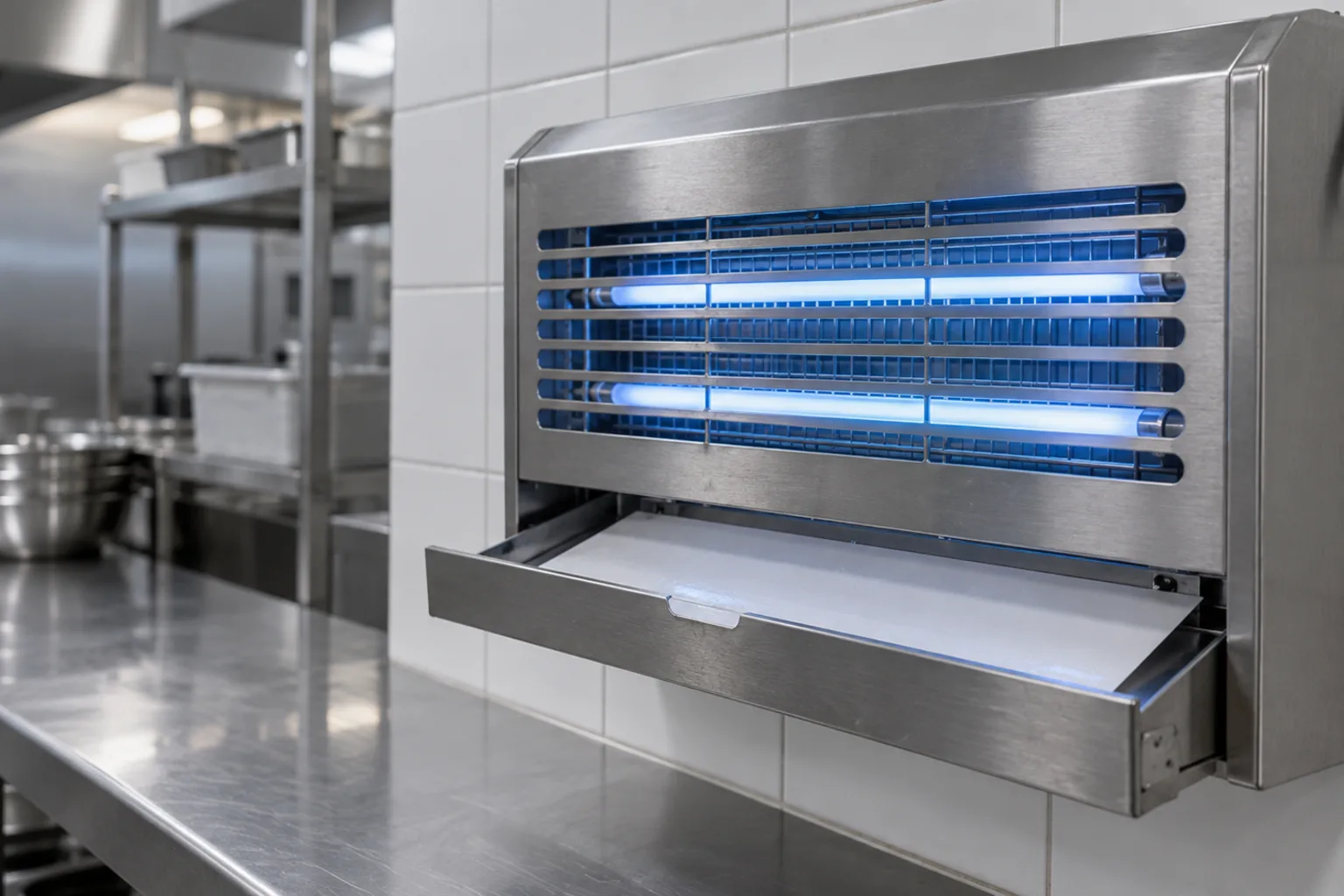
Per-unit catch counts / replaced on the cycle / trend kept by zone
Flying insects entering with deliveries are trapped at the door rather than found in the preparation area.
Each trap is on the inventory with its own location, and the catch count is recorded per unit at every visit, so a rise at one door shows up as a number before it shows up as a complaint. Boards and tubes are replaced on the cycle the contract states. Where the count keeps rising, the larval source is inspected at the waste and wash-down points and written up as a finding for the site, because trapping alone does not close a breeding site.

Issued within the month / signed on site / one page for twelve months
The document an auditor reads first is written on the day of the visit, not assembled before an inspection.
Before the visit the devices are checked against the inventory, so a missing unit is a finding rather than an oversight. During it, activity is recorded by zone and device number with the harbourage or entry point named where it can be identified. Anything needing preparation is flagged to your nominated person the same day, and after it the devices are reset or replaced and the cycle is written into the monthly report: findings by location, device counts, activity per zone, action taken, and a rolling twelve-month table on one page.
Devices stay ours and are serviced or replaced on the cycle the contract states. The inventory, the device map and the monthly report set are the three documents the monthly figure rests on, and each of them is re-issued rather than amended quietly.
What a visit leaves behind
A contract is renewed on the file, not on the visit. So each attendance produces the same documents, in the same format, whether or not anything was found.
Request the sample packA nil return is still a report: it records that the areas were attended and nothing was found, which is the entry an inspector reads first. Where an inspection or a scheme asks for a particular format, tell us which one and confirm the current requirement with the body that set it. The pack is then built to what you give us, and the report says what was found, what was done and where — the compliance statement is the scheme's to make, not ours.
The schedule and the file
Frequency is a floor, not a ceiling: each area carries a minimum, and it rises with what the reports keep showing. Nothing about it is a general promise.
Check a site schedule| Area | Minimum frequency | What is checked each visit |
|---|---|---|
| Food preparation & storage | Fortnightly | Devices on the inventory, droppings and gnaw marks, seal and door gaps, waste handling in the area |
| Waste and bin centres | Fortnightly | Station condition and contents, spillage, wash-down state, entry points into the building |
| Roof voids, false ceilings, service runs | Monthly | Runs, cabling damage, moisture, evidence along the route |
| Walls, door gaps, beams and floors | Monthly | Structural gaps, burrows at floor level, harbourage behind fittings |
| Perimeter, landscape and loading areas | Monthly | Station placement and integrity, vegetation and refuse against the building, external runs |
| Sighting during the cycle | Within the attendance window in the agreement | Cause investigated, action taken, and a written finding added to the current report |
Signed by the attending technician and acknowledged by your nominated person. It is due within the month it describes — and the contract states that a report that is late or missing is a payment item, because documentation is what you are buying.
The crew assigned to your site is named in the contract, with a nominated contact and a stated attendance window, and we give written notice before any change of personnel. Where a licensing regime applies to the work, the licence or registration number of every attending technician is annexed to the agreement before work starts, and the same number appears on the technician's own paperwork, so the person who turns up and the document you hold describe the same crew.
The materials are annexed with their safety data sheets, and the report format is agreed from a sample pack before the first cycle. What we do not do is print a number, a badge or a scheme name on an agreement to make it look better than the file behind it.
The monthly line on the invoice is released when the report for that month is issued, so a month with no report is a month with no payment line. A report issued late is still issued before the next cycle, and the withheld line is released with it. A scheduled cycle missed without an agreed variation is credited at the contract rate rather than rescheduled into a busier month.
Corrective actions are listed with the date each is due and the person on your side who owns it. Repeated open items are what triggers a frequency increase, and that increase arrives as a written variation with its own price before it takes effect — never as a quiet change to the schedule you are paying for.
If a report is late, that is ours to fix: the missing report is issued and the payment item applies as written, rather than being argued about afterwards.
The rate basis
Most operators in this category quote only. The basis below is written so a budget can be tested before anyone visits, and so the monthly figure can be argued from the device count.
| Premises | Devices and cycle | Monthly from |
|---|---|---|
| Small premises Under 500 m², one kitchen, no storage yard | Up to 8 devices, monthly service | S$180 |
| Food premises Kitchen, storage, bin centre | Up to 16 devices, fortnightly in food and waste areas | S$340 |
| Warehouse or light industrial Racking, loading bays, perimeter | Up to 30 devices across zones, monthly with a quarterly perimeter round | S$520 |
| Multi-area or multi-building site Several kitchens, stores or blocks | Inventory per building, cycle set per area | Quoted from the inventory |
| Priced separately | Basis | From |
|---|---|---|
| Monitoring device, added mid-term | Per device, per month, including servicing | S$18 |
| Digital sensor point | Per point, per month, with activity logged between visits | S$45 |
| Additional attendance on a sighting | Per visit, outside the stated window | S$120 |
| Proofing and exclusion work | Quoted from the survey finding, per opening | Quoted |
| Audit preparation and support | Per audit, documents and attendance | S$350 |
What moves the number: the number of distinct areas rather than the floor area, the device count, how often the food and waste areas need attendance, access hours and escort time, and whether the site produces repeated findings. A figure quoted over the phone is a guess dressed as a rate — the inventory is what the number rests on, and it is re-issued whenever the site changes.
The written scope
Compliance work is where a pest contract quietly grows. Both lists are agreed before the first visit.
Check a scope with usThe scope states which requirements are ours and which stay the operator's. Where a regulation, inspection standard or certification scheme applies to your premises, the obligation is yours to meet and ours to document — what we do is document the programme to the current requirement, and we say so in writing.
Before the contract starts
A pest contract touches food areas, stock and staff, so the paperwork is part of the offer rather than an answer given later: it is issued with the agreement, before the first visit.
Scope a contractEvery name, number and count on the agreement is one we can produce on the day: the same licence number appears on the technician's paperwork as on the annex, and the device count on the invoice matches the inventory. Where your premises is measured against a food-safety scheme, a customer standard or a head-office audit, meeting it stays your obligation and the documents it asks for are what we supply.
How a contract starts
Every accessible area, refuse points and bin centres inspected, signs of activity recorded, entry points and housekeeping issues identified. Output: a written baseline with the problem areas named.
Devices specified by zone, agreed with your operations team, then fitted, numbered, labelled and mapped. Output: the device inventory.
The per-area cycle set from the baseline, with term, notice, the attendance window and the report due date on one page. Output: the schedule and the agreement.
Routine service begins, devices serviced and findings recorded by zone. Output: the first monthly report.
The report is walked through with your nominated person: what was found, what was done, what the site must arrange, and whether the frequency still fits. Output: an agreed action list and any written variation.
A quality manager's view
“The audit asked for twelve months of pest records and we handed over one table. The device count in the report matched the invoice.”
Food premises contract · sample story
Sample story. Not a real customer review.Terms and objections
The visits at the frequency floor in your schedule, the devices serviced or replaced, and the report pack: findings by location, device counts, activity per zone, action taken and the rolling twelve-month table. The areas and their minimum frequencies are listed in the contract, so “what does a month contain” has a written answer.
You get the documentation an inspector asks for: the schedule, the device inventory, dated reports with findings and actions, and a twelve-month summary on one sheet. Our reports state what was found, what was done and where it was done; a statement of compliance is the certifying body's to make, not ours. Where your premises is measured against a scheme, the documentation is written to that scheme's current requirement, which is confirmed at the survey and kept on file.
Because the basis is not a secret: areas, device count, frequency and access. A budget can be tested against the table, and the survey then moves the figure for a reason you can see. Where a figure genuinely depends on the site — proofing, fumigation, multi-building inventories — it is quoted rather than guessed at.
The attendance window in your agreement applies, and the visit is part of the contract inside that window. The cause is investigated and written up rather than treated and closed, and the finding is added to the current report so the pattern is visible at the next review.
The contract names the crew, a nominated contact and the attendance window, and it requires written notice before any change of personnel. If a cycle is missed or a report is late, the payment item applies as written. There is no unnamed subcontracting behind the schedule.
Yes, in both directions and in writing. A cycle is raised when the reports show activity, and it is reduced only by an agreed variation — which means the frequency you are paying for is the frequency the documents show you needed.
Start with the site
Give us the kind of operation, the areas involved and any inspection your site is measured against. A survey follows, and the schedule and inventory come out of it.
Concept only. Nothing is sent or booked.