Commercial laundry & linen · Singapore

Rented or your own linen.
One rate card.

Every commercial line carries two columns — our stock at a pre-agreed rental, or your own linen washed by the kilogram — with the minimum per collection, the collection days and the term stated before you sign.

Price my contract
Standard
Three working days
Express
Next day, surcharge
Collection
Minimum order applies

Common items

Illustrative concept pricing. Confirm the current price list, the minimum order for collection and the express surcharge.
Shirt, laundered and pressedS$2.50
Shirt, dry cleanedS$6.00
TrousersS$7.00
Two-piece suitS$22.00
Dressfrom S$14.00
Duvet, single or queenfrom S$28.00
Curtain, per panelfrom S$18.00
Sneakers, per pairfrom S$25.00
Illustrative laundry counter with stacked folded shirts and a rail of plain garments behind
LINE CARD / PER KILO
Wash and foldDry cleaningCollection and deliverySee what we check before cleaning ↓

Who the account is for

Six sectors,
one rate card.

Pick the sector closest to your operation. Each one collects on the cadence that sector actually runs, and every item behind it sits on the same two columns as everything else on this rate card.

Illustrative concept pricing, not a quotation. Per-piece figures are per item per service cycle, assuming a weekly collection, a 150 kg weekly minimum and a rolling monthly agreement. Rented figures assume our stock and include replacement at normal wear; wash-only figures assume your own stock and exclude all replacement. Clinic and healthcare programmes, contaminated loads and anything needing a separate wash programme are quoted separately. Confirm current rates with the operator.
Line, per pieceRented · our stockWash-only · your stock
Bed sheet, single or queenS$0.95S$0.55
Duvet coverS$1.40S$0.80
PillowcaseS$0.45S$0.25
Bath towelS$0.80S$0.50
Hand or face towelS$0.45S$0.25
Tablecloth, banquetS$2.60S$1.50
NapkinS$0.40S$0.20
Chef jacket or trousersS$1.80S$1.10
Salon capeS$1.20S$0.70
Patient gownS$1.10S$0.65

The two columns are the point of the page. Price both against your own item list before you choose a model: on some lines your own stock is cheaper, and on the short-life items the rental spread usually is.

Illustrative concept pricing, not a quotation. Per-kilogram bands are for mixed commercial work — bed linen, towels, table linen and workwear — at the weekly volume committed to in the agreement, with the minimum per collection applied on top. The band follows what you commit to weekly, not what you happened to send this week: a 900 kg week after twelve 200 kg weeks is quoted as a one-off. Heavily soiled kitchen linen, workwear with a name or size tag, and any single-textile programme sit outside the band and are priced from the per-piece card. Confirm current rates with the operator.
Band, by weekly volumePer kg
Mixed linen, under 300 kg a week
Notes: Weekly or twice-weekly collection; 25 kg minimum per collection
S$1.80
Mixed linen, 300 to 800 kg a week
Notes: Twice-weekly collection included; sorted at our plant, not at your back door
S$1.55
Mixed linen, above 800 kg a week
Notes: Daily collection available; rotation report included in the monthly invoice pack
S$1.30
Towels only
Notes: Tumble-dried and folded; spa wraps and bathrobes are priced per piece above
S$1.45
Table linen only
Notes: Pressed and returned flat or on hangers, to whatever service standard your floor requires
S$1.90
Workwear only
Notes: Per garment, tagged; repairs quoted and approved before they are made, never after
S$2.30

Starter account

Two collections a week, up to 150 kg a week, next-working-day turnaround, one invoice a month. Priced from the under-300 kg band for the volume you commit to, and the band steps down as the weekly figure grows, without a fresh negotiation at each step.

Custom account

More than one site, daily collection, a programme per textile type and stock held at our plant for you. Written as an account schedule rather than a price per piece: sites, collection days, committed volumes, rate basis, review date and the name of the person who answers when it goes wrong.

Before it goes in the wash

What we check,
and what we
decline.

A commercial wash hides damage inside a cage. So the check happens on arrival, in front of your driver, and it goes on the docket. This is what is recorded and where we stop.

Counted in, on paper

Every load is counted by item type against the collection docket while the van is still there. A count that is not written down is not a count, and a dispute about a missing sheet eight weeks later is unfixable without one.

Existing damage recorded

Thinning hems, perished elastic, split seams, torn edging, missing buttons and faded panels are noted per piece. The note decides what is a wash problem and what was already on its way out.

Stains flagged, not promised

Ink, bleach, rust, oil, sunscreen and anything heat-set by an iron are permanent often enough that we will not sell a removal. They are flagged on the docket, treated where the fibre allows, and reported back either way.

What we decline

Linen contaminated with blood, body fluids or chemicals; loads with sharps, glass or surgical waste in them; wet or mouldy loads; and commercial loads with household items mixed through them. A refusal is written on the docket with the reason.

What happens instead

A contaminated or sharps load goes back unused and unbilled, or is referred to a laundry set up and permitted to handle it. Mixed domestic and commercial articles are separated and billed as two loads, and you are told before the second one runs.

Colour, shrinkage and new stock

New or heavily dyed stock is washed separately the first time, because that is when it runs. Shrinkage on a first wash is a property of the fibre, not a fault in the wash, and we say so before the first load rather than after the third.

The return count, and the 48-hour clock

Every return is counted against the collection docket as it is unloaded, and that count travels back with the delivery. A short or wrong count is raised in writing within 48 hours of the return: inside that window the docket decides, after it the docket is the record and the variance is closed. A shortfall raised eight weeks later cannot be priced against anything, which is the whole reason the window exists.

What we pay for, and what we do not

Where an item is lost or damaged in our care, liability is capped at the lower of the depreciated value of the piece and the multiple of its cleaning charge agreed in the schedule, and a settlement is final. An item already noted on the docket as thinning, faded, split or missing a button is not a wash claim; neither is colour loss on heavily dyed new stock in its first wash, shrinkage on a first wash, or damage caused by something left in a pocket. A piece settled at the cap is written off rather than returned, because a written-off item cannot come back into circulation.

Reconciled monthly, not argued yearly

The running count is reconciled every month against a physical spot-check of the linen room, and the difference is reported to you rather than held until renewal. A write-off rate above the rate agreed in the schedule, measured per year on stock in circulation, triggers a route and handling review with you. Par levels come from your covers or occupancy, not from last month’s order: three par where the turnaround is 24 hours, more where part of the wash runs on site.

Whose towel is it

Marking, counting,
and the record.

The question behind every linen contract is whether your own stock comes back. That is answered with a mark and a count, never with a promise.

Item marking

Woven name tabs, heat-sealed labels or a bar-coded chip at the hem. Our rental stock is marked at the plant before it ever reaches you. Your own stock can be marked for a per-piece charge, quoted before it is done and invoiced as its own line.

Count in, count out

Both figures, by item type, sit on the return docket. The docket goes back with every return, and the first month's dockets come as a set, so the difference between what went out and what came back is on paper rather than in a conversation.

Shortfall and write-off

A difference is raised against the load it belongs to. Liability is capped at a multiple of the service charge for that item, not at what it cost to buy, and the multiple is written into the agreement rather than quoted from memory. For new, branded or specialist stock, agree a declared value at the start.

Repair or replace

Torn hems, split seams and missing buttons on rental stock are repaired at a stated per-piece price. On your own stock the repair-or-replace decision is yours, written on the docket, and we do not make it for you.

The rotation report

Item-level tagging produces a monthly report: what went out, what came back, what is in the plant, and what is out of circulation for repair. It is the artefact that ends a stock argument, and it is the reason tagging is quoted at all.

What tagging does not do

A tag does not stop loss, and it does not replace the weekly count. When a tagged item does not come back, the figure it is settled at and the claim window that runs from the signed docket are both written into the agreement rather than quoted from memory.

When the van comes

The collection
you actually get.

Cadence, by route day

Daily, three times a week, twice a week or weekly, chosen from the route days that already run past your address. The day is fixed per site, named in the account schedule, and does not move because another customer needs it more.

The window

A morning or an afternoon window, not a promise of a time. The same driver runs the same route, so a late van is a known problem with a name attached rather than a surprise.

Same-day and next-day

Offered only on a route that already passes your address, priced per trip, and not absorbed into the per-kilogram rate. In a peak week it is offered as capacity allows, and we say which day it cannot be done rather than accepting the order.

If the load is not ready

The trip is charged at the stated visit rate, and the next route day stands. Tell us before the window closes and the load rolls to the next collection at no charge, which is the option most accounts use.

If we miss you

The return trip is ours, in the same week where the route allows, and the missed visit is logged on the account rather than absorbed quietly. Our miss rate for the quarter is sent with the invoice pack, and every missed visit is logged against the account rather than absorbed quietly.

Off-route addresses

An address off a running route day is priced as an off-route visit at the figure in the service guide, not refused and not quietly loaded into the per-kilogram rate. If the route later covers your area, the charge comes off.

Peak weeks and holidays

Peak periods are planned with you: the volume you expect in a peak week is stated when the contract is written, and holiday weeks are published as a revised calendar a month ahead. A December that nobody planned for is a December that short-ships somebody.

Gate, floor and access rules

Trolley access, loading bay hours, security clearance and lift booking are agreed before the first collection. If the site cannot give access at the collection time, that is a route change, quoted as one.

Whose stock it is, and whose record

Three accounts,
and how each one is run.

Rented linen or your own, priced on the same two columns. What changes by sector is the cadence, the item list and which column is cheaper for that item — so each account below is written the way the schedule is written.

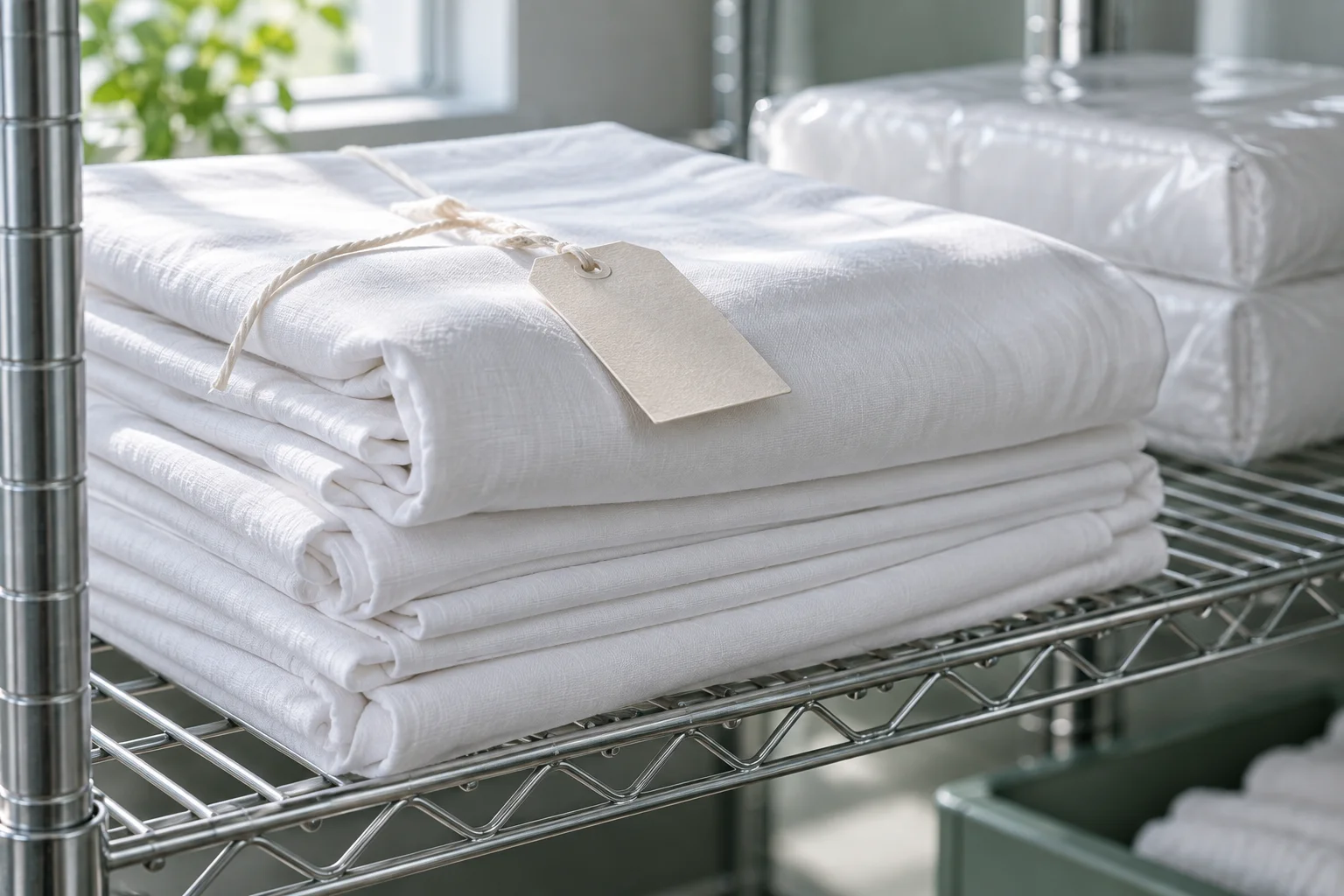
Illustrative linen detail: a folded stack of white cotton sheets with a blank unlettered docket tag on a steel shelf
HOTEL & SERVICED APARTMENT · RENTAL STOCK · 620 KG A WEEK

Hotel and serviced apartment linen

41 rooms · three-times-weekly rotation · 2.8 sets per bed

Bed linen, towels and bath mats on our stock, with the unit cost per item pre-agreed, replacement at normal wear inside the rate, and a reserve of your item types held at the plant.

How the monthly figure is built ↗

41 rooms on a three-times-weekly rotation, 620 kg a week committed, and two sites of the same group on one schedule and one invoice. The figure follows the volume you commit to rather than the load of the week, and it is reviewed each month against the rotation report that comes back with the invoice.

Illustrative kitchen line: a stack of white tablecloths and folded linen napkins on a stainless pass with a folded white chef jacket beside them
KITCHEN LINE · TABLE LINEN AND CHEF WHITES · TWICE WEEKLY

Restaurant and kitchen linen

Tablecloths, napkins, chef whites · pressed and returned flat

Table linen washed and pressed flat rather than tumbled, chef whites tagged per garment, and grease, oil and red wine treated as known stains on this line rather than as a conversation after the fact.

What this line costs to run ↗

A 90-cover restaurant sending 620 pieces a week, collected before service twice a week. Napkins and tablecloths come back pressed and flat, chef jackets and trousers are billed per piece, and the count sheet goes back with every delivery. Heavily soiled kitchen linen is priced from the per-piece card, not folded into the per-kilogram band.

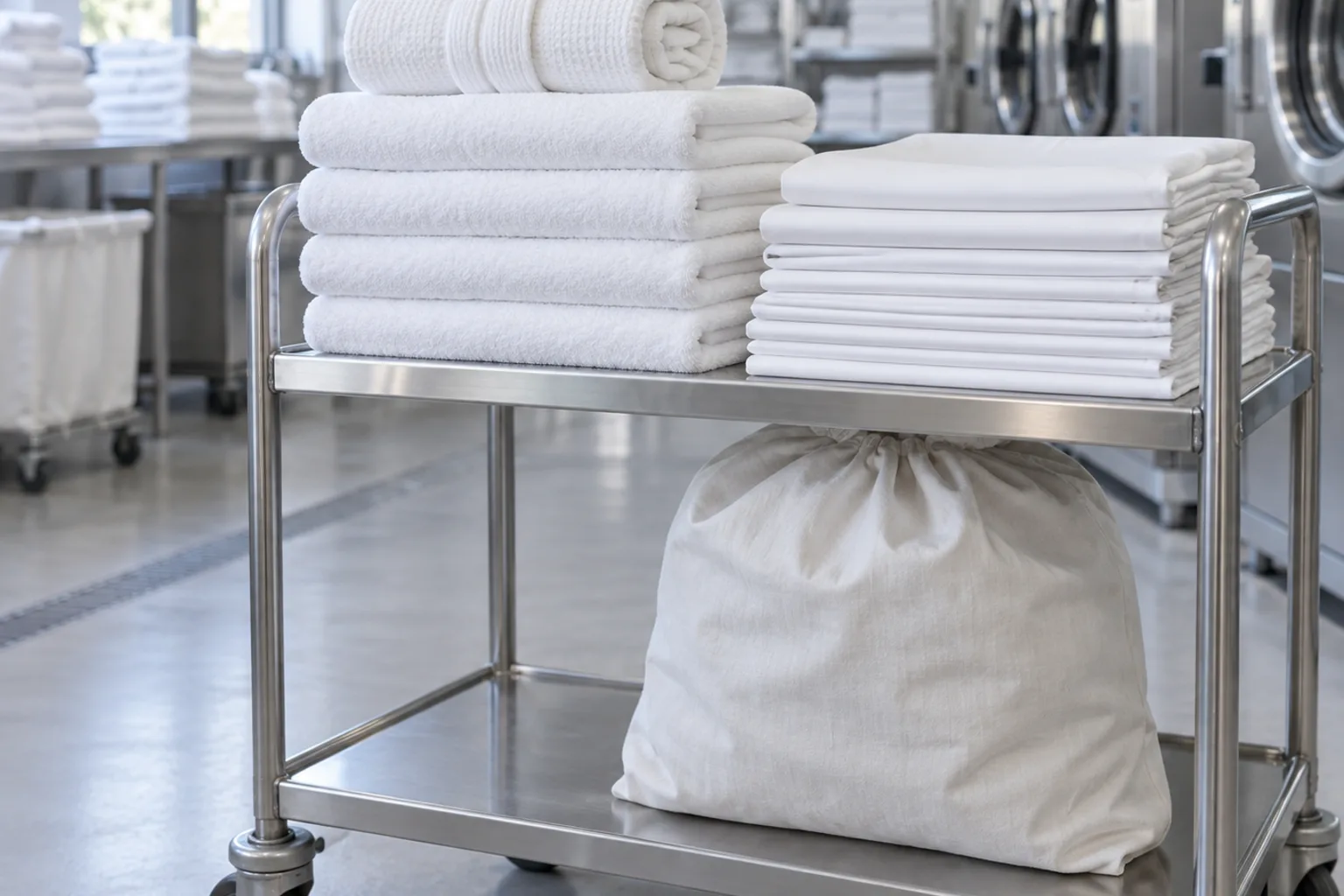
Illustrative laundry room: folded white bath towels and bed linen stacked on a steel trolley with an unmarked linen sack below
GYM, SPA & CLINIC · TOWELS AND TREATMENT LINEN · DAILY

Gym, spa and clinic linen

Towels, wraps, gowns and couch covers · 900 kg a week over three sites

Washed as their own load on the programme the fibre allows and never in with kitchen linen, with the programme and the temperature it reaches recorded per batch.

What comes back with a clinic load ↗

Couch covers, patient gowns and scrubs run on their own programme, and the per-load record — programme, temperature, batch — travels back with the invoice. Contaminated or sharps-adjacent loads are returned unused and unbilled, or referred to a laundry permitted to handle them, rather than being run through the same programme as everything else.

Whichever sector you are in, the same two columns sit behind it: our stock at a pre-agreed rental, or your own linen washed by the kilogram. Both are priced against your item list before the first collection, and wash-only puts replacement, shrinkage and colour loss on your books rather than inside the rate.

Price both columns

Check, note, clean, hand back.

  1. Drop off or collect

    Counted in front of you, or photographed and logged at pickup.

  2. Inspect and note

    Existing damage and stains recorded, and the note is shared with you before cleaning.

  3. Clean

    The method the fabric allows — not the method that is fastest.

  4. Hand back

    Your items with the inspection note, and an honest answer on anything we could not remove.

Before the contract

Four things move
your number.

They are named here, above the rate card, because they decide your figure before a single item is counted. Any operator who will not name them is quoting you a number they can move later.

1 · Volume you commit to

The weekly band, not the load you happened to send this week. Under 300 kg a week is a different rate from 900 kg, and the band is written into the agreement so it does not drift.

2 · The textile mix

Bed linen washes differently from chef whites and both differ from clinic linen. A mixed commercial load is cheaper per kilogram than a single-textile programme, so say what your mix actually is rather than what the invoice template assumes.

3 · Cadence and route

Daily on a route that already passes your door costs less per kilogram than a weekly pickup from an address we have to route separately. Whether you are already on a running route day is answered with the quote rather than after it.

4 · Who owns the stock

Rental spreads replacement across the rate; wash-only moves it to your books. Both columns are priced against your own item list, line by line, and we say which one is cheaper where.

The minimum, per collection

A minimum applies to every collection, because a van visit costs the same whether it carries 8 kg or 80 kg. These are the floors, and what happens when an order lands under one.

Illustrative concept pricing, not a quotation. Figures are per collection or per week as stated, under a rolling monthly agreement with the collection cadence named in the schedule. They are floors and charges, not item prices: the per-kilogram and per-piece rates are in the rate card above. Off-route work assumes the address is outside the running route days. Confirm current rates with the operator.
TermFigure
Minimum per collection
What it means: An order below this is billed at the minimum, or rolled into the next collection if you say so before the driver leaves
S$40
Minimum per week, rental stock
What it means: Applies when we own the stock, because linen sits in circulation whether it is used that week or not
S$220
Off-route visit
What it means: An address outside the running route days, priced as a route charge instead of hidden in the per-kilogram rate
S$25 per visit
Load not ready at the door
What it means: The trip is not free to run. Rolled to the next route day at no charge when you tell us before the window closes
S$15 per visit
Contaminated or sharps-adjacent load
What it means: Returned unused and unbilled, or referred to a laundry permitted to handle it
Declined
Stock take, on request
What it means: A counted stock level at your site, with a written list of what is short and what to reorder
S$90

The term, the allowance and the overage

Rolling monthly

The agreement rolls month to month with a stated notice period on both sides. No multi-year lock-in, and no exit fee that only appears when you try to leave.

Service cycles included

Six service cycles a month are included on the standard rotation: four weekly collections and two additional turnaround runs. A fifth week in a month is not a fifth charge.

The allowance

An agreed quantity of replacement stock per month is inside the rate, because normal wear is normal. The allowance figure is in the schedule, per item type, not a single number for all linen.

Overage and one-offs

Volume above the committed band, or a collection outside the schedule, is billed at a pre-agreed rate named in the schedule — never at a rate decided after the load is already wet. That rate is named in the schedule before you sign.

Rented or bought, over twelve months

Illustrative concept pricing, not a quotation. The comparison is per 100 kg a week of mixed bed linen and towels over 52 weeks, against a 150-piece stock of our linen bought outright at the figures a buyer would be quoted. It excludes the labour of counting, storing and repairing your own stock, excludes stock lost on your premises, and assumes the same wash rate in both columns. Confirm current rates with the operator.
Twelve monthsRented · our stockWash-only · your stock
Washing, 100 kg a weekS$1.55 per kgS$1.55 per kg
Washing, 52 weeksS$8,060S$8,060
Stock, first purchaseNothing to buyS$4,800
Stock, replacement over the yearInside the rate, up to the allowanceAbout S$1,900
Linen lost or damaged on your premisesOurs, up to the agreed allowanceYours, at the declared value you set
Repairs and pressing on your own stockInside the rateCharged per piece

On those figures the rental column is higher on paper and lower once replacement, repairs and write-offs are counted. The working comes with the quote: both columns against your own list, so the decision is arithmetic instead of a preference.

An account's view

“They wrote the liability cap, the replacement allowance and the collection days into the schedule before we asked for them, and the count sheet matched every week of the first quarter.”

Rental linen, 41 rooms · sample story

Sample story. Not a real customer review.

Before you sign

The questions a
contract buyer asks.

Who owns the linen, and what happens to it?

Either we do and you rent it, or you do and we wash it. On rental, the unit cost per item is pre-agreed and replacement at normal wear sits inside the rate, up to a monthly allowance written into the schedule. On your own stock, replacement, shrinkage and colour loss are yours, and repairs are billed per piece. Ask for both columns priced against your item list before you choose, because the answer changes by item type.

What is the smallest order you will take?

A minimum applies per collection and, on rental stock, per week, because a van visit and a circulating stock level both cost money whether the volume is there or not. The figures are stated in the service guide above. If you fall under the minimum we either bill the minimum or roll the load into the next collection, and you choose which when you sign, not on the day.

What if you miss a collection?

We return in the same week where the route allows, and the trip is ours. Misses are logged against the account, and you can ask what the rate was last quarter. If the load is not at the door when the driver arrives, the visit is charged at the stated rate unless you call before the window closes, in which case it rolls forward at no charge.

What happens when staff or capacity fail?

This has happened to most buyers at least once, so ours is written down: a named person answers the account, a short-staffed week is declared to you in advance rather than discovered, and a missed rotation is recovered on a stated make-up day. What we will not promise is unlimited same-day capacity in a peak week — we say which day cannot be done instead of accepting the order.

What do you hold, in writing?

Four things, in writing, from us: public and employer's liability cover with a policy reference you can check with the insurer; the vetting drivers and plant staff go through before they handle your linen; the wash programme and the temperature your textile type is run at, with the per-load record that comes back with the invoice; and what happens to a load that fails a check. All four are stated in the account schedule rather than described here, and none of them should be read as an accreditation.

How do we exit, and what happens to the stock?

The agreement rolls month to month with a stated notice period on both sides, and there is no exit fee. On rental stock we collect the marked linen and reconcile it against the last rotation report; on your own stock the linen simply stays with you. The reconciliation window is written into the schedule, since that is where disputes at the end of a contract are actually resolved.

Start with your item list

Send the list.
We price both columns.

Send your item list, the volume you expect in a normal week and in a peak week, and the days your site can accept a collection. We price rental and wash-only line by line and say which one is cheaper where, rather than quoting the one that suits us.

Concept only. Nothing is sent or booked.

Liability cover
Public and employer's liability cover are in force, and the policy reference in the schedule is one you can check with the insurer directly. We state what we hold; we do not dress it up as an accreditation.
Staff vetting
Every driver and plant operative is screened before they handle your linen, and the schedule names what that screening covers.
Wash programme
Each textile type runs on the programme the fibre allows, at the temperature that programme reaches, and the per-load record goes back with the invoice.
Claim window
A shortfall or damage claim runs for 48 hours from the signed return docket, and it is settled at the cap written into the schedule.
Preview your message
Send this enquiry on WhatsApp Opens WhatsApp with this enquiry ready to send. Nothing is sent or booked until you press send there.

The two-column line card · Minimums and term · Counting and the record

Price my contract