Business device repair & fleet support · Singapore
Uptime first. Then the repair.
A volume tier with a response time written into it, a named owner on every ticket, loaner units on stated terms, and a per-device log your finance team can file.
Every organisation in this market has the same four jobs on its list, and none of them is IT work.
Chasing warranty queues
Four to six weeks per device with the manufacturer, with nobody able to say where a machine is this week.
Managing the calls about them
The person who chose the devices is now the person on hold about them, between the user and the manufacturer.
Devices returned wiped
A depot or manufacturer repair that comes back reset, and a user who has lost their working files with it.
Being the face of the delay
Nobody in your team was hired to explain a two-week wait to the person who cannot work.
Data in our custody
Handling is a clause, not a promise.
For a business, the device is replaceable and the data is not. These terms sit in the service agreement before the first batch moves.
Who may access a device
Access is limited to the technicians named on the ticket, and it is logged against the asset tag. Nobody else opens a device under your account.
No wipe without a written request
Where a repair needs a reset, it is requested on the ticket and recorded against the asset tag. Nothing is wiped because it would make the repair easier.
Insured while in custody, with the figure stated
Devices are insured in our custody and in transit on runs we arranged. The cover figure is written into the agreement rather than left as the phrase “fully insured”: the number your estate is insured for is the same number the invoice refers to.
Your rules, applied to your estate
If your organisation has its own retention, jurisdiction or destruction rules, send them with the first batch and we work to them, or say plainly that we cannot.
No copies kept
Images taken to run a repair are destroyed at return unless the account asks for them to be held, and the destruction is dated on the monthly summary.
Drawn for schools with a dated asset list, clinics where a tablet cannot leave the building, retail and F&B groups with one device per outlet, and IT support teams that need overflow capacity under their own name.
Parts across an estate
Every part is written on the ticket.
At volume the question stops being about one screen and becomes which grade the whole estate is running on.
The grade is named per device
Manufacturer original, an original pulled from a decommissioned unit of the same model, or an aftermarket part. The ticket says which before the work starts, and the grade decides which warranty row applies.
Consumables held for your account
Where a model family makes up a real share of the estate, we hold the common parts — batteries, screens, keyboards, chargers — so repairs do not wait on a supplier. What is held, and at what level, is listed in the agreement.
Pulled parts are not mystery parts
A pulled original is recorded as pulled, with the source unit’s asset tag, and it is never described as new.
Beyond economic repair is reported, not repaired quietly
Where the cost of the part passes the value of the unit, you get the figure and the write-off recommendation instead of a board job at half the price of a replacement.
Parts you supply
You can supply parts. Our labour on them stays covered, the part does not, and we say that before the job rather than after a failure.
What bulk actually buys
The tier is a response time, not a rumour.
Bulk pricing in this category is usually an offer to discuss. This is the table: devices per month, what changes, the response we commit to, and who owns the account.
Illustrative concept pricing, not a quotation. Standard bands are starting figures for a screen, battery, keyboard or port on a device up to four years old, parts included at the grade named on the ticket, collected on the scheduled island-wide run. Figures move with the model, the parts grade, board-level faults, whether a loaner is out, and whether the device is assessed on site. Confirm current rates with the workshop.
Devices / month
Committed response
Account owner
1–4 No minimum · Standard bands, weekly scheduled collection, invoice per batch
Diagnosis in 3 working days
Shared inbox, ticket reference only
5–19 10% off the standard bands, spares held for your two most common models
Diagnosis in 2 working days
Named coordinator, the same person each time
20–49 20% off, two loaner units on standby, monthly summary report
Diagnosis in 48 hours, repair started the same day
Named account owner with a direct line
50+ 30% off, loaner pool sized to the estate, asset tagging and per-device log
Diagnosis in 24 hours, on-site response next working day
Account owner, with a workshop lead on escalation
The remedy if the response is missed: the committed time runs from collection to a written diagnosis. Miss it on a device, and 25% of that device’s repair is credited on the monthly summary with the reason stated on the ticket. The clock does not run while a device waits on your approval, on a part we have ordered, or on a loaner you have not returned, and the credit is capped at the repair value of that device. A response time with no consequence behind it is a target, not a commitment.
On site, or at the depot: depot work is collected by courier at no extra charge on the scheduled run. An on-site visit is charged at S$40 per trip within the island, waived for scheduled collections at the 20+ tier; where a device cannot leave the building the visit is booked with your account owner, and the trip is charged even if the device is later collected.
Included at every tier: assessment and written finding, labour, parts at the grade named on the ticket, an asset tag per device, a per-device log, the monthly summary and secure handling of your data. There is no minimum: a three-device school and a four-hundred-device fleet sit on the same table, and nothing is renegotiated because your volume moved.
After the repair
Two channels, two warranty rows.
The account and the walk-in counter do not carry the same terms. Both are written on the ticket, and this is what differs.
Loan units, and the terms that come with them
A loan unit is issued while your device is with us, not instead of a repair. The model is the one available that day; the specification may differ from your own device.
The loan period is fixed at the point it is issued and written on the job sheet. Keeping it past the agreed date is charged per calendar day or part of a day, at the rate on the sheet.
Returning it early does not reduce the charge, and the loan fee is not refunded once it has been issued.
A deposit is taken and is held against loss, damage beyond ordinary wear, or an outstanding balance. If the unit is lost, stolen or not returned, the deposit is applied to the cost of the unit and the difference is invoiced.
One reschedule of the collection or return is allowed if it is requested before the agreed date. Beyond that, the missed appointment is treated the same as a late return.
Your own data never goes on a loan unit: it is issued wiped and must come back wiped, and the deposit is not released until it is checked back in with its charger.
Business channel: six months
Six months on the part and the work for a device repaired under an account, claimed through the account owner with the ticket reference. Warranty work goes to the front of the queue and a loaner can be issued while it runs.
Walk-in counter: ninety days
Ninety days on the part and the work for an individual at the counter, claimed in person with the job sheet. No loaner, and the standard queue.
Not covered in either channel
New physical damage, liquid after the repair, wear items such as a battery beyond the cycle count recorded on the ticket, and unrelated faults that appear later. A screen replaced after a drop is not a claim on the drop.
What voids it
Another shop opening the device, a repair attempted in-house, or an unrecorded parts swap inside your own estate. Rotating a repaired device to another user does not void it: the cover follows the asset tag, not the person.
Claims route, stated per channel
An account claim is raised with the ticket reference and the asset tag, answered within 48 hours with the device either re-repaired or written off, and shown on the monthly summary. A walk-in claim is made in person with the job sheet and is answered in the standard queue.
Batches left uncollected
Where a batch is not collected within 30 days of a written return notice, storage is charged per device per week, and after two further notices the device is wiped, destroyed with a dated note and disposed of. That term sits in the agreement from the first batch.
Three account jobs
What the account covers, and what it costs.
DEPOT / BATCH INTAKE
Batch intake · from one device a month
Collected on the weekly run · tagged against your asset list · one invoice per batch
A batch from one site, collected on the scheduled run, tagged at intake and returned with a log your finance team can file against the invoice.
What the per-device log carries ↗
The asset tag and serial as your record has them, the model, the fault as reported, the finding in writing, the grade of the part fitted, the technician, the date out and the date back. One row per device, exported as a file with the monthly summary rather than left in a portal.
ESTATE SHELF / SPARES HELD
Spares held for your models · 5 devices a month and up
Your two most common models · listed in the agreement · a held part is not invoiced until it is fitted
Where a model family is a real share of the estate we hold the common parts — batteries, screens, keyboards, chargers — so a repair does not wait on a supplier.
What the monthly summary shows ↗
Devices in and out, the response achieved against the tier, every credit applied, every device written off as beyond economic repair with its figure, and the parts held for your account. One page, sent as a file.
ON SITE / DESK-LEVEL WORK
On-site visit · S$40 per trip, waived at 20+
Within the island · booked with your account owner · charged even if the device is later collected
Screen, battery and keyboard work at your premises for a device that cannot leave the desk: a clinic tablet, a till, a device wired into a fixed install.
Where the ticket lives ↗
In your system. We work inside your existing ticketing workflow rather than beside it: your reference on our log, our finding on your ticket, and no second system for your team to check.
Every line above is what the account is billed on: the run it was collected on, the parts held for your models, the visit charge, and the log that reconciles the invoice. Nothing on the tier table is renegotiated because your volume moved.
Intake, diagnose, approve, hand over.
Intake
The fault, the device’s condition and the passcode, logged on a job sheet.
Diagnose
Fault confirmed and priced. The fee is credited if you go ahead.
Approve
No work starts without your agreement on the figure, in writing.
Hand over
Working device, the old part, the warranty terms and your data left alone.
From first ticket to monthly summary
Six steps, one owner.
Each step has an output you can file. The loaner terms sit at step four, because that is where downtime is actually decided.
01We join your process, not the other way round+
Before the first device moves we agree what your ticket reference is, who on your side may authorise work, and what counts as approval. Output: a one-page process note signed by both sides.
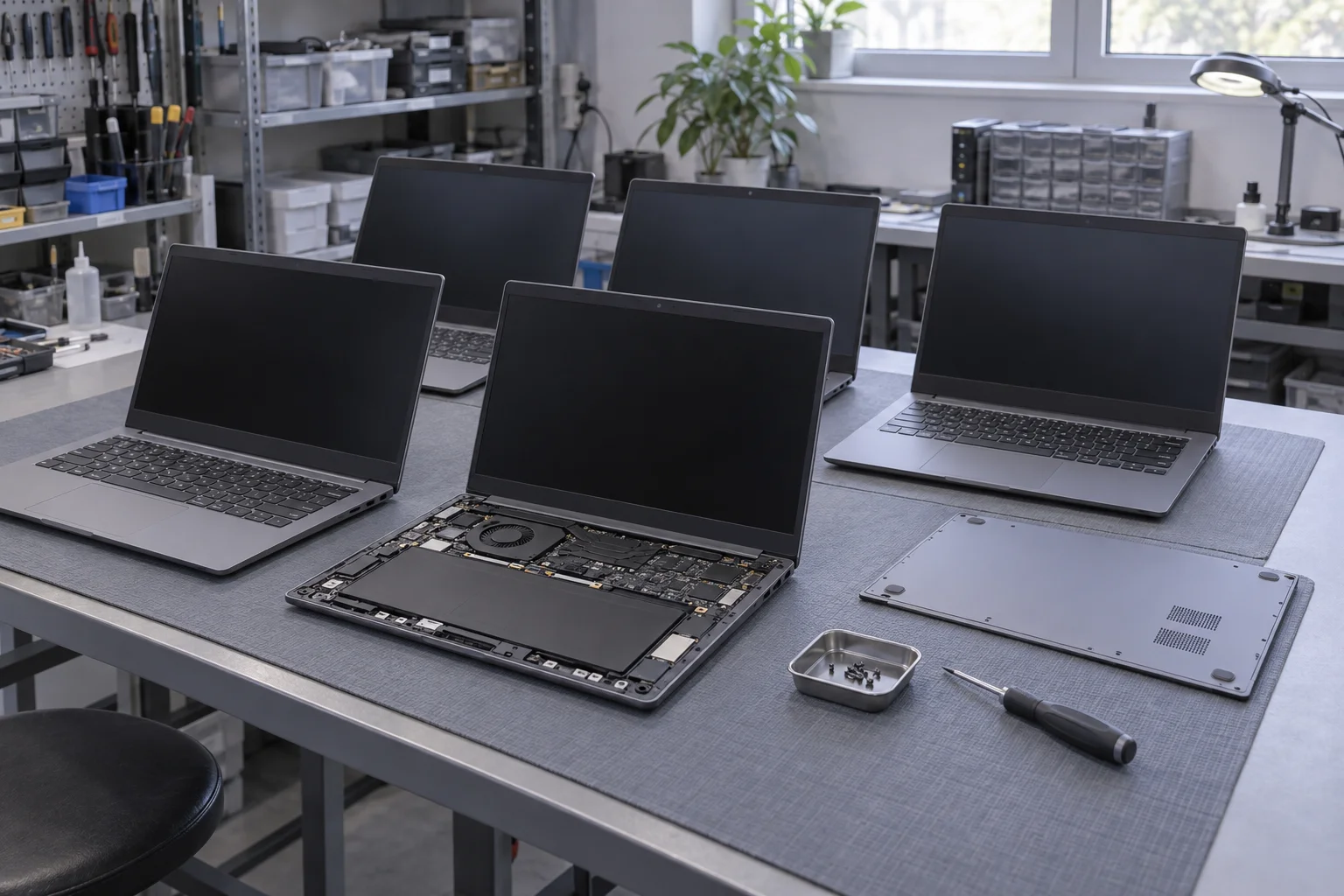
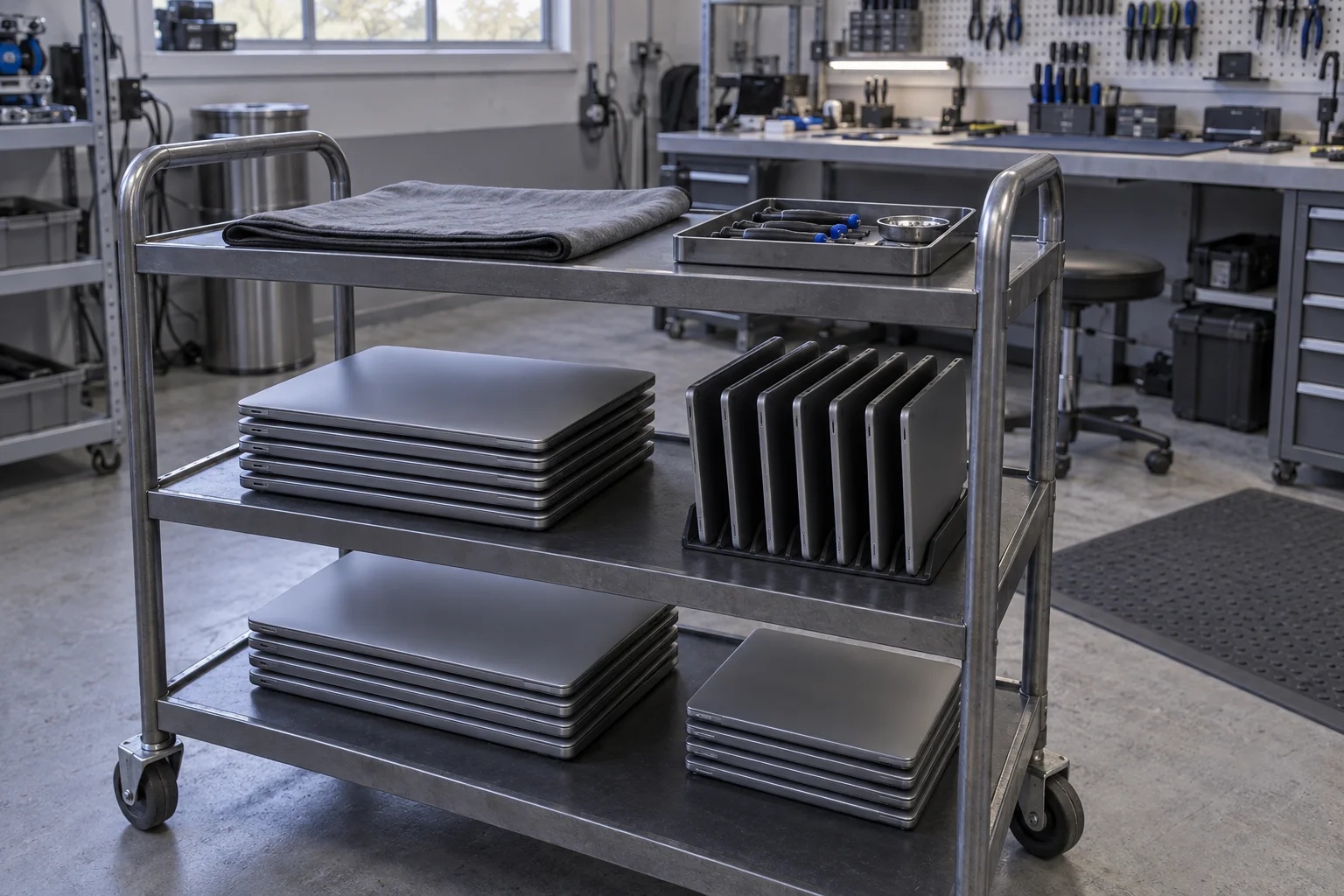
On-site pickup or courier collection against your device list. Every device is tagged at intake with your asset reference and the fault as reported, and the batch list is confirmed back to you the same day.
Each device is assessed and priced against the tier. Output: a written finding per device, and a batch approval sheet listing what is authorised, what is declined, and what is beyond economic repair.
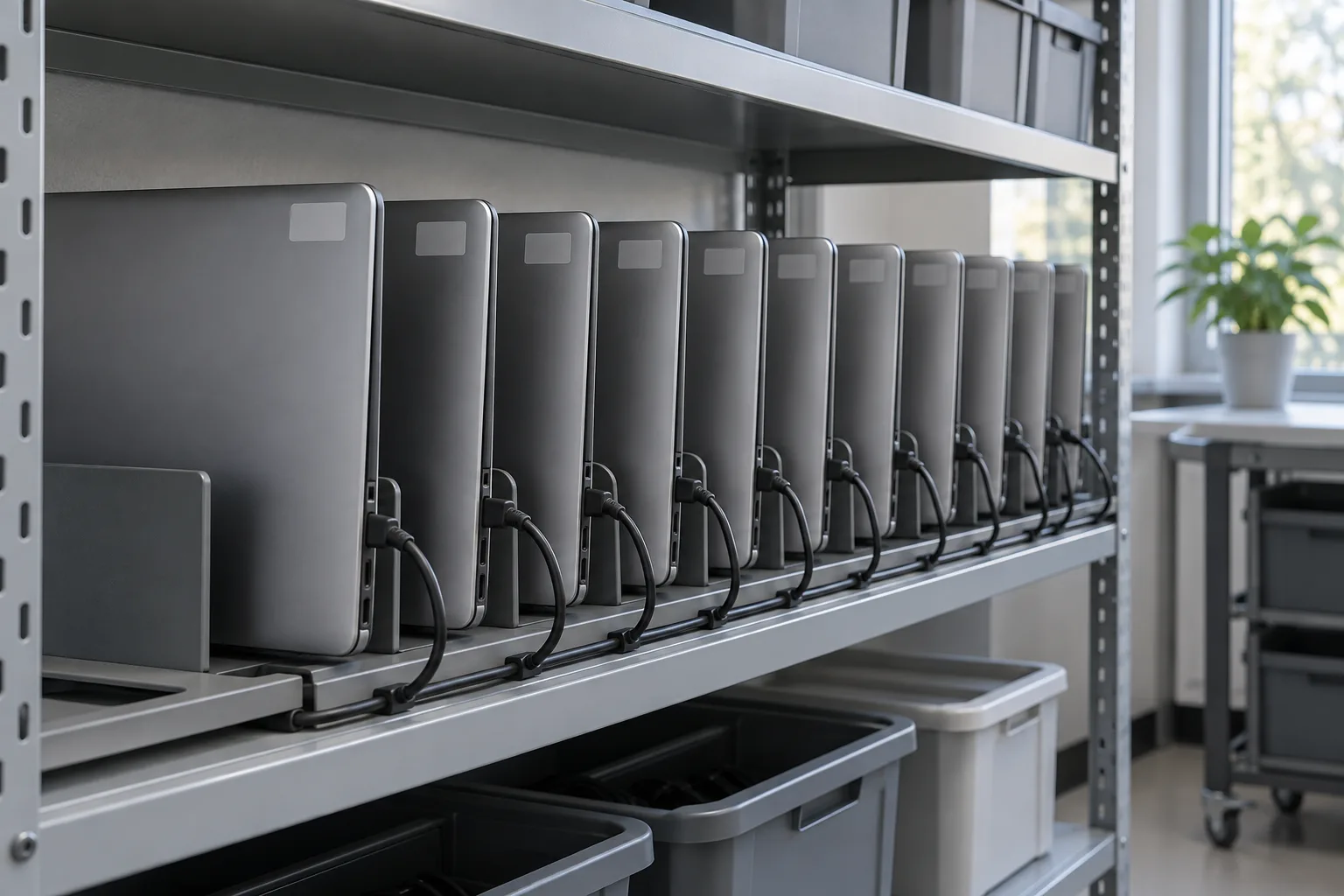
Units from the account pool are issued against a signed handover listing the model, serial and condition. The deposit is S$150 per unit, fully refundable when the unit comes back in the condition it left in. Damage beyond wear, or a unit not returned within 30 days of the repair being ready, is charged at the replacement value on the handover sheet. The pool size is in the agreement, not on request.
Parts at the grade on the ticket, then a check on the repair before it is bagged: function, charge, and the asset tag matched against the log. Anything that fails the check is re-done before it leaves.
Devices are returned on the same run against the same list. Output: the per-device log as a file, the invoice reconciled to the approvals you gave, and the warranty term printed per device.
The ticket has an owner. A named coordinator or account owner is printed on every ticket and on the monthly summary, with a direct line and a working-hours escalation to the workshop lead. Where that person is away, the covering name is on the summary before your team has to ask for it. On-site or depot work is chosen per device, on the same ticket.
Overflow capacity is available to IT support providers under their own name: your client, your ticket reference, no contact from us unless you ask for it.
An account holder’s view
“The tier table said what two working days actually meant, and the monthly summary showed we got it — including the week it was credited instead.”
Volume tier, 20–49 devices · sample story
Sample story. Not a real customer review.
The procurement questions
Before you open an account.
Is there a minimum volume?+
No. A three-device school and a four-hundred-device fleet use the same table; the tier changes the price, the committed response and who owns the account, and nothing is renegotiated because your volume moved. The minimum is nil, and it is a clause in the agreement rather than something agreed case by case.
What does the discount apply to?+
The labour and parts bands on the tier table. It does not apply to the on-site trip charge, to loaner deposits, or to devices written off as beyond economic repair, and it does not change because a device turns out to need board-level work. Those are separate lines on the same invoice.
What happens if you miss the committed response?+
25% of that device’s repair is credited on the monthly summary and the reason is stated on the ticket. The clock stops while a device waits on your approval, on a part we ordered, or on a loaner you have not returned, and the credit is capped at the repair value of that device.
How does the business warranty differ from walk-in?+
Six months on the part and the work for an account device against ninety days at the counter, claimed through your account owner with a 48-hour answer rather than in the counter queue, and with a loaner available while warranty work runs. Both periods are printed on the ticket.
Who is allowed to authorise work?+
You name the authorisers per site, and you set the figure above which a written approval is needed. Nothing above that figure is done on a phone call, so the invoice cannot arrive as a surprise to finance. Nothing is approved on your behalf, ever.
Can you work under our own name?+
Yes. IT support providers use us as overflow capacity under their own brand: their client, their ticket reference, our log, and no contact from us with their client unless they ask for it. We will not approach your clients, and that is a term in the agreement, not a courtesy.
Procurement ready
Put us through your process.
Purchase orders accepted; a quotation on your own template if you have one; tax invoices carrying a PO reference line; 30-day account terms after the first cleared batch; a signed service agreement that holds the handling, insurance, loaner, storage and response terms; and no minimum volume to open an account.
Tell us the estate: how many devices, which model families, how many sites, who authorises work, and the turnaround you need. We reply with the tier we would place you in, the response we would commit to, and the name of the owner on your account.